

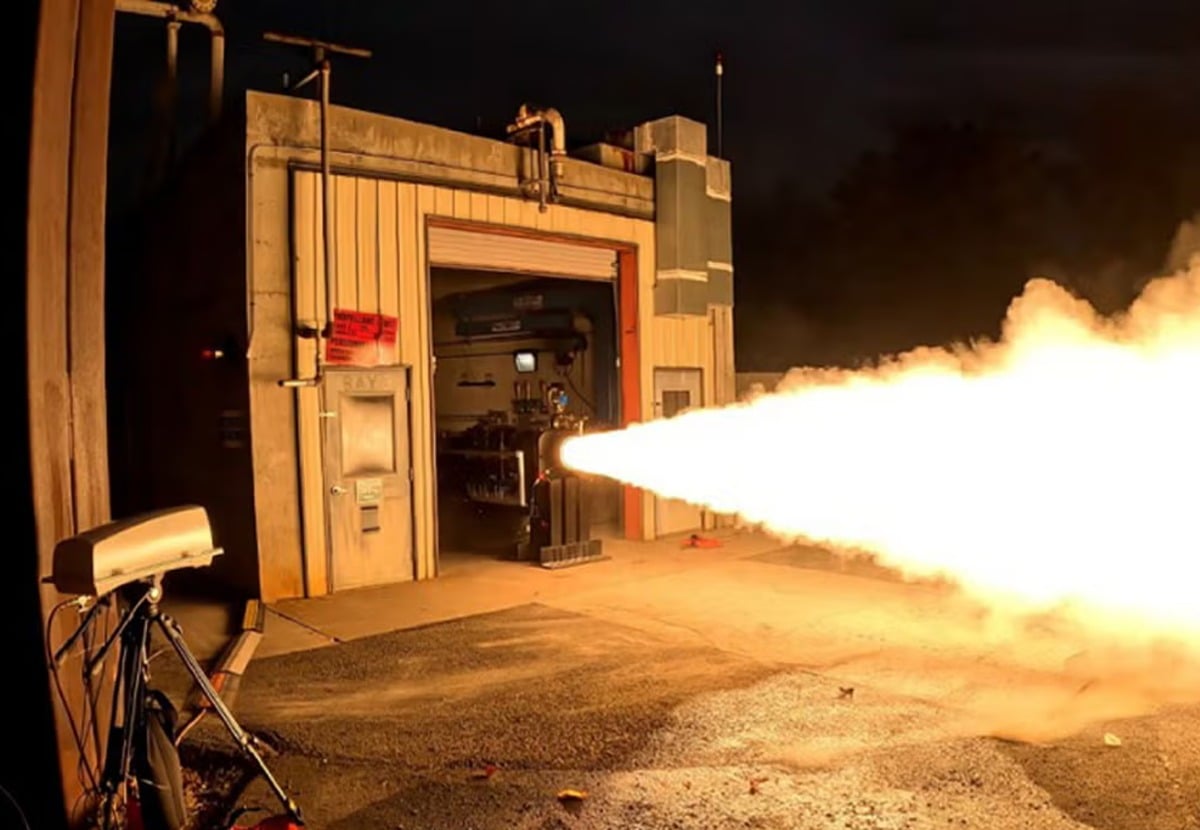
- L3Harris successfully tested a solid rocket motor-to-ramjet propulsion transition for the U.S. Army's PrSM Increment 4 program at Orange County, Virginia, on June 3, 2026.
- The propulsion system is designed to launch from existing HIMARS and M270 launchers, with Lockheed Martin and Army Aviation and Missile Center representatives witnessing the test.
L3Harris Technologies has successfully tested a propulsion system designed to push U.S. Army missiles well beyond the ranges that current weapons can reach, clearing a key technical hurdle in one of the Army’s most closely watched long-range strike programs.
The test, conducted at L3Harris’s facility in Orange County, Virginia, with representatives from Lockheed Martin and the Army’s Aviation and Missile Center present, validated the transition from a solid rocket motor boost phase to a ramjet sustainer engine — the precise moment in flight where the propulsion system either works or doesn’t. That transition, called a Direct Connect Transition Test, is among the most demanding checkpoints in developing a combined solid rocket motor and ramjet propulsion system, because the two technologies operate on fundamentally different principles and must hand off thrust cleanly at high speed and altitude without a gap in propulsion or a loss of control. L3Harris announced the successful result on June 3, 2026.
The program this test supports is the Army’s Precision Strike Missile Increment 4, known as PrSM Inc 4, the most ambitious stretch of a weapon system the Army has been developing since the late 2010s. The baseline PrSM, designed to replace the legacy Army Tactical Missile System that was retired in 2003, has been in development by Lockheed Martin as the prime contractor and already completed its first production deliveries.
Earlier increments of PrSM progressively extended range beyond the approximately 70 km (43 miles) maximum of its predecessor, with the program targeting ranges beyond 500 km (310 miles) in later variants. Increment 4 is aimed at the furthest reach of that roadmap, requiring a propulsion solution that conventional solid rocket motors cannot provide on their own. A ramjet, which sustains flight by drawing in air and burning fuel continuously rather than carrying all its oxidizer internally like a rocket, can maintain propulsion across much longer distances and at higher sustained speeds, making it the enabling technology for the extended-range ambitions PrSM Inc 4 represents.

What makes the L3Harris test result operationally significant is not just that the propulsion worked, but that it is designed to work inside existing Army launchers. HIMARS, the High Mobility Artillery Rocket System, is a wheeled vehicle that fires GPS-guided rockets and missiles from a pod of six MLRS rockets or two ATACMS missiles, and has become one of the most strategically visible Western weapons systems of the past four years following its extensive use in Ukraine. The M270 Multiple Launch Rocket System is its tracked, higher-capacity predecessor, still operated by the U.S. Army and multiple allied nations. Both platforms are already deployed, already maintained, and already integrated into Army fire support networks. A missile that can load directly onto those launchers — without requiring new vehicles, new logistics chains, or new training pipelines — can reach warfighters far faster than a system requiring new ground equipment. That is the argument Lockheed Martin’s vice president for advanced programs made explicitly in connection with the test.
“The Direct Connect Transition Test shows the missile’s core propulsion is not a future concept but a validated capability that can be loaded onto current HIMARS and M270 launchers quickly, dramatically shortening the time to warfighter delivery,” said Randy Crites, Vice President of Advanced Programs at Lockheed Martin.
L3Harris conducted the test at its Orange County, Virginia campus, a facility spanning more than 2,000 acres (809 hectares) with 256,000 square feet (23,784 square meters) of manufacturing space that includes a static test facility, an aerothermal propulsion laboratory, and an altitude test site. The presence of Army Aviation and Missile Center representatives at the test is standard procedure for milestone events of this kind, but it also signals that the Army is actively monitoring progress and treating the L3Harris propulsion solution as a viable candidate for the program.
L3Harris says it has invested significant internal funding over the past two years to mature the propulsion technology ahead of formal program milestones, a strategy sometimes called self-funded development, where a company advances technology at its own expense to reduce risk and compress timelines once government contracts are in place. That approach is increasingly common among defense companies competing for programs where the government is selecting between multiple propulsion solutions and the winner will be determined partly by demonstrated maturity.
“Rapidly advancing our next-generation propulsion system through ground test and into flight test demonstrates our unique ability to deliver on the Army’s mission requirements and near-term fielding plans,” said Scott Alexander, President of Missile Propulsion at L3Harris Missile Solutions. “Our propulsion system strikes a balance between capability and affordability by meeting the Army’s requirements for speed, range and lethality.”