

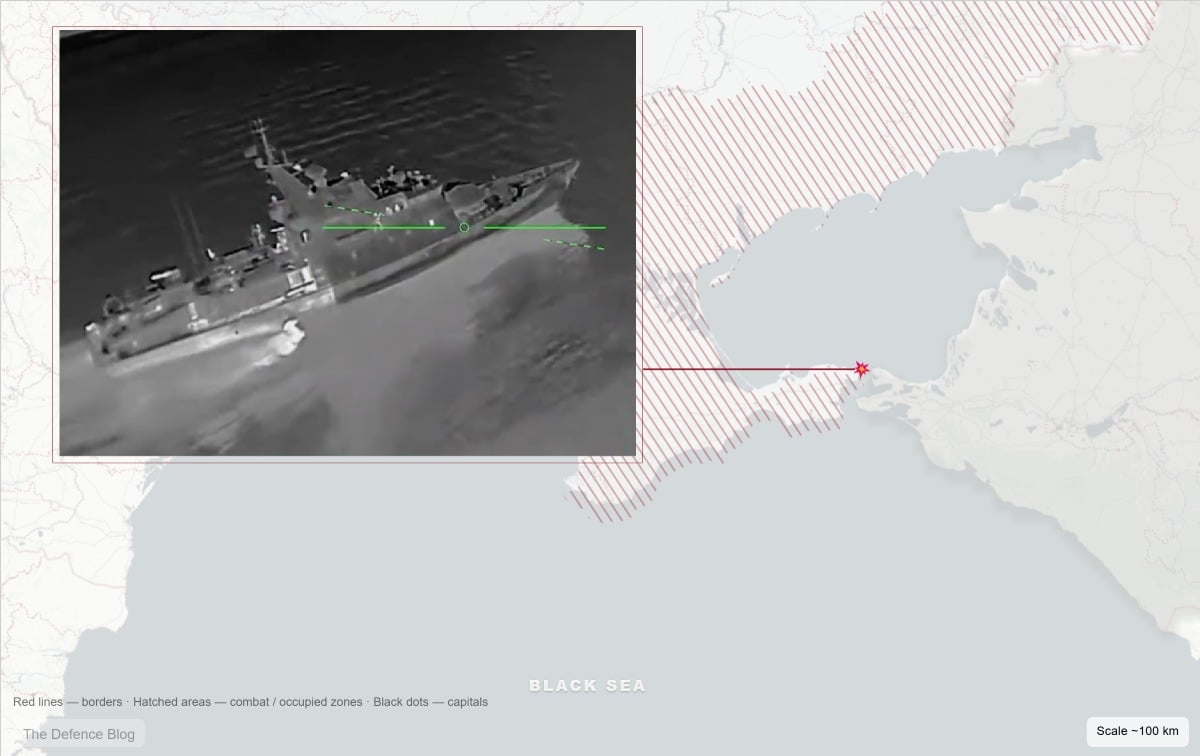
- Ukraine's Unmanned Systems Forces struck a Russian Project 10410 Svitlyak border patrol ship near occupied Crimea using FP-2 strike drones.
- The attack occurred near Kerch; video evidence and multiple sources report crew casualties and sailors jumping overboard to survive.
A Russian border patrol vessel went down near occupied Crimea overnight after Ukrainian drone operators guided fixed-wing strike drones into it under the cover of darkness, the latest sign that Ukraine’s homegrown drone industry has matured to the point where it can reach and destroy warships operating deep inside waters Moscow considers secured.
Ukraine’s Unmanned Systems Forces, the military branch established specifically to develop and deploy drone warfare at scale, announced that operators from the 1st Separate Unmanned Systems Center struck a Project 10410 Svitlyak-class border patrol ship in temporarily occupied Crimea. The vessel had been performing coastal patrol and maritime surveillance duties at the time of the strike. Ukrainian forces used FP-2 drones, a medium-range fixed-wing strike aircraft developed by the Ukrainian company Fire Point on its FP-1 platform, according to sources familiar with the operation.
The Svitlyak, whose name translates from Russian as “firefly,” is a class of small patrol vessel built in the 1990s for the Russian Federal Security Service’s Border Guard. Displacing roughly 375 tonnes and stretching 49 meters (160 feet) in length, these ships are designed precisely for the kind of work that makes them valuable in a warzone: monitoring port approaches, escorting vessels through contested waters, and providing a layered tactical screen for both air defense and anti-submarine operations in coastal zones. They are not capital warships, but they are far from irrelevant, serving as the eyes and gatekeepers of Russia’s coastal security architecture around the peninsula.
Several sources following the strike reported that the vessel was hit near Kerch, the city at the eastern tip of Crimea that sits astride the strait connecting the Black Sea to the Sea of Azov, a chokepoint of considerable strategic value. Video footage circulating after the attack appears to show the moment crew members jumped into the water in an attempt to survive, and multiple sources have reported fatalities among the crew, details that indirectly corroborate the footage. Neither the Russian Ministry of Defense nor Russian border service authorities had confirmed the incident or casualty figures at the time of publication.
Fire Point is one of a growing number of Ukrainian defense startups that have moved from prototype to battlefield deployment within the compressed timeline that wartime necessity demands. The FP-2, built on the company’s FP-1 airframe and optimized for medium-range strike missions, represents the kind of capability that did not exist in Ukraine’s arsenal before the full-scale invasion began in February 2022. Detailed technical specifications for the system have not been officially published, but its successful employment against a naval target in defended waters points to a weapon with meaningful range, reliable guidance, and a warhead capable of inflicting serious structural damage on a vessel of the Svitlyak’s size.
The strike near Kerch carries significance beyond the destruction of a single patrol vessel. Kerch and the strait it guards remain one of the most sensitive nodes in Russia’s logistical and military infrastructure in the region, with the Kerch Bridge connecting mainland Russia to Crimea having already been struck twice in separate Ukrainian operations. A successful drone strike on a patrol vessel operating in those waters signals that Ukraine retains the reach and the ingenuity to threaten Russian assets at one of the most heavily monitored and defended stretches of coastline in the entire theater.