


- Russian Su-35 and Su-27 jets intercepted an unarmed RAF RC-135W Rivet Joint over the Black Sea in April 2026, closing to within six metres and triggering emergency systems.
- The UK Ministry of Defence revealed the incidents on May 20, 2026, and formally demarched the Russian Embassy over what it called the most dangerous such incident since 2022.
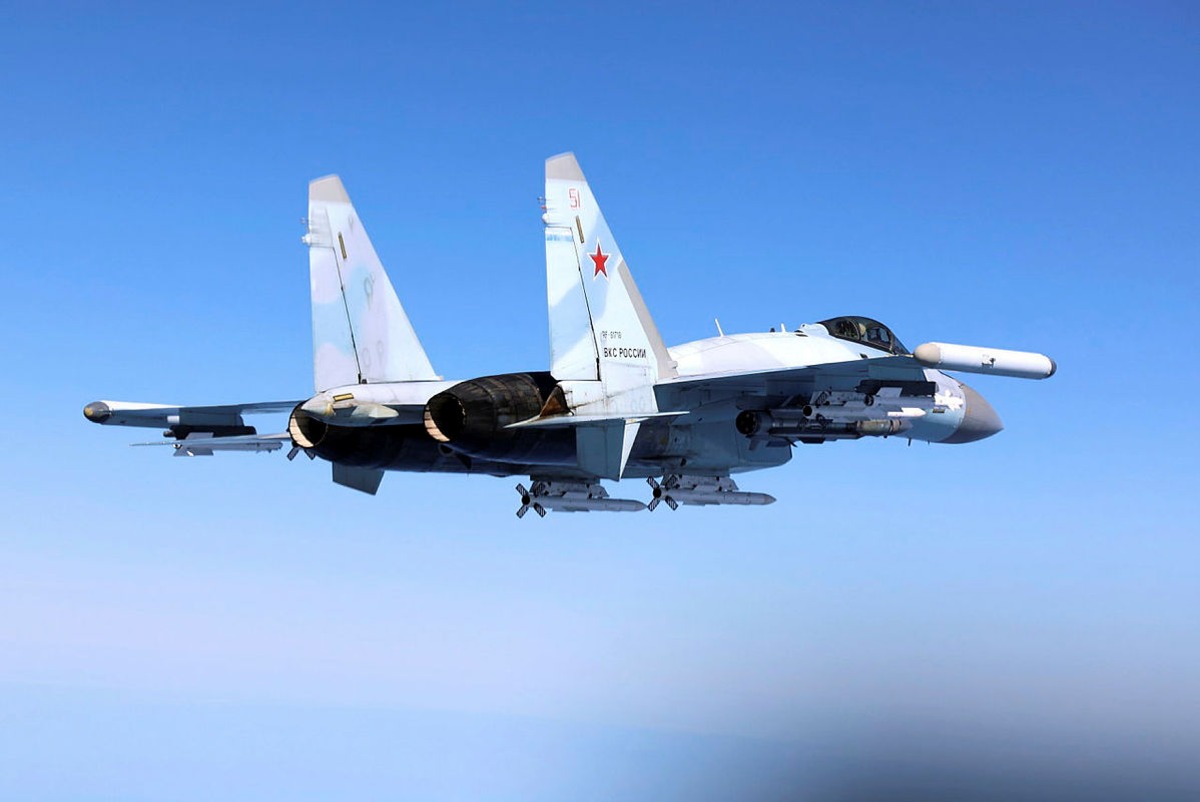
Russian Su-35 and Su-27 fighter jets repeatedly and dangerously intercepted an unarmed Royal Air Force RC-135W Rivet Joint reconnaissance aircraft operating in international airspace over the Black Sea in April 2026, the UK Ministry of Defence revealed on May 20, 2026, releasing images and video of the encounters.
In the most serious incident, a Russian Su-35 flew close enough to the British aircraft to trigger its onboard emergency systems and automatically disable its autopilot. In a second interception, a Russian Su-27 made six passes directly in front of the Rivet Joint, closing to within six metres of the aircraft’s nose. Despite the repeated provocations, the RAF crew completed their planned mission.
The UK government has since formally complained to the Russian Embassy, with both the Ministry of Defence and the Foreign, Commonwealth and Development Office summoning Russian diplomats to condemn what they described as dangerous and unacceptable conduct.
Defence Secretary John Healey did not hold back in his characterization of what happened. “This incident is another example of dangerous and unacceptable behaviour by Russian pilots, towards an unarmed aircraft operating in international airspace,” Healey said in a statement, adding that “these actions create a serious risk of accidents and potential escalation.” He called the RAF crew’s conduct a reflection of “outstanding professionalism and bravery” and made clear that the incident would not change British operations. “Let me be very clear: This incident will not deter the UK’s commitment to defend NATO, our allies and our interests from Russian aggression,” Healey said. He later told parliament that the UK had formally “demarched the Russians over this totally unacceptable act.”
The RAF RC-135W Rivet Joint, operated by 51 Squadron from RAF Waddington in Lincolnshire and sometimes referred to as the Airseeker in its British configuration, is one of the most capable electronic intelligence-gathering platforms in the Western alliance. Based on the Boeing 707 airframe and extensively modified with arrays of specialized antennas and sensors, the aircraft is designed to detect, intercept, and analyze radar emissions, electronic signals, and communications over wide geographic areas and at operational ranges that keep it well clear of contested airspace. The Rivet Joint can operate at altitudes up to 39,000 feet and delivers near-real-time signals intelligence, known as SIGINT, to commanders across the NATO alliance. Its presence over the Black Sea is a routine part of the UK’s contribution to monitoring Russian military activity along NATO’s eastern flank, a mission that has intensified significantly since Russia’s full-scale invasion of Ukraine in February 2022. The Defence Blog has reported on multiple occasions over the past two years when British and American Rivet Joint aircraft have operated over the Black Sea, sometimes jointly, in support of that intelligence mission.
The UK Ministry of Defence described these April encounters as the most dangerous Russian actions against a British Rivet Joint since September 2022, when a Russian aircraft released a missile in the vicinity of an RAF RC-135W over the Black Sea during what Russia subsequently described as a technical malfunction. That 2022 incident prompted then-Defence Secretary Ben Wallace to temporarily suspend patrols and write formally to his Russian counterpart, before restarting them with fighter escort. The fact that the current incidents are now being characterized as worse than anything in the four years since then underscores how significantly the risk threshold has escalated.
Six metres is approximately the length of a standard mid-size car. At the speeds and altitudes at which military jets operate, that margin is not a close pass. It is effectively zero. The forces involved in any mid-air contact at those speeds would be catastrophic for both aircraft. The Su-27’s six passes across the Rivet Joint’s nose at that distance, each representing a deliberate choice by the pilot to execute the maneuver again and again, is not consistent with any professional standard of airmanship. The Su-35 approach was severe enough to trigger the British aircraft’s automated emergency response systems, which exist precisely for moments when proximity to another object threatens the aircraft’s structural integrity or flight path.