


Azerbaijan’s Navy has for the first time publicly showcased its Turkish-made “Salvo” unmanned surface vessel (USV), signaling a new phase in Baku’s maritime capabilities amid growing regional security concerns in the Caspian Sea.
The debut of the armed drone boat came during recent naval exercises and was noted by Baku-based policy analyst Fuad Shahbazov, who wrote, “Very timely decision amid the rising security risks in the Caspian Sea.”
According to Azerbaijani media outlet Crossmedia.az, the “Salvo” USV is a product of Turkish shipbuilder Dearsan in collaboration with Aselsan, Roketsan, and Yaltes.
The 14.8-meter-long and 3.8-meter-wide drone features a composite hull and is capable of reaching speeds between 45 and 60 knots, or approximately 83 to 111 kilometers per hour. The vessel reportedly has an operational range of about 300 nautical miles, or roughly 550 kilometers.
The Azerbaijani Navy’s version of the Salvo is outfitted with a stabilized remote weapon system.
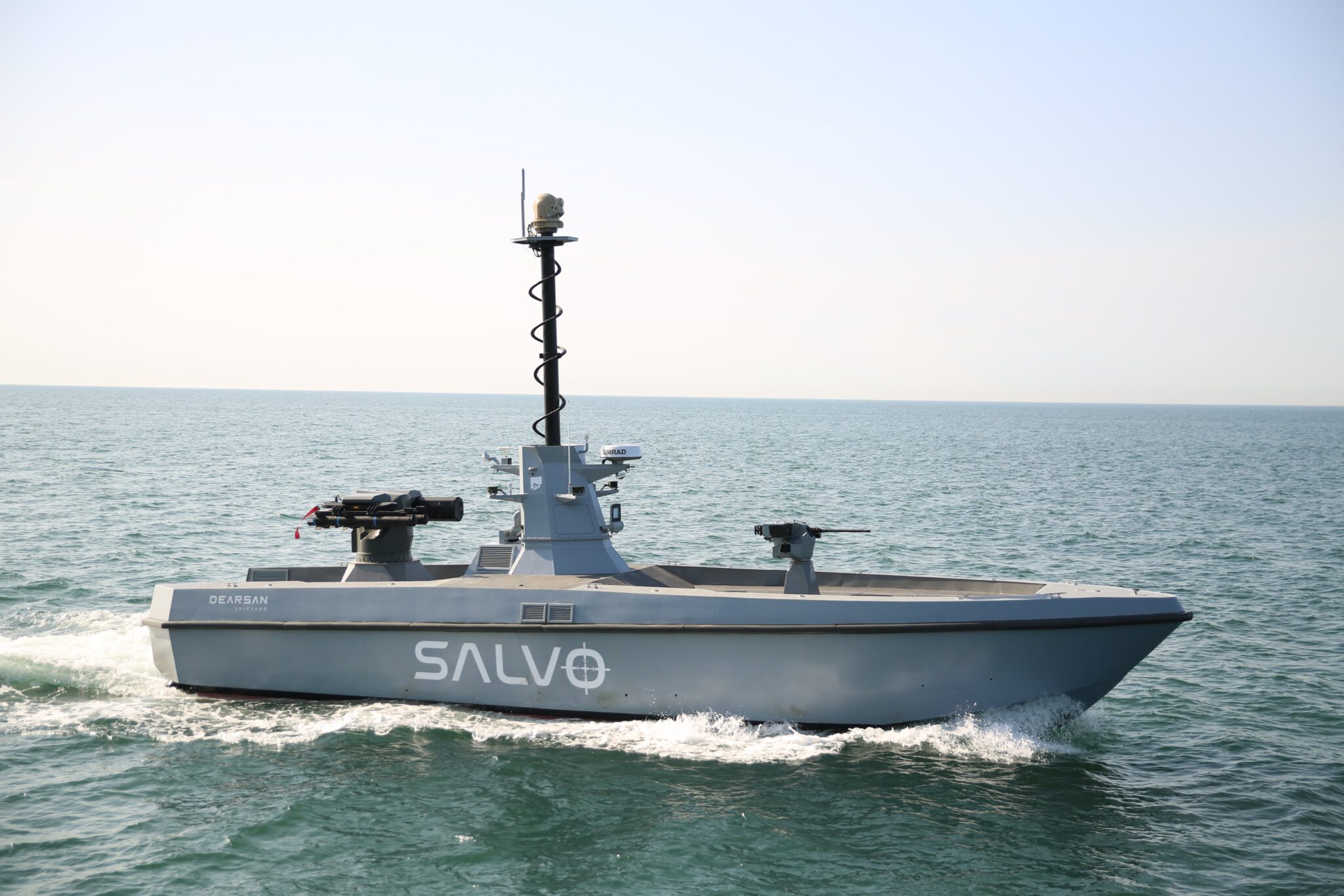
The Salvo’s role extends beyond conventional naval missions. Azerbaijani defense sources say the platform is designed for intelligence gathering, surface warfare, asymmetric combat, anti-smuggling patrols, escort missions, and critical infrastructure protection. Control of the vessel can be conducted from both land-based stations and naval command ships, offering flexible deployment options across multiple domains.
This is the first time Azerbaijan has officially presented the Salvo system in a military setting. Its introduction comes at a time of renewed military activity in the Caspian basin, where regional navies have been expanding capabilities and increasing their operational tempo.
The Azerbaijani Navy’s unveiling of this new naval drone comes as maritime dynamics in the Caspian Sea grow increasingly complex. While the body of water is landlocked and governed by a specific legal status agreed to by littoral states, it has seen a steady rise in surveillance activity, exercises, and territorial defense initiatives. Russia, Iran, and Turkmenistan all maintain naval forces in the region, and Azerbaijan’s push to modernize its fleet — including with unmanned systems — is widely viewed as a response to evolving threat perceptions.