


India’s Air Force chief has publicly claimed that the country’s air defenses shot down five Pakistani fighter jets and one airborne early warning aircraft during clashes in May, marking the first official statement from New Delhi on Pakistan’s reported losses in the brief but intense exchange.
Speaking in the southern city of Bengaluru on Saturday, Indian Air Chief Marshal A.P. Singh said most of the aircraft were destroyed by India’s Russian-made S-400 surface-to-air missile system. He cited electronic tracking data as confirmation of the strikes, noting the interceptions took place during what India refers to as Operation Sindoor.
The comments came months after what has been described as India’s worst military confrontation with Pakistan in decades.
According to Singh, the S-400 systems—acquired from Russia in recent years—played a central role in neutralizing the Pakistani aircraft. The S-400 is designed to engage multiple aerial threats at long ranges and is considered among the most advanced air defense systems currently in service.
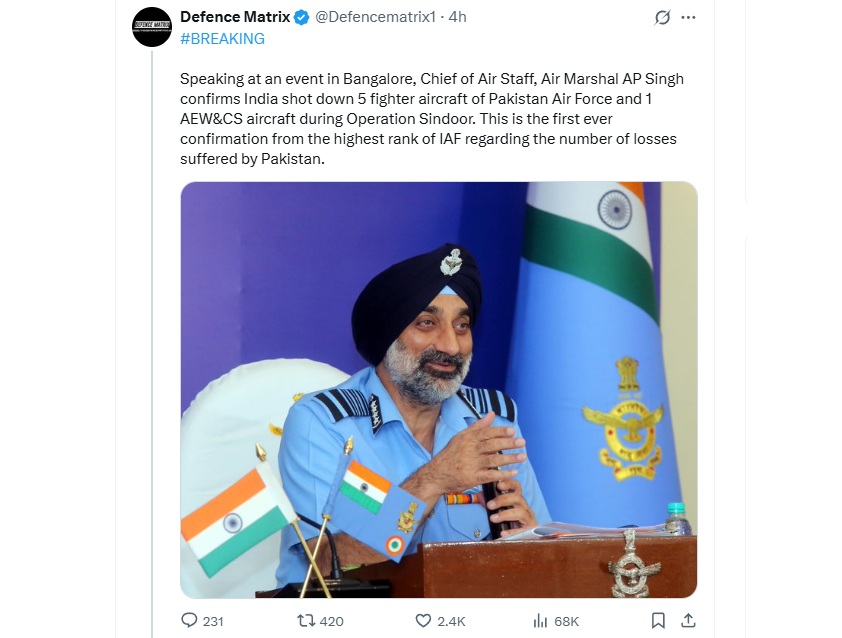
However, the technical performance characteristics of the S-400, even when taking into account Russia’s often-inflated marketing claims, do not support the theoretical possibility of confirming Singh’s statement as presented. Analysts note that the claim appears more like an effort to justify the enormous expenditure on a missile defense system that, during the ongoing war in Ukraine, has been shown to be both vulnerable and of limited effectiveness in actual combat.
While the remarks drew considerable attention in India, they have also triggered skepticism. The absence of photographic or video evidence has fueled doubts and generated memes across social media platforms, with military analysts pointing to the lack of verifiable proof.
By contrast, Indian losses during the same period were confirmed by both official statements and widely circulated local footage. However, the exact number and types of Indian aircraft downed remain unverified.
At the Shangri-La Dialogue in Singapore, India’s Chief of Defense Staff Gen. Anil Chauhan addressed the events more broadly, focusing on the rationale rather than the numbers.
“The number isn’t important, but the reason they were downed is,” Chauhan said, underscoring the operational and strategic lessons India draws from the incident.
The May exchange took place near the disputed border region, an area with a long history of military confrontations between the two nuclear-armed neighbors. While cross-border skirmishes are not uncommon, the scope of air operations on both sides marked an escalation from previous patterns.
Pakistan’s government has not publicly acknowledged the losses cited by Singh, and its military has not issued a formal statement in response to the claim.