

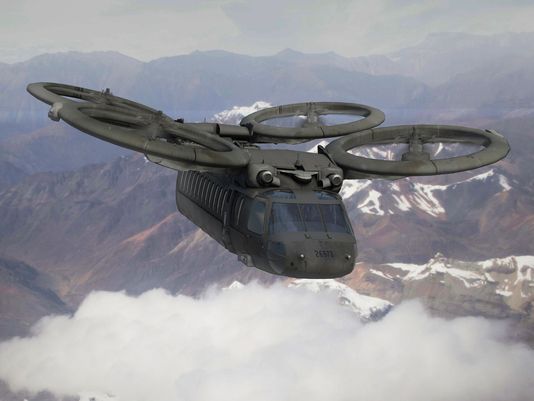
For those who know defense acquisition, it’s never a surprise when timelines to bring revolutionary weapon systems to life slip to the right, but the US Army’s new program office to manage the acquisition of a Future Vertical Lift (FVL) aircraft is laser-focused on getting to low-rate production by its goal of 2030.
Over the past several years, Army leaders and analysts have discussed varying timelines for the program, often with more pessimistic estimates of when the helicopters could come online, such as 2040 or even as late as 2045.
But according to Richard Kretzschmar, who leads the Army’s new Improved Turbine Engine and Future Vertical Lift program office, if things go well, FVL could reach low-rate initial production even earlier than 2030.
Considering the type of efforts to develop a new helicopter from scratch — from both industry and government perspectives — the schedule is a “sporty” one, a “low- to medium-risk approach to acquisition,” Kretzschmar said Monday at a rotorcraft conference at the Defence and Security Equipment International (DSEI) exhibition. “We are doing what we can to explore moving that to the left and shortening that timeline, we are certainly leveraging the [Joint Multi-Role, or JMR] tech demonstrator.”
The JMR technology demonstration is a science and technology effort to study what is in the realm of the possible for a future helicopter — one that can fly twice as far, twice as fast, with low maintenance needs at an affordable cost. Boeing and Sikorsky are building one air vehicle demonstrator and Bell Helicopter, partnered with Lockheed Martin, is building another. Both will undergo flight tests starting in fiscal 2017 through 2019.
The demonstration will feed into the FVL program of record and help the Army define its requirements for the helicopter.
The Army could move its timeline up, Kretzschmar said, if the established FVL requirements line up with the requirements of the JMR program. “If they are drastically different, then obviously there is more development on the industry side required in the early part of the program, so really our ability to do that is going to hinge on how far the technology has matured under the JMR [technology demonstrator],” he said.
Keith Flail, Bell Helicopter’s program director for future vertical lift, said at the same conference, “There is an opportunity to bring the program to the left. … I would argue a lot of what you’d typically do in a [technology-maturation and risk-reduction] phase … JMR is doing a lot of those activities.”
Bell Helicopter and the Boeing Sikorsky team, are burning down risk through the JMR program, not just by test-flying air demonstrators but also by “fabricating parts, we are showing this intense focus on design for manufacturing, design for affordability, gathering a lot of data, actuals, that they can provide to the costing community,” Flail said.
Yet even if the program is able to enter low-rate production earlier, it would only be by a margin of one or two years, Kretzschmar said in an interview with Defense News at the conference. “2030 is really what we are driving toward,” he said. “I think it’s going to be driven really more by resources from the Army perspective in when we can fit FVL into the portfolio.”
The establishment of Kretzschmar’s program office in May — that will oversee FVL acquisition as well as the Army’s Improved Turbine Engine Program within the Army’s Program Executive Office Aviation — can be seen as a symbolic gesture that the service is getting serious about making its development projects a reality.
At the same time, Army Training and Doctrine Command stood up a capability manager for the two programs, he added.
Kretzschmar is focused on reaching a materiel development decision in October 2016, which will trigger the start of an analysis of alternatives. The service will likely choose to develop a smaller helicopter first, he said, potentially a “special ops, street fighter-type aircraft.”
Ultimately, the Army will develop a family of future vertical lift helicopters to replace the current fleet of utility, armed reconnaissance, attack and heavy-lift helicopters, but that development won’t happen concurrently.
The Army expects to enter into a five-year technology-maturation and risk-reduction phase in 2019 then another five-year engineering and manufacturing development phase in 2024 or 2025 leading up to low-rate production in 2030.