

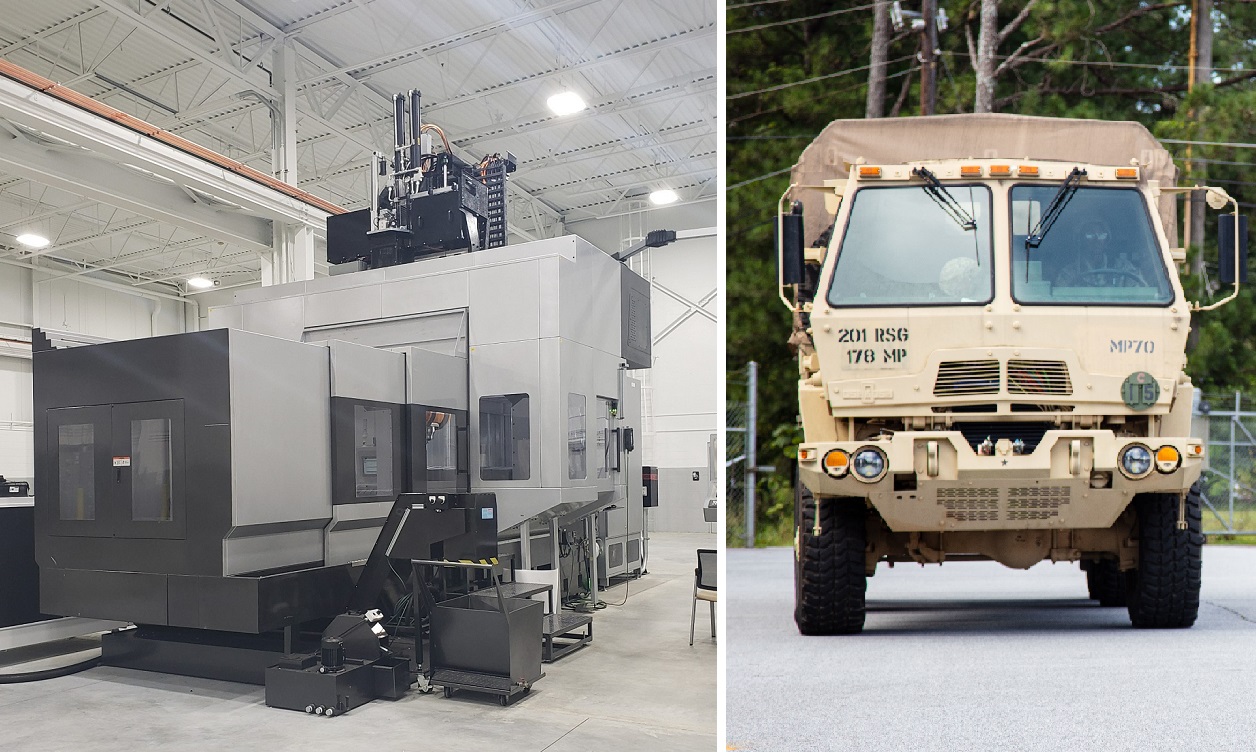
The U.S. Army designated several research programs as essential for future Army force modernization capabilities. As one of the initiatives, the integration of additive manufacturing, also known as 3-D printing, will play a vital role in Army-unique applications.
Additive manufacturing has opened the door for the creation of geometric designs never thought possible with traditional manufacturing methods and Army is employing it to print large parts for military ground vehicles.
The U.S. Army DEVCOM Ground Vehicle Systems Center (GVSC), together with U.S. Army TACOM, and SAE Government Technologies, will hold a reception April 6 for the opening of a new Advanced Manufacturing Commercialization Center (AMCC), located in Sterling Heights, Michigan.
The center will house the Army’s Jointless Hull subsection tool, a hybrid metal additive manufacturing machine used for engineering development and production in support of the full-size Jointless Hull machine located at Rock Island Arsenal – Joint Manufacturing and Technology Center. The full-size machine will be capable of producing large metal parts such as monolithic hulls for military ground vehicles.
The Army is using additive manufacturing to improve manufacturability and reduce logistic supply chain timelines.
“We’re planning to leverage the technology in this center to more efficiently manufacture parts, reduce weight, lower costs, and improve long-term sustainment efforts, all to improve Army readiness,” said Brandon Pender, GVSC Associate Director for the Materials Division.
“Building the future Army, while continuing to outpace 21st century threats, requires developing and fielding next-generation technology that provides Army formations with distinct advantages over near-peer competitors,” Pender said, “and GVSC remains at the forefront of Army readiness support through our aggressive pursuit of advanced manufacturing capability.”
Advanced manufacturing, including additive manufacturing, has the potential to reduce the logistics burden throughout the force by enabling a capacity to build replacement parts on-demand.
GVSC’s subsection tool, available to industry partners for commercial and military use through its partnership with SAE Government Technologies and the AMCC, can produce parts up to 3 cubic feet in size, and will be used for development work to support the larger machine at Rock Island Arsenal.
Monolithic hulls for combat vehicles have well-established advantages—especially in survivability and weight savings—but traditional manufacturing processes are not cost-effective or adaptable to full production, especially when multiple vehicle platforms are considered.
“The Jointless Hull project ultimately aims to realize an overall improvement to the complete manufacturing process and supply chain for large metal subsystems with the potential of enabling additional advancements through the additive manufacturing process combined with materials and design to improve performance,” Pender said.
While the ability to produce monolithic hulls is important, the new machine also will have the capacity to build and machine much larger additively manufactured parts than currently possible.
“There are a lot of big, heavy metal parts within the Army inventory that additive manufacturing is not even an option to make simply because they don’t fit within the build envelop of the current machines available in industry,” said Christopher Spangler, GVSC Materials Division Advanced Manufacturing Branch Chief.
“This new machine will provide Rock Island Arsenal with an additive and machining capability that doesn’t exist anywhere else to not only produce parts for the Army but also across the DOD,” Spangler said.