

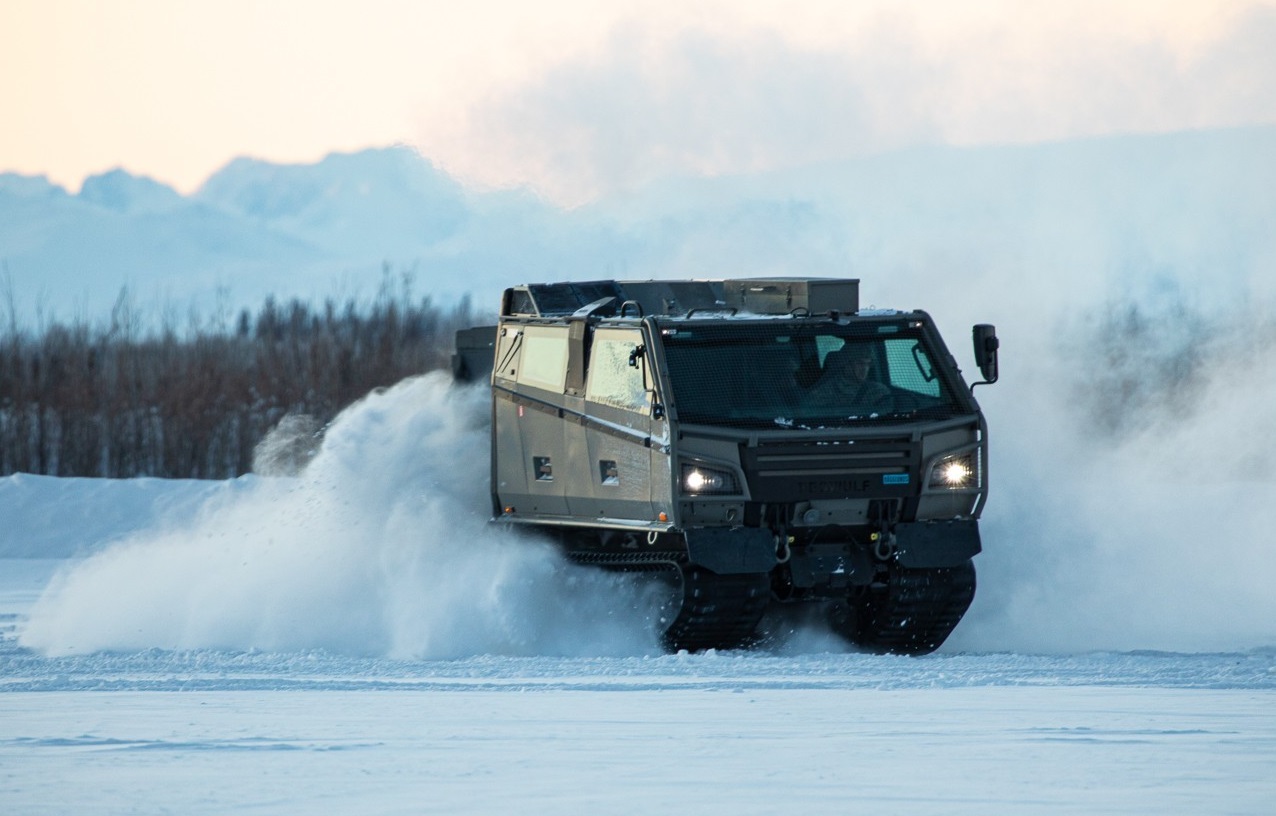
The U.S. Army has chosen the BAE Systems and Armaments L.P., Sterling Heights, Michigan, to produce the Cold Weather All-Terrain Vehicle, or CATV.
According to a press release from Army PEO Combat Support & Combat Service Support, the service is to buy tracked troop carrier capable of operating in the Arctic.
Delivery of this modernized capability for Arctic and extreme cold-weather mission sets is slated to begin in the fourth quarter of fiscal year 2023 with the U.S. Army Northern Warfare Training Center, Fort Wainwright, Alaska, designated as the first unit equipped. The award is a firm-fixed price requirements contract valued at $278 million.
The Army intends to purchase 110 vehicles for the active-duty Army and Army National Guard.
The comprehensive U.S. Army team responsible for bringing the CATV program to production contract award involves not only Army acquisition professionals assigned to the Program Executive Office, Combat Support & Combat Service Support headquartered at Detroit Arsenal, but also, relevant stakeholders representing the Army’s funding and testing communities, Army Futures Command, and Forces Command. Soldier evaluation via user-acceptance — or Soldier Touchpoint — efforts has been a key element of the CATV program from the outset and ensures the fielding of a modernized capability that meets cold-weather Warriors’ needs.
“We look forward to the CATV fielding and the increased capabilities it will bring to America’s Arctic Airborne Division,” said Maj. Gen. Brian S. Eifler, commanding general, 11th Airborne Division, and deputy commander, U.S. Alaskan Command, Joint Base Elmendorf-Richardson, Alaska. “The small unit support vehicles were great in their day, but have needed replacing for the past two decades. These new vehicles will provide our Arctic Angels with capable, reliable mobility and increase their survivability in the harshest conditions Alaska and the Arctic has to offer.”
Lt. Col. Seth Langston, Maneuver Requirements Division’s Mobility and Lethality Branch chief, based in Fort Benning, Georgia, echoed Eifler. “The CATV gives our Arctic Warriors greater mobility and increased survivability in extreme Arctic conditions.” The Maneuver Requirements Division in the Maneuver Capability Development and Integration Directorate is the Army’s proponent for generating required capabilities and operational requirements for the Cold Weather All-Terrain Vehicle.
The CATV gives Arctic Warriors a modernized ground platform for extended operations and force projection in the region, said Langston. “It is a platform that meets long-known capability gaps in Arctic regions. This enhanced capability will increase the Army’s ability to operate in extreme cold-weather, mountainous and high-latitude environments and supports the Army and DoD Arctic Strategies,” he emphasized.
As the Army’s newest modernized tactical vehicle family, CATVs will be Table of Distribution and Allowances vehicles requiring little to no modifications to meet military mobility requirements in the Arctic, Langston emphasized.
The CATV family of vehicles’ basic operational capabilities include:
- Enhanced mobility in extreme cold weather through varied terrain including water, tundra, and muskeg — a swamp or bog with a mixture of water and partly dead vegetation, frequently covered by moss
- Transportation for up to nine Soldiers supporting homeland defense, defense support of civil authorities and search and rescue mission sets
“The Cold Weather All-Terrain Vehicle program team has focused on meeting the Army’s emphasis to enhance extreme cold-weather mobility and survivability by rapidly procuring a modernized capability in support of the Army’s Arctic Strategy,” said Brig. Gen. Samuel L. Peterson, the Army’s program executive officer for Combat Support and Combat Service Support, or PEO CS&CSS. “Our product management team for Multi-mission Protected Vehicles undertook a great challenge to quickly develop and execute a strategy using all the authorities and tools available to streamline and accelerate the CATV acquisition process.”

According to Lt. Col. Benjamin Boring, the Army’s product manager for Multi-mission Protected Vehicle Systems, PEO CS&CSS, the CATV acquisition team used a two-step approach. First, an other transaction authority-based prototype agreement was awarded in the second quarter of Fiscal Year 2021 to two competing providers identified for the prototype phase. The Army received these vehicle prototypes last summer. The prototypes were used as test assets evaluating performance for mobility, payload and swim capability, as well as in extreme cold-weather conditions in Alaska from August 2021 to January 2022.
As a result of the evaluation, the second step in the Army’s acquisition approach culminated in BAE’s selection for a contract to support the production phase of the program.
The CATV acquisition strategy was structured to promote the highest level of competition possible to include nontraditional defense contractors, culminating with Soldier evaluations to inform the source selection process. “This approach front-loaded risk reduction, drove down costs, and ensures the delivery of a mature capability focused on Arctic Warfighter needs. It is indicative of the creative, dedicated nature of our acquisition team and speaks to the rapid nature of this important source selection,” Boring said.
The next steps in the CATV program include BAE Land and Armaments L.P. delivering four CATVs to the Northern Warfare Training Center, Fort Wainwright, Alaska.
Current plans call for the first vehicles to enter service in late Fiscal Year 2023.
“The program office is marching toward delivering CATVs to the Northern Warfare Training Center roughly 12 months after the contract award,” Boring added. “We are excited about fielding this capability to our Arctic Warriors, as this is a critical step in equipping an Arctic-focused force in the near term.