

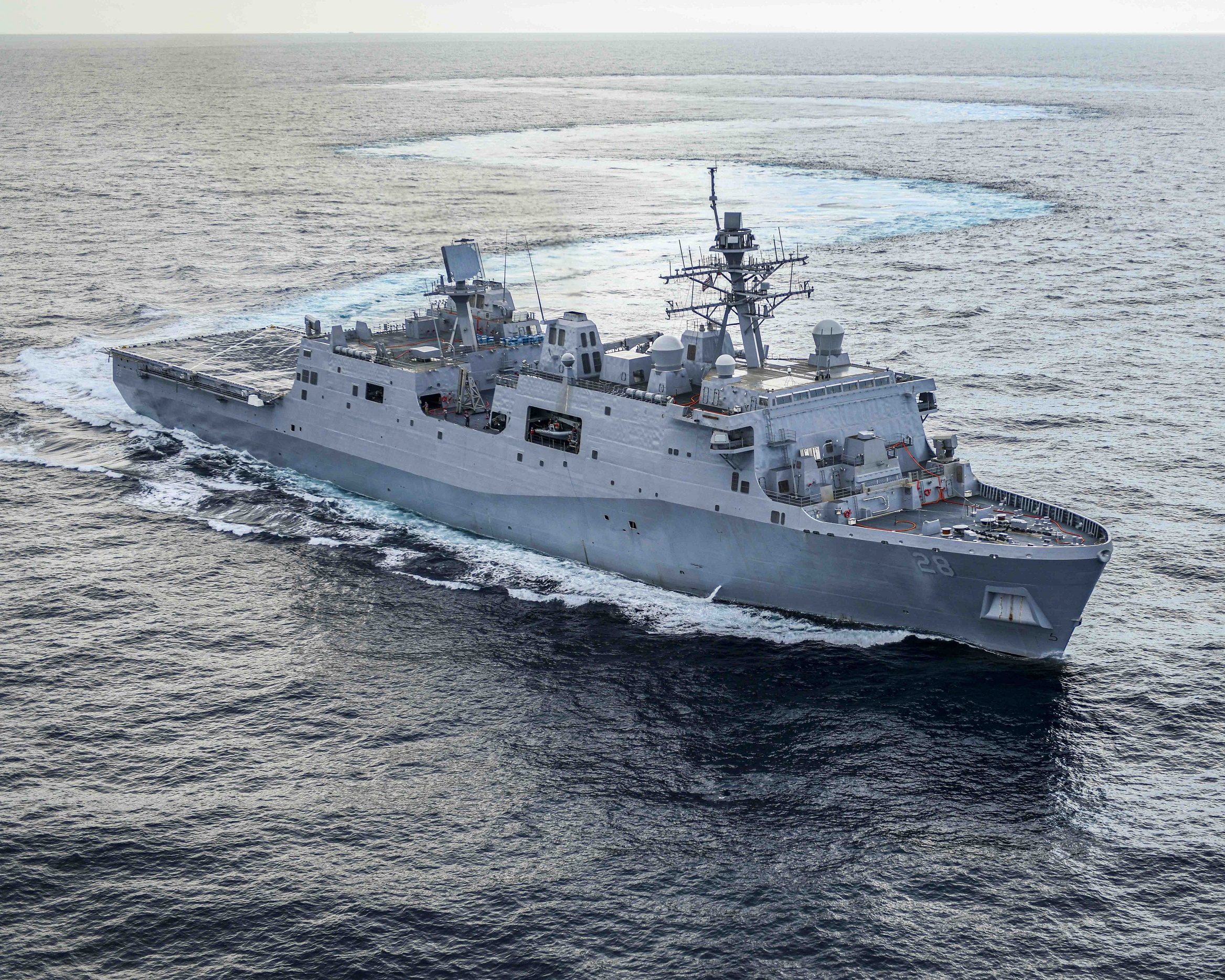
The amphibious transport dock, Fort Lauderdale (LPD 28), successfully completed its acceptance trials, America’s largest military shipbuilding company Huntington Ingalls announced.
The San Antonio-class ship, built at HII’s Ingalls Shipbuilding division, spent several days with the U.S. Navy’s Board of Inspection and Survey. As noted by the company, Ingalls’ shipbuilders will now complete final finish work on the ship in preparation for delivery this quarter.
“Fort Lauderdale is a terrific example of what our collective team is accomplishing together,” said Kari Wilkinson, president of Ingalls Shipbuilding. “LPD 28 demonstrates what Navy-industry collaboration can do to evolve a ship design to new requirements while maintaining the talented team that is demonstrating such efficiency and predictability in delivering on commitments. I couldn’t be more proud of their success.”
Key demonstrations by the Ingalls’ test and trials team included: anchor handling, ballast/de-ballast, detect-to-engage, and running the ship at full power and steering.
“It takes a lot of hard work from the entire shipbuilding team to make these sea trials successful,” said Mike Pruitt, LPD ship program manager at Ingalls Shipbuilding. “Fort Lauderdale is exhibit A of HII’s commitment to quality and meets our high standard for every ship that we build.”
Ingalls has delivered 11 San Antonio-class ships to the U.S. Navy and has three under construction that include Fort Lauderdale (LPD 28), Richard M. McCool Jr. (LPD 29), and Harrisburg (LPD 30). Additionally, fabrication of the 15th San Antonio-class ship, Pittsburgh (LPD 31), will begin in the spring.
LPD 28 is named Fort Lauderdale to honor the Florida city’s historic ties to the U.S. Navy, which date back to the 1830s and include an important naval training center during World War II.
The San Antonio-class is a major part of the Navy’s 21st century amphibious assault force. The 684-foot-long, 105-foot-wide ships are used to embark and land Marines, their equipment and supplies ashore via air cushion or conventional landing craft and amphibious assault vehicles, augmented by helicopters or vertical takeoff and landing aircraft such as the MV-22 Osprey. The ships support a Marine Air Ground Task Force across the spectrum of operations, conducting amphibious and expeditionary missions of sea control and power projection to humanitarian assistance and disaster relief missions throughout the first half of the 21st century.