

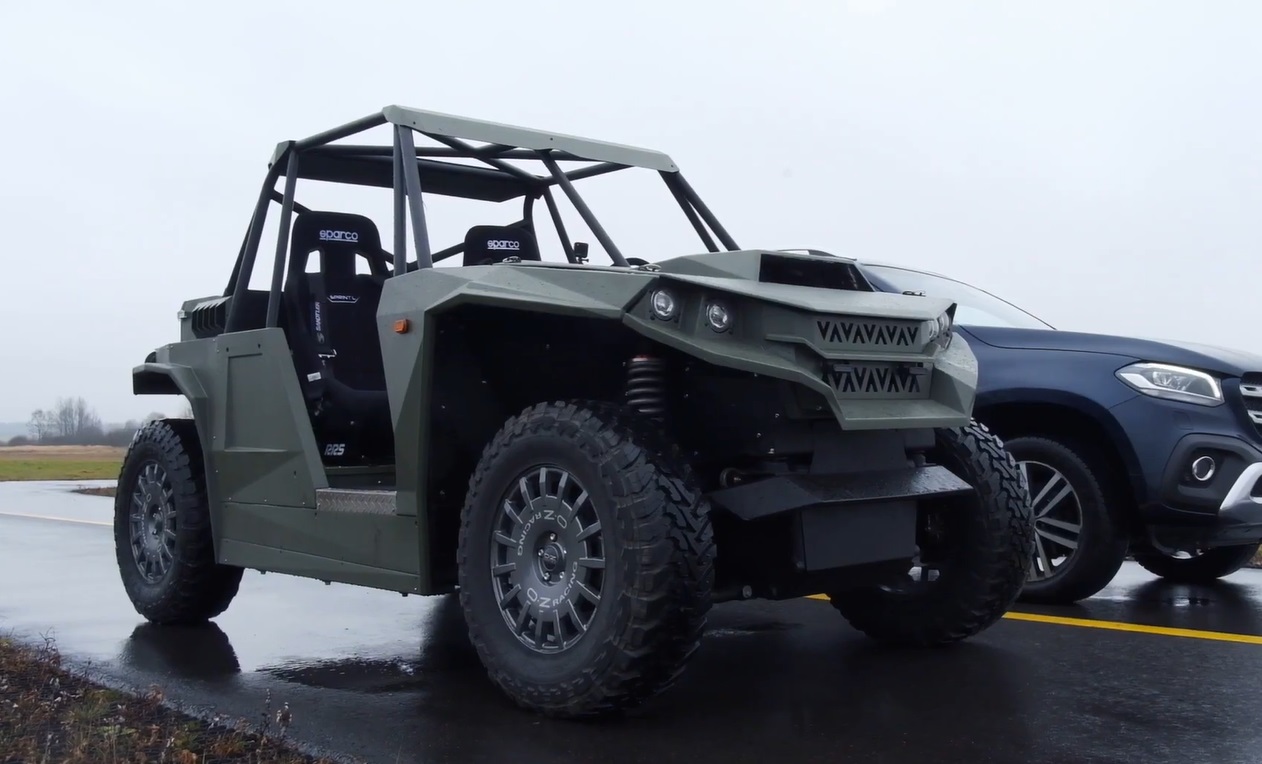
Ostara, the Lithuania-based company developing hybrid electric-diesel all-terrain vehicles, announced that it has completed the field test phase and is now developing remote control and autonomous solutions.
As noted by the company, Krampus Mk1 technology demonstrator completed tests in electric drive mode on a speedway in harsh weather conditions, including temperatures of 0-0.5 degrees Celsius, rain and strong headwinds.
“Krampus was tested at an aerodrome with 84 accelerations to maximum speed and braking. This mode is likely to deplete the batteries, and unsuitable weather conditions also contribute to faster depletion. However, we welcome the fact that even under these conditions, Krampus covered a distance of almost 100 kilometers, which is quite a long distance when driving in silent mode during various covert operations”, said Darius Antanaitis, CEO of Ostara.
According to Mr. Antanaitis, during the development of the Krampus prototype the vehicle’s stealth-enhancing characteristics of the hybrid electric- diesel drivetrain are being successfully developed, such as the silent operation, and a minimal thermal footprint. These features would give Krampus a wide range of applications, not only in the military, as well as law enforcement such as border protection, but also in civilian areas.
According to Mr. Antanaitis, Ostara will continue to focus on the development of remote control and autonomous modes after completing the development of Krampus hybrid drivetrain and the field testing of the vehicle in 2021. The aim is that in the final phase of the Krampus project, the vehicle will be fully autonomous – it will be able to recognize and overcome obstacles on the road, autonomously choose the best route to the destination, and even navigate in the absence of a GPS connection.
The Krampus diesel engine is switched on when charging electric batteries or to maintain their charge level.
Krampus has a design range of up to 1 000 kilometers with full fuel tanks. The plan is to achieve a range of up to 200 km on battery power alone. In the static position, an external mains supply can be used to charge the batteries. The vehicle is designed to carry two people and an additional 500 kg of mission load, e.g. scientific equipment, an electronic optical surveillance module, a remote-controlled weapon station, ammunition and other supplies.
“Krampus is highly mobile thanks to its design features and can even operate on rough terrain, on high mountains where conventional internal combustion engines run out of oxygen, and in dungeons and tunnels where internal combustion engines are not allowed. Krampus could also be used for environmental protection and border surveillance due to its silent operation and long ranges.
According to Mr. Antanaitis, technology demonstrator Krampus Mk1 is planned to be presented at the international security and defence exhibition Eurosatory 2022 in Paris next year, and to already be launched on the market in 2023 or 2024. Ostara is already planning Krampus Mk2, the second prototype, with enhanced capabilities for driving over rugged, hilly terrain.