

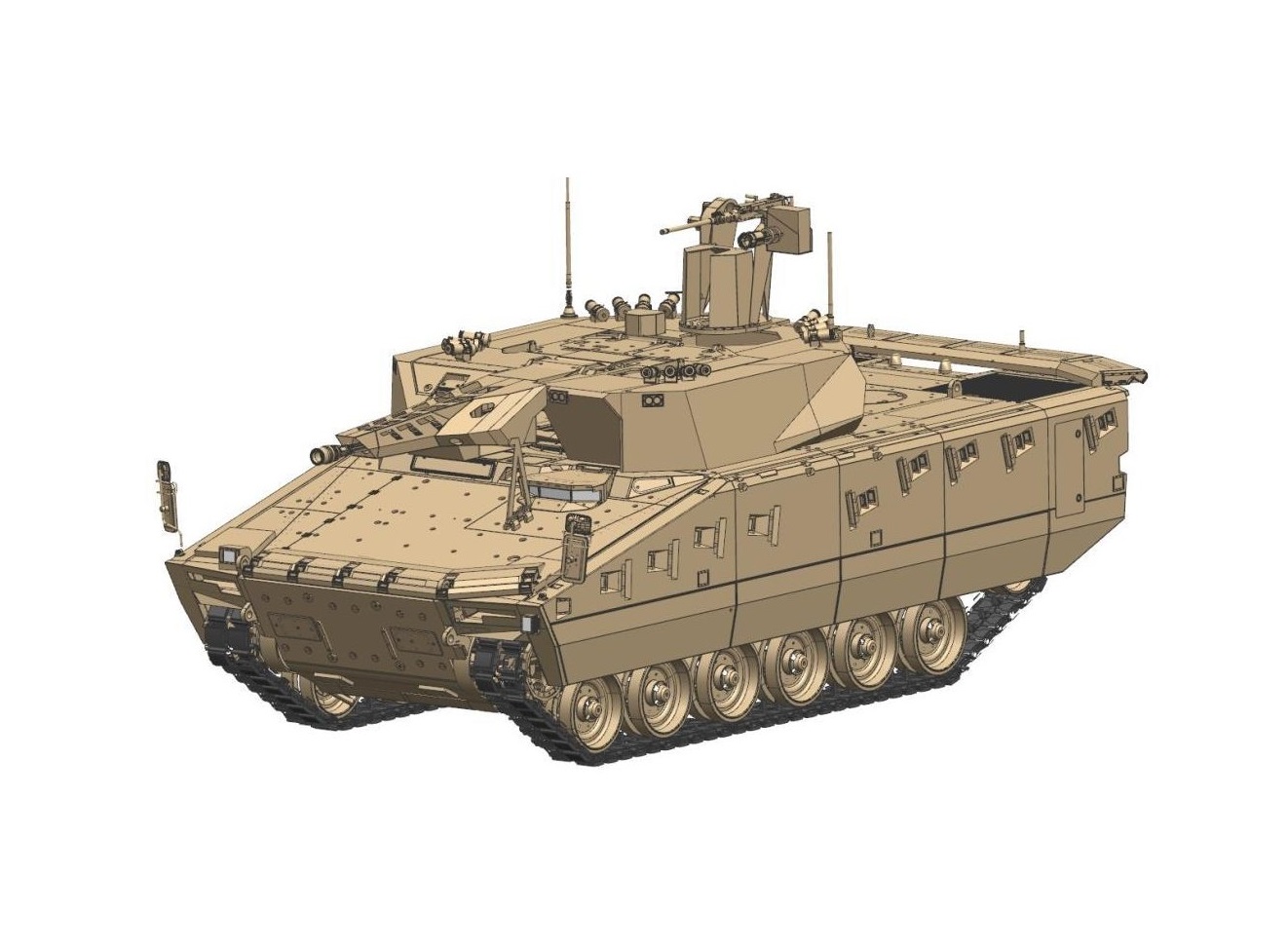
German defense conglomerate Rheinmetall has confirmed that the 209 new Lynx infantry fighting vehicles recently ordered by Hungary from Rheinmetall of Germany will be equipped with Rheinmetall’s StrikeShield hard-kill active protection system, or APS.
Hungary is the latest customer for this innovative technology, which has formed part of the Rheinmetall portfolio since 2006. It will be supplied by Rheinmetall Protection Systems GmbH. The order is worth over €140 million. Hungary’s decision in favor of StrikeShield was driven by the NATO member’s commitment to taking part in demanding missions where modern anti-tank weapon systems present a dangerous threat to their own forces.
StrikeShield is the third and latest generation of Rheinmetall’s acclaimed Active Defence System (ADS) technology, a specific variant of hard-kill APS. It is a distributed system whose sensors and countermeasures are integrated into the contours of the entire vehicle. Among other benefits, StrikeShield has the lowest emissions in the electro¬magnetic spectrum on the market, as well as the fastest reaction time in ambush and multi-hit situations. It protects the vehicle from shaped charge warhead threats such as rockets or missiles by neutralizing incoming projectiles before they hit the platform itself.
The StrikeShield APS will be mechanically integrated into hybrid armour tiles on the Lynx. Instead of conventional passive add-on armour modules, the platform will feature spaced passive armour tiles that incorporate the components of the APS between an outer ply and inner tiles mounted on the vehicle’s hull.
“We see huge benefits from hybrid designs”, declares Dr Manfred Salk, CEO of
Rheinmetall Protection Systems GmbH. “The effects that passive armour protects you from are standardized and well understood. Hybrid designs are different. They allow us to do a much better job of dealing with new effects and threats, such as residual energy from a disabled rocket hitting the vehicle and deflagrating. The combination of our passive and active technologies into hybrid systems, therefore, offer our customers unique benefits with regard to the protection capability, but also weight- and cost-efficiency.“
Rheinmetall Protection Systems GmbH is Rheinmetall’s center of excellence in survivability technologies, formed in 2019. The core of the product strategy is the hybridization of armor solutions, which provide the outlook to lighter and sensor-based survivability solutions for armored platforms.