

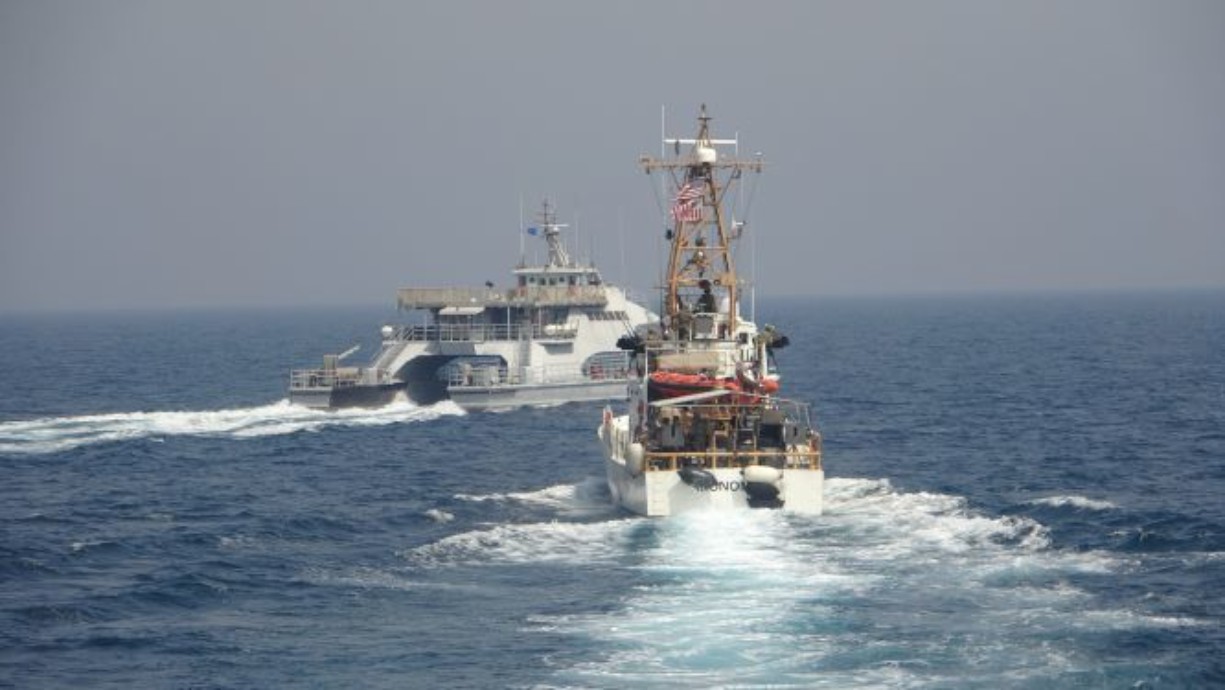
U.S. Naval Forces Central Command (NAVCENT) has reported that Iran’s Islamic Revolutionary Guard Corps Navy Harth 55, accompanied by three fast attack craft (FAC)/fast inshore attack craft (FIAC), approached U.S. Coast Guard patrol boats USCGC Wrangell (WPB 1332) and USCGC Monomoy (WPB 1326) on 2 April while the U.S. vessels were conducting routine maritime security patrols in the international waters of the southern Arabian Gulf.
Service also shared footage showing Iran’s Islamic Revolutionary Guard Corps Navy (IRGCN) Harth 55 conducted an unsafe and unprofessional action by crossing the bow of the Coast Guard patrol boat USCGC Monomoy (WPB 1326) forcing the U.S. ship to conduct a defensive maneuver.
The Harth 55 repeatedly crossed the bows of the U.S. vessels at an unnecessarily close range, including crossings both Wrangell and Monomoy’s bows at a 70 yard closest point of approach (CPA).
The Harth 55 closed aggressively on Wrangell’s bow, resulting in Wrangell maneuvering to avoid collision while sounding five short blasts from the ship’s horn.
The U.S. crews issued multiple warnings via bridge-to-bridge radio, five short blasts from the ships’ horns, and while the Harth 55 responded to the bridge-to-bridge radio queries, they continued the unsafe maneuvers.
After approximately three hour of the U.S. issuing warning and conducting defensive maneuvers, the IRGCN vessels maneuvered away from the U.S. ships and opened distance between them.
The IRGCN’s actions were deemed unsafe and unprofessional. Their actions increased the risk of miscalculation and collision, were not in accordance with the internationally recognized Convention on the International Regulations for Preventing Collisions at Sea (COLREGS) “rules of the road” or internationally recognized maritime customs, and were not in accordance with the obligation under international law to act with due regard for the safety of other vessels in the area.
U.S. naval forces continue to remain vigilant and are trained to act in a professional manner, while our commanding officers retain the inherent right to act in self-defense.
The USCGC ships are assigned to Patrol Forces Southwest Asia (PATFORSWA), the largest U.S. Coast Guard unit outside the United States, and operate under U.S. Naval Forces Central Command’s Task Force 55.
Iran’s Islamic Revolutionary Guard Corps Navy (IRGCN) Harth 55 conducted an unsafe and unprofessional action by crossing the bow of the Coast Guard patrol boat USCGC Monomoy (WPB 1326) forcing the U.S. ship to conduct a defensive maneuver, Apr. 2. Video by NAVCENT Public Affairs pic.twitter.com/xe2WOLYMUR
— Dylan Malyasov (@DylanMalyasov) April 27, 2021