

The U.S. Army has reported that Army Futures Command (AFC) is using rapid prototyping to integrate tactical network systems, which will enhance functionality of the Soldier-worn Integrated Visual Augmentation System, onto combat and tactical vehicles.
The details were given in a 23 July media release, to announce that Integrated Visual Augmentation System (IVAS) provides Soldiers with improved situational awareness capabilities as they fight, train and rehearse missions. IVAS capabilities include a digital display to access information without taking eyes off the battlefield, thermal and low-light sensors, rapid target acquisition, aided target identification and augmented reality.
The Command, Control, Communications, Computers, Cyber, Intelligence, Surveillance and Reconnaissance (C5ISR) Center — a component of AFC’s Combat Capabilities Development Command — is leading the prototyping efforts, in coordination with IVAS developers and network project management offices. The Center uses its in-house expertise to inform and refine the design, fit and function needed to house and integrate network components, including radios, servers and cables.
The C5ISR Center started design work this spring to integrate IVAS devices with Stryker armored vehicles, leading to Vehicle Excursion 2 (VE2) in January 2021 at Joint Base Lewis-McChord, Washington. The Soldier Lethality Cross-Functional Team (SL CFT) will host VE 2 with about a dozen participating organizations from Army research and development, acquisition and operational forces. It will be a static vehicle user study focused on assessing the utility and proof of concept of new capabilities on Strykers and Bradley Fighting Vehicles to gain early Soldier feedback.
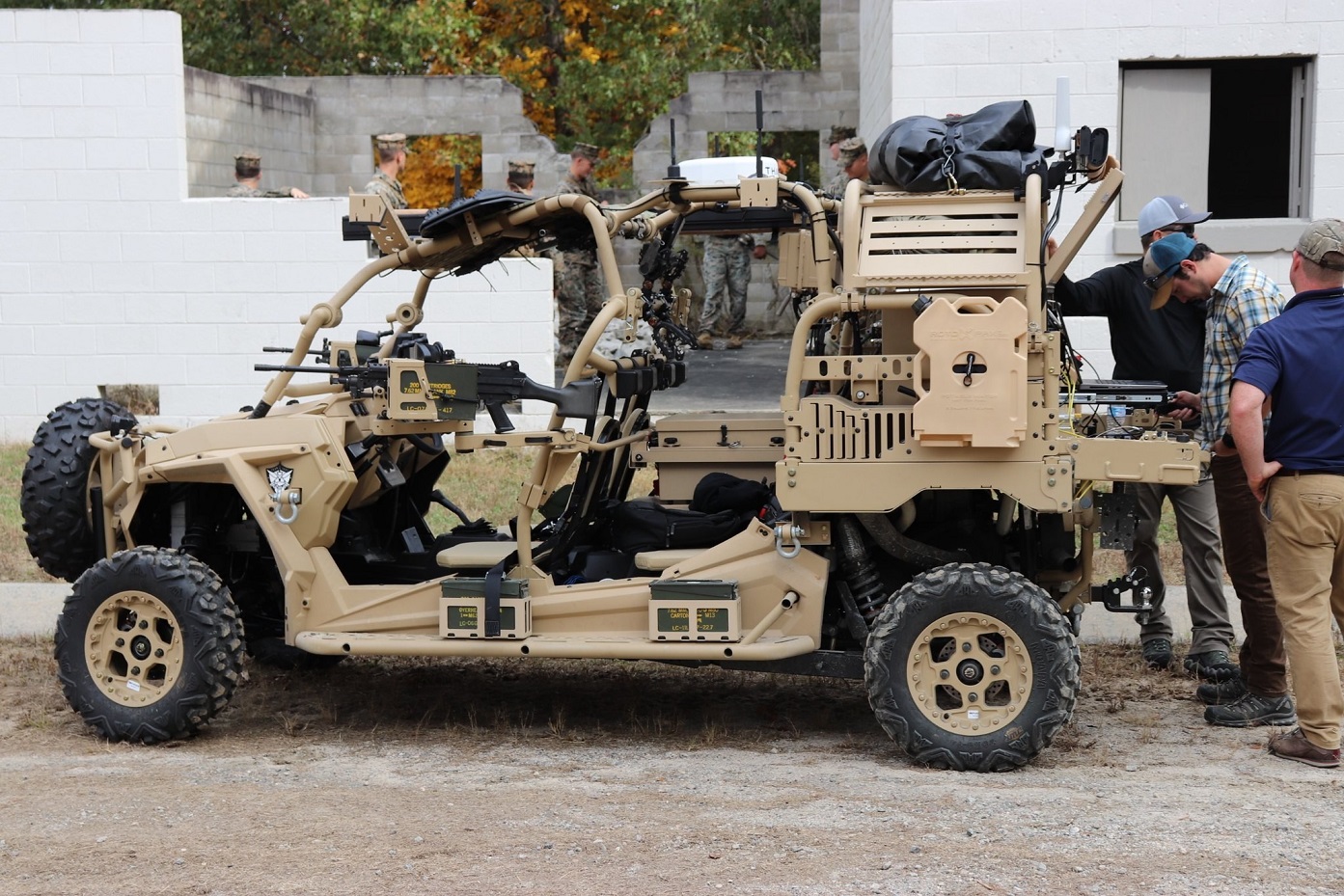
To enhance IVAS network connectivity and capabilities, C5ISR Center engineers and network system developers engineered a network communications gateway and data management kit known as Project Bloodhound in 2019. The C5ISR Center delivered the integrated network kit mounted on an MRZR all-terrain vehicle, which allowed dismounted Soldiers using IVAS to connect into the broader Army tactical network to share and receive data.
This prototype and others will enhance modernization efforts led by the C5ISR Center, SL CFT, the Network CFT, Program Manager IVAS, and PM Tactical Radios.
Bloodhound allows greater connectivity throughout the company echelon, through a tactical radio integration kit that includes radio gateways that enable voice and data information to be pushed and pulled from multiple sources. This concept is being applied to the Stryker prototype effort.
“We designed Project Bloodhound as a modular vehicle-mounted system that can be integrated into any vehicle,” said C5ISR Center mechanical engineer Ryan Stuk. “Certain features could be employed in a command post or dismounted capacity. We’re now taking the knowledge and expertise gained from the MRZR integration and applying those to Strykers.”
The Stryker effort will provide additional capabilities for Soldiers, whether they are mounted, dismounted or in transition, Stuk said. The Army’s three objectives are to leverage the Strykers as an IVAS power source to maintain mission capability, integrate with existing and future vehicle-based onboard camera systems, and enhance Soldiers’ situational awareness while mounted or transitioning to dismounted.
The Center’s organic, internal prototype integration facility (PIF) has enabled the Army to meets its objectives for multiple design iterations, changing requirements and quick deadlines, said Tom Brutofsky, chief of the C5ISR PIF. A key aspect to Project Bloodhound has been additive manufacturing, commonly known as 3D printing.
“The C5ISR PIF has invested heavily in additive manufacturing to develop a rapid prototyping capability to deliver functional designs with significant cost and time savings,” Brutofsky said. “The PIF manufactured the MRZR Bloodhound prototype approximately 80 percent through additive processes and went from concept to functional prototype in less than three months.
“Additive manufacturing also enables easier modifications as engineers gather Soldier feedback during exercises and as the Army identifies additional vehicles for network kit integration.”
Soldier touch points like VE2 enable the Army to transition from R&D to prototypes and then mature capabilities for fielding.
“For the C5ISR Center, incorporating Soldier feedback is essential,” Brutofsky said. “Understanding the needs of Soldiers on the battlefield early on helps us make better use of time and resources.”