

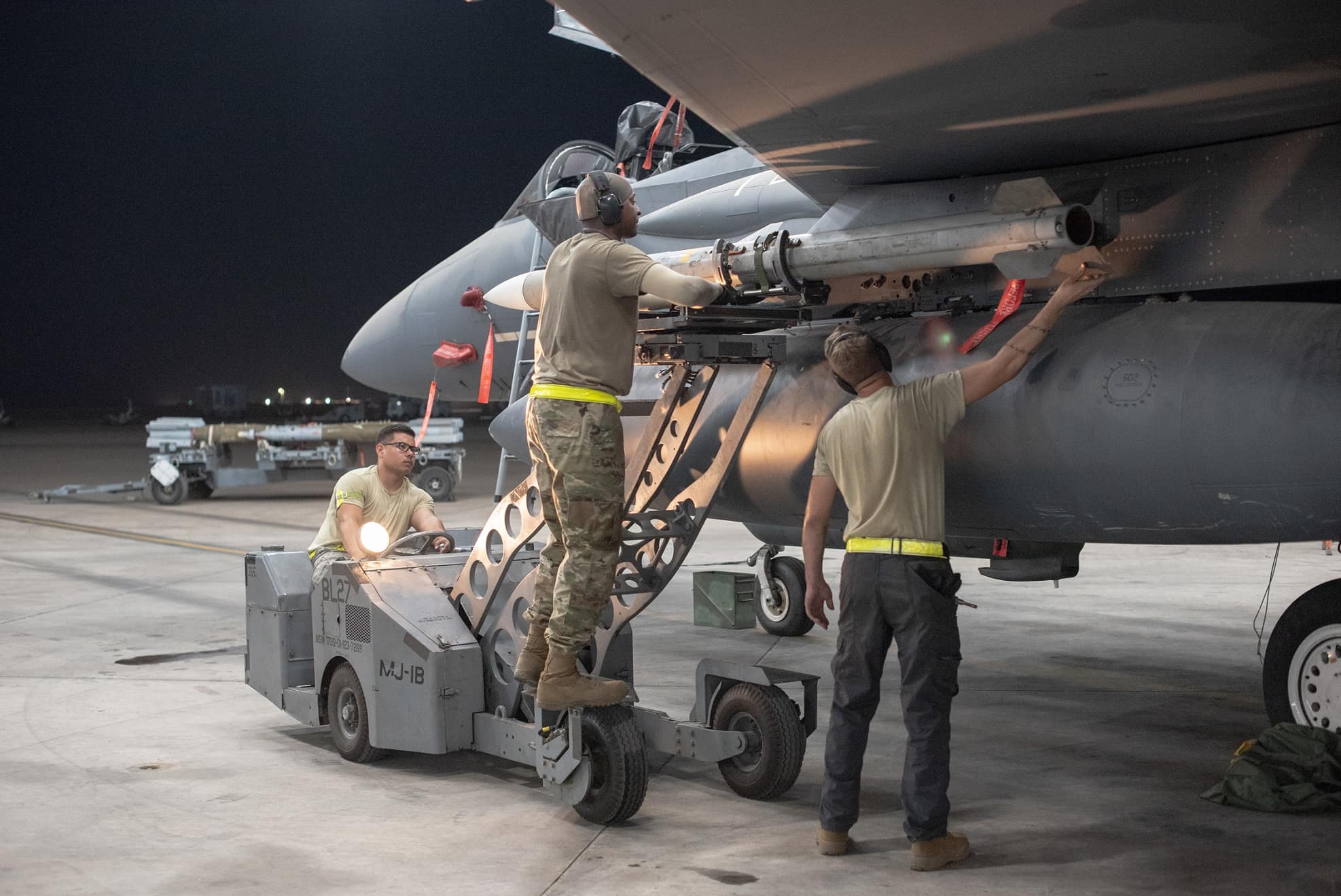
This week the U.S. Air Force awarded a contract to Raytheon Missiles Systems Co. for Advanced Medium Range Air to Air Missile (AMRAAM) technical support, the Department of Defense (DoD) announced on 22 November.
The combined indefinite-delivery and indefinite quantity contract valued at $72 million. The work under the new contract is expected to be completed by Sept. 30, 2025.
“This award is the result of a sole source acquisition. No funds are being obligated on the action at the time of award,” the DoD message states. “Concurrently, the first task order will be awarded with $238,173 in fiscal 2019 missile procurement funds”
According to the Air Force, AMRAAM is compatible with the Air Force F-15, F-16, F-22, and Navy F/A-18 C-F. The AIM-120C5 and AIM-120C7 missiles are fully integrated onto the F-35 and support the U.S. Marine Corps’ F-35B initial operational capability as the only air-to-air missile qualified on the F-35.
AMRAAM is a follow-on to the AIM-7 Sparrow missile series. The missile is faster, smaller and lighter, and has improved capabilities against low-altitude targets. It incorporates active radar with an inertial reference unit and micro-computer system, which makes the missile less dependent upon the fire-control system of the aircraft. Once the missile closes on a target, its active radar guides it to intercept. This enables the pilot to aim and fire several missiles simultaneously at multiple targets. The pilot may then perform evasive maneuvers while the missiles guide themselves to their targets.
Raytheon website said the AMRAAM air-to-air missile is the world’s most sophisticated air dominance weapon. With more than 25 years of design, upgrades, testing and production, the AIM-120 missile continues to meet all warfighter requirements. Its capabilities have been fully demonstrated in over 4,200 test shots and 10 air-to-air combat victories.
In the air-to-air role, no other missile compares to the AMRAAM missile. The weapon’s advanced active guidance section provides aircrew with a high degree of combat flexibility and lethality. Its mature seeker design allows it to quickly find targets in the most combat challenging environments.