

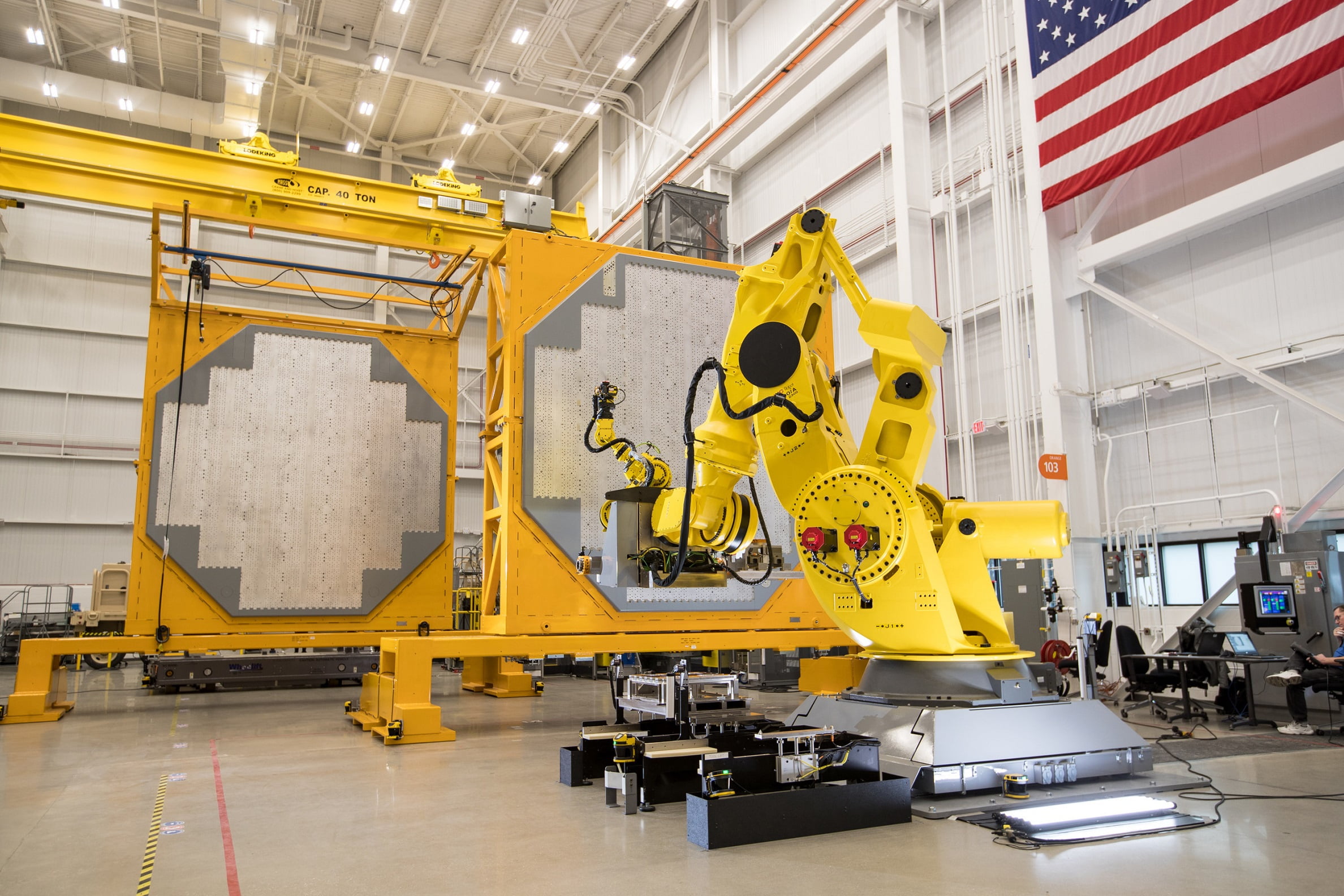
Raytheon, leading global defense company providing innovative military systems, has been awarded a $97,3 million U.S. Navy contract modification for newest SPY-6 radar work.
The U.S. Department of Defense announced on Friday that the company has received a modification to previously awarded contract N00024-19-C-5501 to exercise the options for Air and Missile Defense Radar AN/SPY-6(V) integration and production support efforts.
This option exercise is for performance of the integration and production support for continued combat system integration and test, engineering, training, software and depot maintenance in support of the Air and Missile Defense Radar AN/SPY-6(V).
Work is expected to be completed by November 2020, according to the release.
SPY-6 is a family of advanced naval radars. These sensors are being installed on destroyers, large-deck amphibious ships, aircraft carriers and frigates.
SPY-6(V)1 provides significantly enhanced range, greater resistance to environmental or man-made electronic clutter, and higher reliability and sustainability than currently deployed radars. The radar’s demonstrated sensitivity – significantly more than current fielded radars – provides better coverage for early and accurate detection.
SPY-6(V)2 and SPY-6(V)3 are smaller, rotating and fixed-face versions respectively, which are also known as Enterprise Air Surveillance Radar, or EASR. They provide continuous, 360° situational awareness, air traffic control and ship self-defense coverage.
SPY-6(V)4 has four fixed faces. It will offer next-generation, integrated, air-and-missile defense for Flight IIA destroyers as they are brought in for modernization.
The SPY-6 family are integrated, meaning they can defend against ballistic missiles, cruise missiles, hostile aircraft and surface ships simultaneously. They provide several advantages over legacy radars, including significantly greater detection range, increased sensitivity and more accurate discrimination.
Each variant uses the same hardware and software, and their construction is modular, making them more reliable and less expensive to maintain.
SPY-6 radars are built from individual ‘building blocks’ called Radar Modular Assemblies, or self-contained radars that come in 2’x2’x2’ boxes. Those boxes stack together to fit the mission requirements of any ship – a feature that makes the SPY-6 family the Navy’s first truly scalable radars.
SPY-6 counters large and complex raids, and works in high-clutter and jamming environments. Its software baseline is reprogrammable, meaning it is able to adapt to new missions and emerging threats. And the radar harnesses advanced tech like gallium nitride, a semiconductor technology that enables 360-degree, Active Electronically Scanned Array capability. AESAs lets operators adjust radar beams in ways older systems can’t.
AN/SPY-6(V)2 recently completed initial, system-level tests at the Surface Combat System Center at Wallops Island, Virginia. Upon completion of system-level testing, the radar will shift from the engineering and manufacturing development phase to the production phase. The first delivery of AN/SPY-6(V)2 will be to the America-class amphibious assault ship USS Bougainville (LHA-8).