

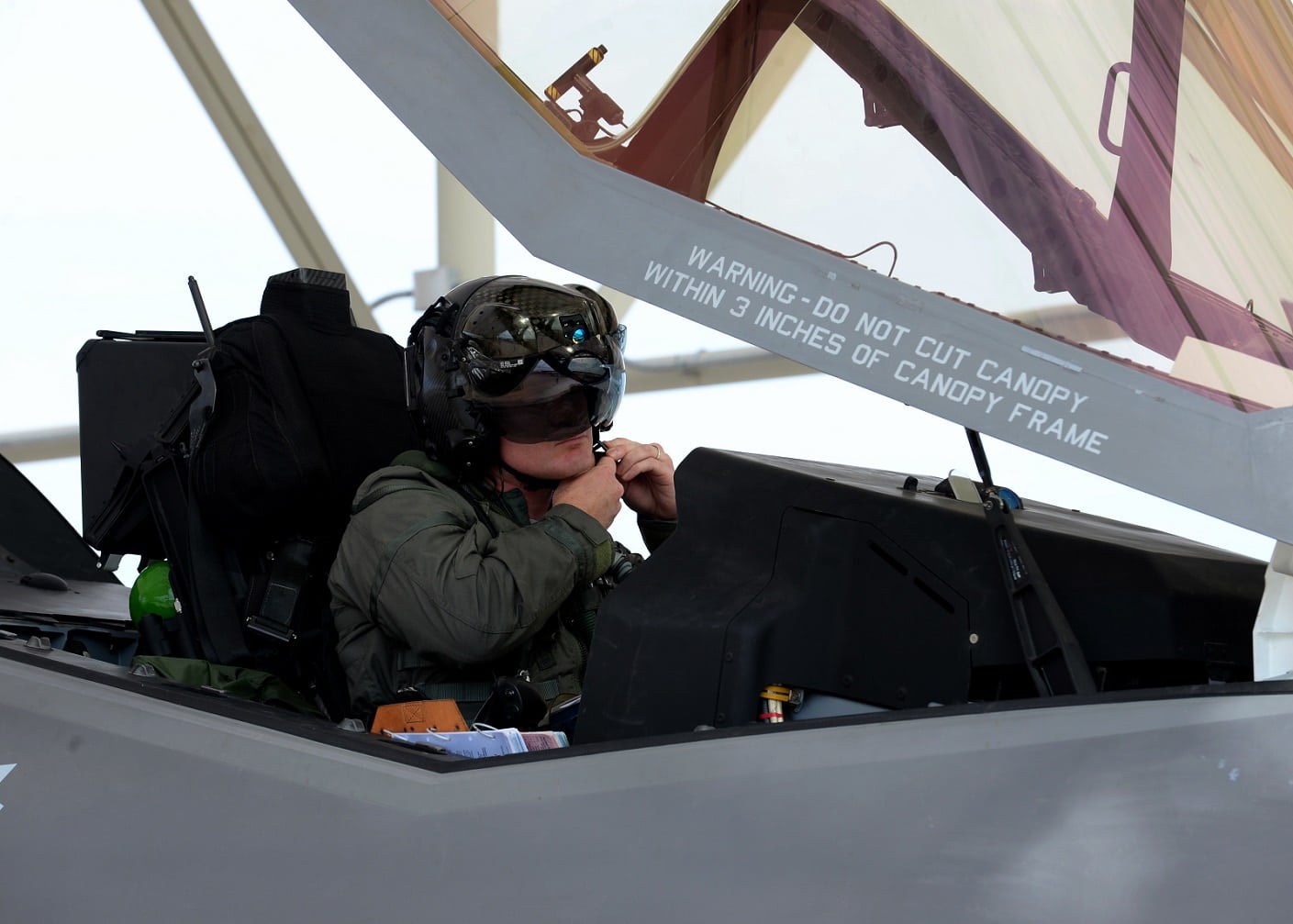
Pentagon’s No.1 weapons supplier Lockheed Martin has been awarded a $352,6 million contract modification for the procurement of Generation III helmet mounted display systems (HMDS) in support of the F-35 Lightning II program, according to a recent U.S. Department of Defense news release.
The modification to the previously awarded fixed-price-incentive-firm contract increases the ceiling and scope of the contract to include the procurement of Lot 12-14 Gen II HMDS in support of the F-35 Lightning II program.
Work performed by the corporation and its subcontractors in Fort Worth, Texas, and is expected to be completed in December 2020, according to the release. Subcontractors include U.S. aircraft parts maker Rockwell Collins and Israeli defense electronics company Elbit Systems.
A vital element of the F-35’s unprecedented warfighter capability, the helmet’s ground-breaking technology equips the pilot with mission-critical information on the helmet’s visor; resolves well-documented fit, comfort, and convenience problems associated with helmets worn by pilots of legacy aircraft; and fuses together the F-35’s cutting edge communications and sensor suite to form a clear picture of the operating environment — giving F-35 pilots unrivaled situational awareness and a decisive advantage over adversaries.
The latest iteration — known as the Generation III helmet — is also easily realigned and readjusted based on the individual pilot’s needs, whereas previous legacy F/A-18 helmets are rigid, cumbersome, and require manual upgrades.
The Rockwell Collins’s website said the F-35 Gen III Helmet Mounted Display System’s next-generation interface provides pilots with intuitive access to vast quantities of flight, tactical, and sensor information for advanced situational awareness, precision and safety.
The next-generation user interface serves as the pilot’s primary display system, and virtual capabilities enable them to see through the bottom of the fuselage or directly at a target. With an uninterrupted display of flight information and sensor data, the pilot experiences extreme spatial orientation, superior weapons targeting, and tactical superiority–both day and night.