

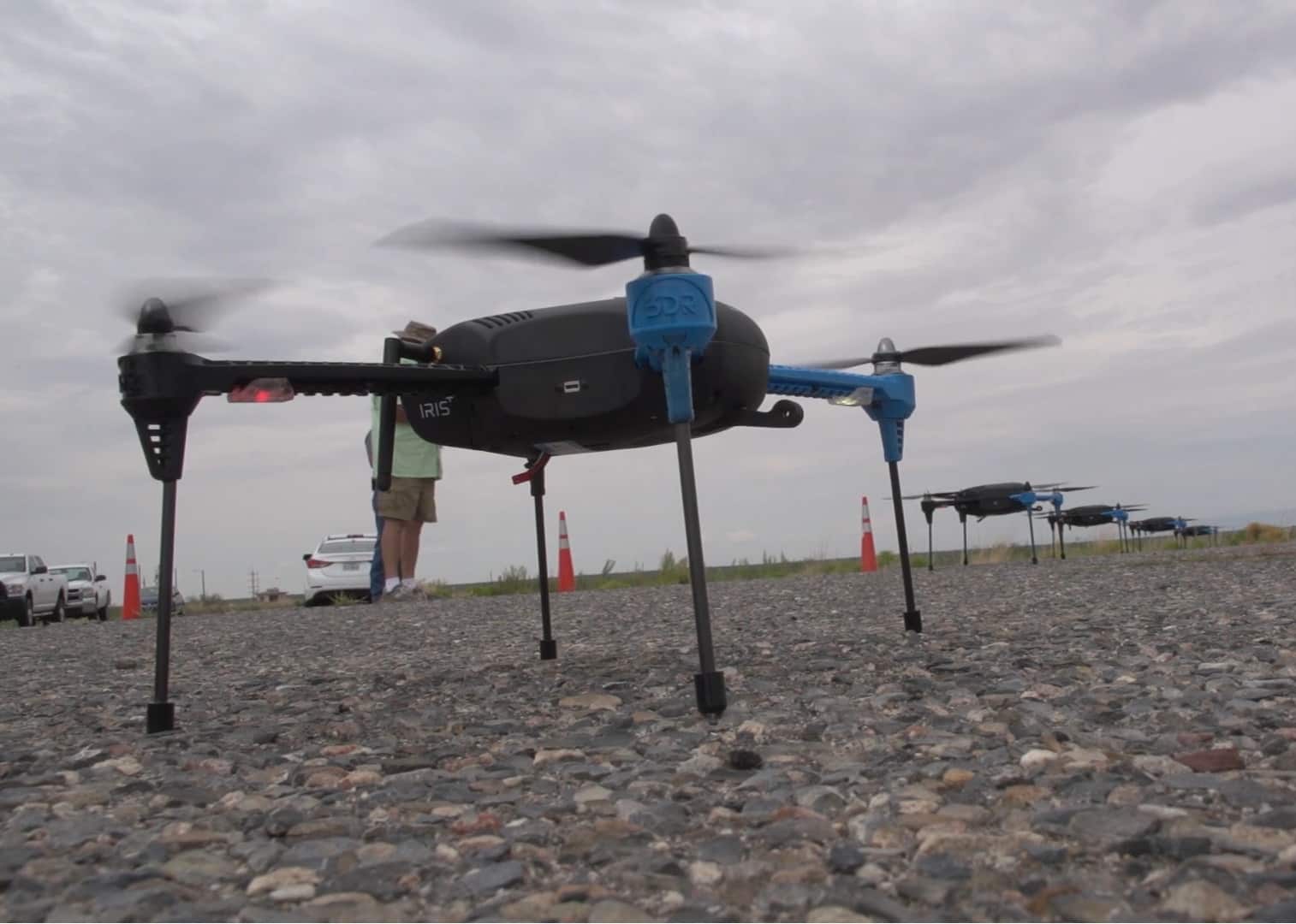
The U.S. Army Futures Command, or AFC, is exploring the extent to which swarming formations of robotic systems could be used to enhance mission-command capabilities for Army small units, according to a statement issued Wednesday by CCDC C5ISR Center Public Affairs.
Scientists and engineers within AFC’s Combat Capabilities Development Command, or CCDC, are exploring the potential to deploy unmanned aerial systems, or UAS, and unmanned ground vehicles, or UGV, to act as complementary swarm components.
Swarming is a method of operations where multiple autonomous systems act as a cohesive unit, actively coordinating their actions.
Once mobilized, the swarms would enable small units to quickly implement manned-unmanned teaming, or MUM-T, for a variety of mission types. Data would flow quickly from the swarm back to Soldiers, mounted or dismounted, who could then provide further instructions, if necessary, to the swarms.
“The Army is looking to swarming technology to be able to execute time-consuming or dangerous tasks. The Army wants robustness, flexibility and persistence, so we’re moving away from controlling through tele-operating and trending toward commanding,” said Osie David, a chief engineer in CCDC’s center for Command, Control, Communications, Computers, Cyber, Intelligence, Surveillance and Reconnaissance — or C5ISR.
Autonomous swarms are designed to complement, not replace, human capabilities as the robotics will assist Soldiers in their complex decision-making process on the battlefield, said David, who noted that the C5ISR Center is exploring the extent to which swarming robotics can support commanders and their staff during the execution of mission command.
Mission command is the Army’s philosophy of command and a warfighting function that promotes freedom and speed of action. It combines the centralized intent from the commander with the decentralized execution of subordinate commanders, who then decide how best to achieve the commander’s objectives.
In executing mission command, commanders must have a broad perspective, understanding and knowledge of activities throughout complex operational environments. Swarming technologies provide versatility for a ground force commander to accomplish different mission sets based on the reconnaissance requirements, said RJ Regars, a systems engineer in the C5ISR Center’s Command, Power and Integration Directorate, or CP&ID.
“Swarm technology, with a potential combination of unmanned aerial and ground vehicles, is ideally suited for difficult-to-maneuver environments like cities, forests or caves. The swarms could move quickly and quietly while tracking specific targets in locations where a traditional Army formation cannot quickly maneuver while sending data to units several miles away,” Regars said. “The ability to continuously patrol an area or route and quickly convey that data back to the unit is extremely valuable.”
A key goal of the project will be how best to combine a Soldier’s cognitive skills with autonomous robotics systems.
To better define and conceptualize the best tactics and applications of future swarming capabilities for mission planning, technical experts from the center met with Soldiers and Marines at Fort Benning, Georgia, to gain insights from their operational expertise.
“The swarming technology provides versatility for how a ground force commander could employ UAS or UGV swarms to accomplish different mission sets based on the recon requirements,” said Capt. Michael McCarty, an Army Infantry officer. “It’s definitely a positive for me as a future commander.”
So far the feedback has centered on reducing cognitive overload by filtering and prioritizing data for actionable information and developing simple-to-use systems that would free up Soldiers to perform other warfighting functions.
“Swarming improves the ability to target specific locations with minimal collateral damage because we can identify our targets ahead of time. When we combine manned and unmanned systems, it’s a force multiplier that turns a platoon into a company,” said Capt. Troy Makulec, an Army Armor officer. “Whether it’s ground or aerial swarming, it improves the likelihood of survival for our Soldiers on the ground.”