

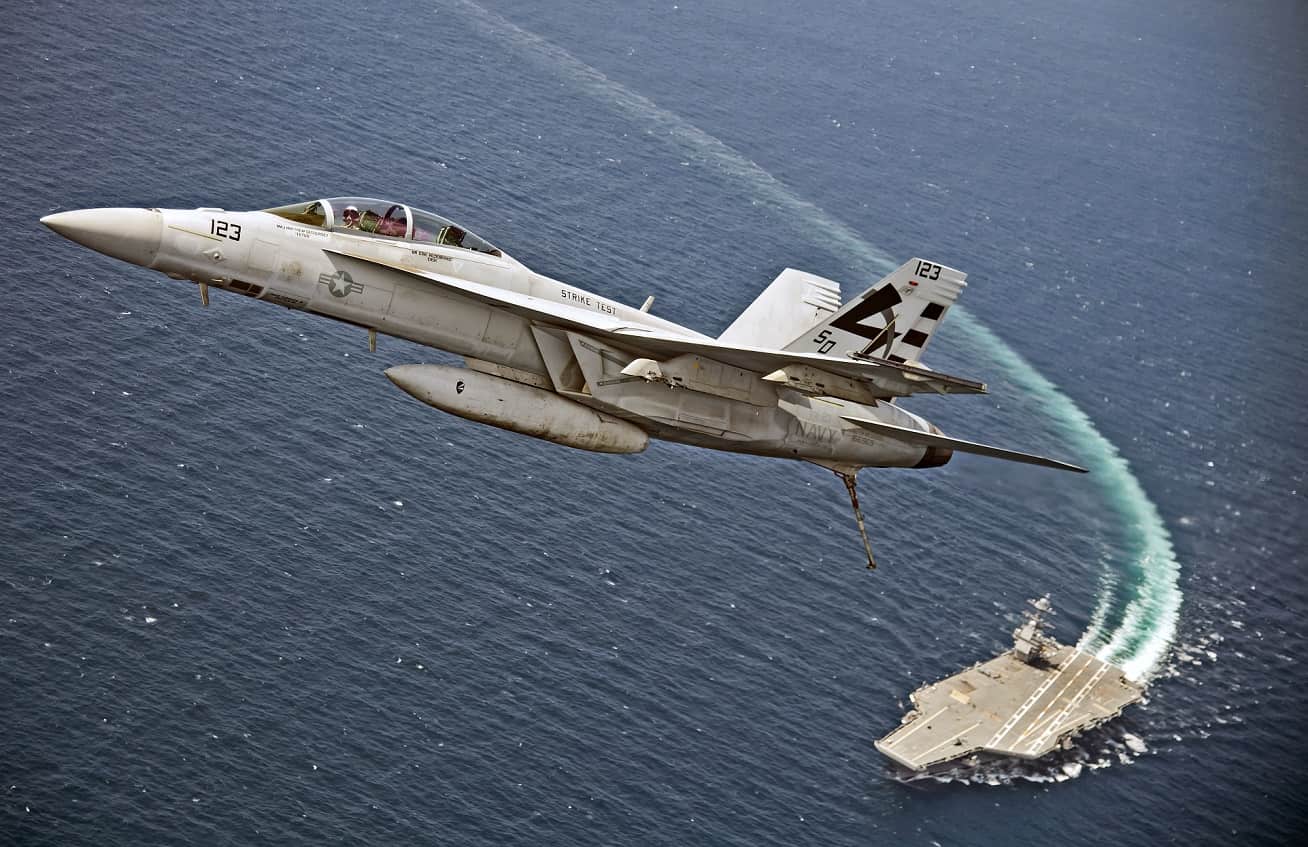
The Navy’s newest aircraft carrier Advanced Arresting Gear (AAG) system, development by General Atomics, received the green light to recover all “props and jets” aircraft, according to the Aircraft Recovery Bulletin (ARB) released Aug. 2.
AAG is a turbo-electric system designed for controlled and reliable deceleration of aircraft. According to General Atomics’s website, the AAG system provides significant benefits over current recovery systems:
- Higher availability and safety margins
- Operational capability to recover projected air wing
- Reduced manning and maintenance
- Self-diagnosis and maintenance alerts.
The ARBs enable propeller aircraft: C-2A Greyhound, E-2C Hawkeye and E-2D Advanced Hawkeye, and jet aircraft: F/A-18E/F Super Hornet and EA-18G Growler to perform flight operations aboard USS Gerald R. Ford (CVN 78).
“The entire team did a tremendous job accelerating the schedule and working through challenges,” said Capt. Ken Sterbenz, program manager for the Aircraft Launch and Recovery Equipment program office (PMA-251). “This achievement is another significant step toward ensuring the system can support the ship’s full airwing.”
ARBs are official Navy instructional documents identifying the weights and engaging speeds authorized for shipboard arrestments of specific aircraft, along with other pertinent information.
“Release of the ARB’s signifies ‘Naval Air Systems Command’s stamp of approval’ for the AAG system to safely recover these type/model/series aircraft aboard the Navy’s newest class of aircraft carriers,” said Jeff Mclean, deputy program manager for AAG System Design and Development.
The team, in collaboration with prime contractor General Atomics, continues to execute the requisite System Development and Demonstration testing at the land-based test sites located at Joint Base McGuire-Dix-Lakehurst, New Jersey.
Mclean added, comprehensive testing of new systems like AAG is critical, and not only ensures the technology meets Navy requirements, but also ensures it is operationally safe for use in the fleet.
Prior to Props and Jets ARB generation, the team conducted more than 2,500 dead-load arrestments at the Jet Car Track Site (JCTS) and 1,420 manned aircraft arrestments at the Runway Arrested Landing Site.
“The pace of system testing was consistently demanding and required numerous team members to perform their duties in difficult conditions and in all types of weather in order to meet critical program milestones leading up to these ARB releases,” said Mclean.
