

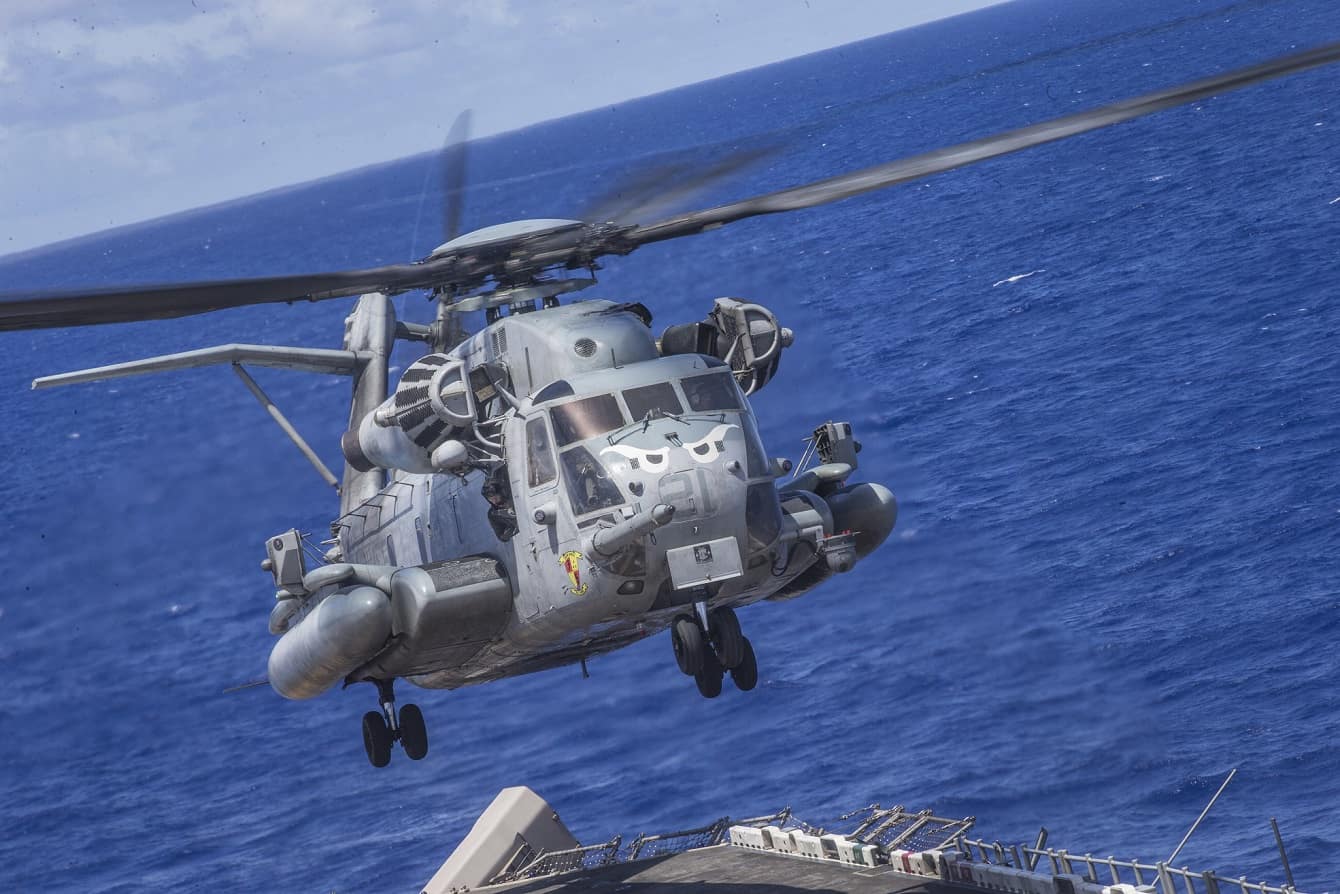
CH-53E Super Stallion reaches one million flight hours

A legendary CH-53E Super Stallion heavy-lift helicopter reached a major milestone this year by logging more than one million flight hours since it first entered service with the Marine Corps in 1981.

The CH-53E is a versatile machine used for amphibious assault and long-range insertion, delivering troops, vehicles and supplies. This rapid resupply vehicle is still one of the most used aircraft in the United States military air arsenal.

“The CH-53E has seen more work than was ever anticipated it would see,” said Major Matthew Baumann, H-53 In-Service, Naval Air Systems Command Heavy Lift Helicopter program office (PMA-261) co-lead.

- ADVERTISEMENT - CONTINUE READING BELOW -

Currently, there are 142 CH-53E Super Stallions in service. Though out of production, the CH-53E is in the middle of a “RESET” – a rolling period of rebuilding, upgrading and increasing safety, reliability and capabilities to lengthen its service life through 2032.

According to Baumann, the first 25 helicopters have completed their RESET process, “allowing the squadron commanders to plan for training, operations and maintenance with renewed confidence,” he said.

Resetting of the CH-53E fleet is an important segue from the current platform to the new CH-53K King Stallion, which will be its heavy-lift replacement.

“The CH-53K is the most powerful helicopter ever built by the United States military,” said Colonel Perrin, PMA-261 program manager. “It will be safer, faster and more capable than any previous heavy lift helicopter in the battlespace.”

Its development is currently in the testing and capability requirements phase, with a goal of bringing the CH-53K to fleet Marines by 2024.

“It’s a game-changer,” said Perrin. “We can’t wait to have the K available for fleet use. But for now we’ve got a capable, reliable and safe helicopter doing heavy-lift for our Marines.”

Readers who wish to follow our weekly coverage can subscribe to the Weekly Defense Roundup.

If you wish to report a grammatical or factual error in this article, please let us know by using the online form.

Executive Editor
  • In this story
  • USA

Support The Defence Blog

Independent reporting takes resources. Join us on Patreon.

Become a patron

More Like This

U.S. Army Reserve tests Pyka’s autonomous cargo aircraft in live exercise

Pyka's autonomous cargo aircraft DropShip flew a 32 km (20-mile) resupply mission entirely without a human pilot from Gulfport to Diamondhead, Mississippi, then executed...

Mayman Aerospace CEO: autonomous drones must replace helicopters in contested battlespace

At 3 a.m. in a contested forward operating base, a patrol thirty kilometres out is taking casualties. They need blood, plasma, and ammunition, not...

U.S. Army buys more of its toughest Arctic combat vehicle

The U.S. Army awarded BAE Systems Land and Armaments a $35 million contract modification on June 30, 2026, for additional production of the general-purpose...

AEVEX wins $50M deal for GPS-resistant strike drones

AEVEX Corp. secured a $50 million contract from the United States Air Force on June 30, 2026, to continue expanding unmanned mission-support capabilities for...

U.S. Air Force spends $471M to fix tanker parts supply problem

The U.S. Air Force awarded a combined $471 million in contracts to 28 different companies on a single day, spreading the work of exchanging...

U.S. Marines deploy Iron Dome-based missile system to Guam

U.S. Marines from III Marine Expeditionary Force were photographed calibrating and evaluating the Medium-Range Intercept Capability system on Mason Range, Guam, on June 24,...