

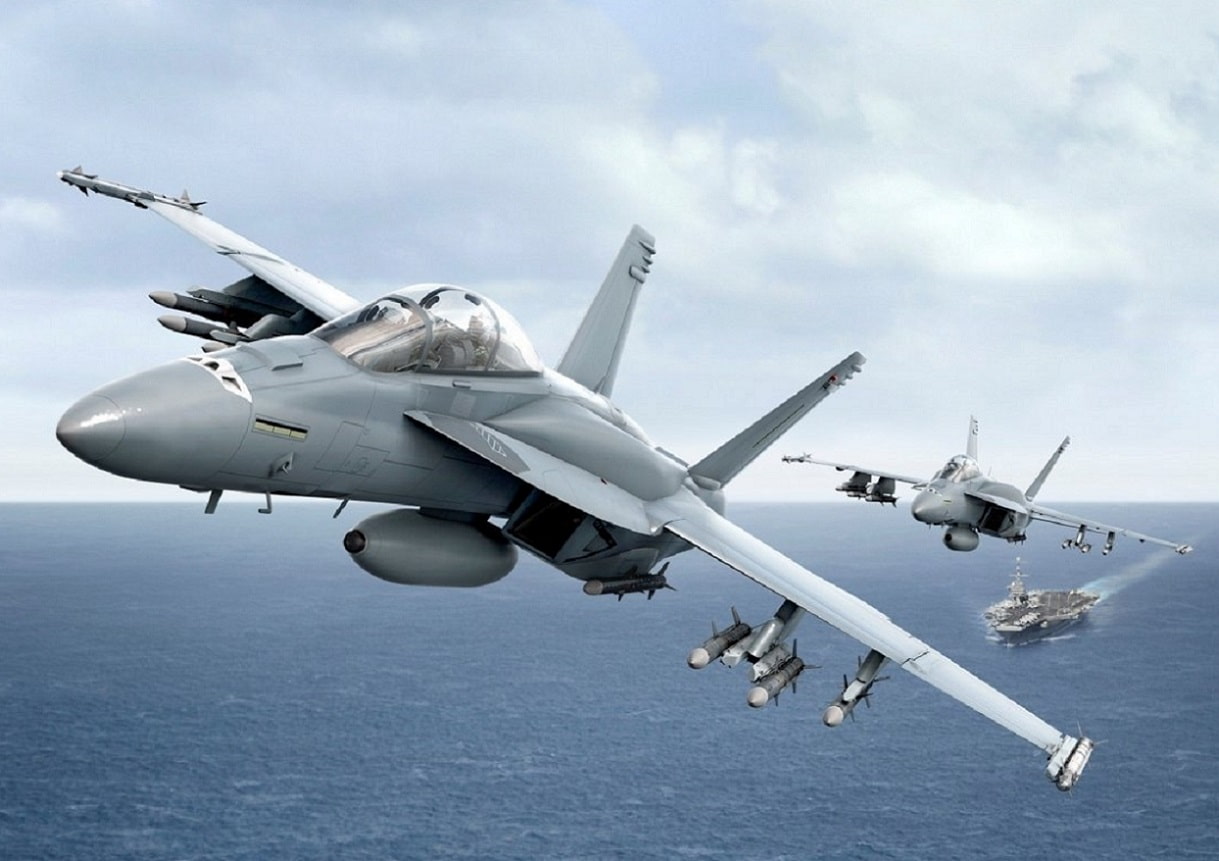
According to the Canadian Broadcasting Corporation, the politically charged competition to replace Canada’s aging fleet of fighter jets will rocket forward at the end of May as the federal government releases a long-anticipated, full-fledged tender call.
Attempts to replace 3-decade-old CF-18s began in 2010, but have been mired in politics
There are four companies in the running: Saab of Sweden, Airbus Defence and Space out of Britain, and the American firms Boeing and Lockheed Martin.
For its part, Boeing is striving to offer the Super Hornet Block III to Canada and support the government’s capability and industrial requirements, pointing that it continuing to invest in the Canadian economy.
The aerospace giant reported a consistently supported the Canadian aerospace industry by contributing more than CAD$4 billion of economic benefit to Canada each year working in partnership with a strong team of Canadian suppliers.
“Boeing guarantees it will fulfill 100 per cent of the ITB requirements, working with Canadian companies of all sizes and specialties, in all locations across our defense and commercial businesses,” said Maria Laine, vice president of International Strategic Partnerships. “We recently completed our Industrial and Regional Benefit (IRB) obligation for Canada’s initial purchase of four C-17 Globemaster III aircraft, which was just over CAD$1 billion. Not only did we meet our obligation, we exceeded it – completing it nearly one year early.”
“This is all backed by Boeing’s 100-year long partnership with Canada and an unmatched track record of meeting and exceeding industrial partnership commitments,” Laine added.
Boeing’s partnership with its Super Hornet Block III Industry Team (General Electric, Northrop Grumman and Raytheon) enhances its overall proposal to exceed ITB requirements. To date, Boeing has successfully completed CAD$9 billion in IRB commitments and generated more than CAD$3.9 billion of additional benefits under the company’s active IRB and ITB programs. There will also be opportunities for innovation and technology collaboration and export assistance for Canadian industry.
As to the Super Hornet Block III, the company’s presentation noted the is the world’s most proven and affordable multi-role fighter. The Super Hornet Block III offers Canada world-class, multi-mission capabilities and is uniquely suited for challenging operating environments. It offers predictable and affordable acquisition and life-cycle cost, which is critically important for a platform that will be in service for at least 30 years, and is designed to stay ahead of future threats for decades to come.
The Super Hornet Block III, while fully meeting Canadian military requirements, is the minimum risk and maximum return on investment solution for Canada. Boeing will be delivering Super Hornets to the U.S. Navy through at least 2033, while the development of next-generation Block III capabilities remains on schedule to deliver by the end of 2020. International interest remains high and includes Finland, Switzerland, India and Germany, who recently down selected the Super Hornet over the competition.