

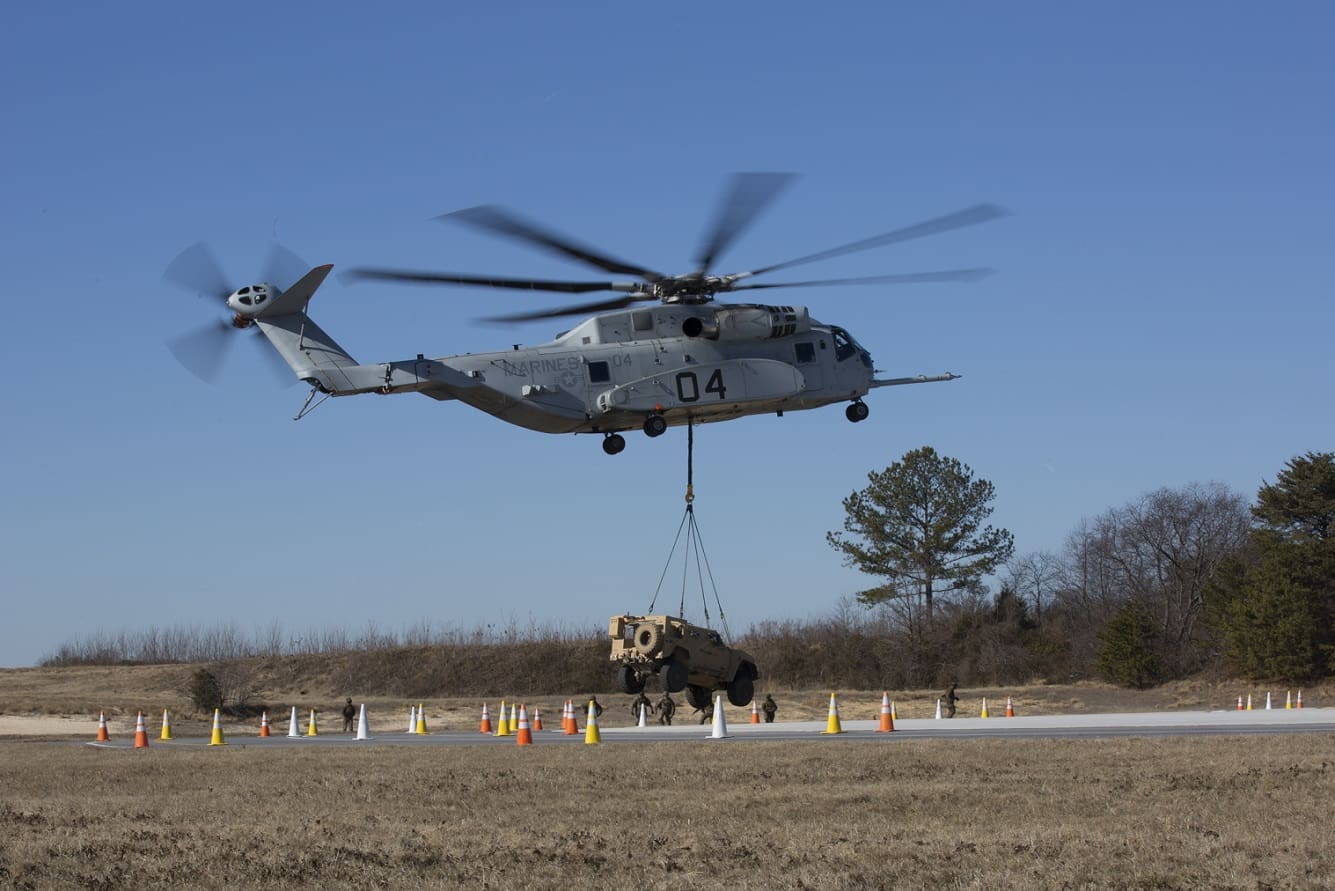
The CH-53K King Stallion is a new build aircraft with the same logistical footprint as the current CH-53E Super Stallion served as the workhorse of the Marine Corps for more than 30 years, but is fly-by-wire, software driven and it can lift three times more.
The Marine Corps’ CH-53K heavy-lift helicopter is intended to transport armored vehicles, equipment, and personnel to support operations deep inland from a sea-based center of operations.
The CH-53K helicopter has been designed and built to the exacting standards of the U.S. Marine Corps (USMC) and will serve as its critical land and sea based logistics connector. The new heavy lifter will allow the U.S. Marine Corps and international militaries to move troops and equipment from ship to shore, and to higher altitude terrain, more quickly and effectively than ever before.
The CH-53K program entered production in March 2017 with mature critical technologies and a stable design, but without demonstrated production processes.
“Due to a number of technical deficiencies identified through developmental testing, since last year’s assessment, the program office has delayed the start of operational testing by almost 2 years, to May 2021, and postponed initial operational capability by 20 months, to September 2021,” the Government Accountability Office said in a compelling report.
The Government Accountability Office said in its annual survey of Defense Department acquisitions that the program office identified two critical technologies—the main rotor blade and the main gearbox—for CH-53K. Although,the program office reported that both critical technologies are mature, there are technical issues with the main gear box causing low service life projections. The program office also noted that while there are parts shortages with the main gearbox,the supplier has recently improved its manufacturing processes in an effort to reduce the backlog of needed parts. It is too soon to tell if this will reduce the parts shortages.
The program office has increasingly discovered software deficiencies over the past year. Specifically, developmental testing showed a failure in the software to detect the transition from ground to flight causing increased safety concerns. The program is currently working to solve this problem through additional software development.
The program office stated they generally revised the software plan so they could be more flexible in addressing software deficiencies. The program office also reported increased risk in completing additional software development efforts to meet cyber security needs.
According to the office of the Director, Operational Test and Evaluation, the program updated its test and evaulation plan to emphasize cyber security test strategies.
In addition, the contractor moved the CH-53K assembly line from West Palm Beach, Florida, to Stratford, Connecticut, in June 2018. The final two test articles will be produced in Connecticut, but the program office does not expect the relocation to affect production.
But apart from that, Сongress has demanded that the Pentagon conduct a detailed assessment of the U.S. Marine Corps’ troubled CH-53K King Stallion program and examine potential alternatives, such as the CH-47 Chinook.
Bloomberg reported that Boeing has provided the Defense Department information on how the Chinook might be adapted for Marine Corps missions, according to two officials, both of whom asked not to be identified because the information isn’t public. Analysts from the Pentagon’s independent cost analysis and program assessment group met at Boeing’s Philadelphia facility April 25 to review the data, the officials said.