

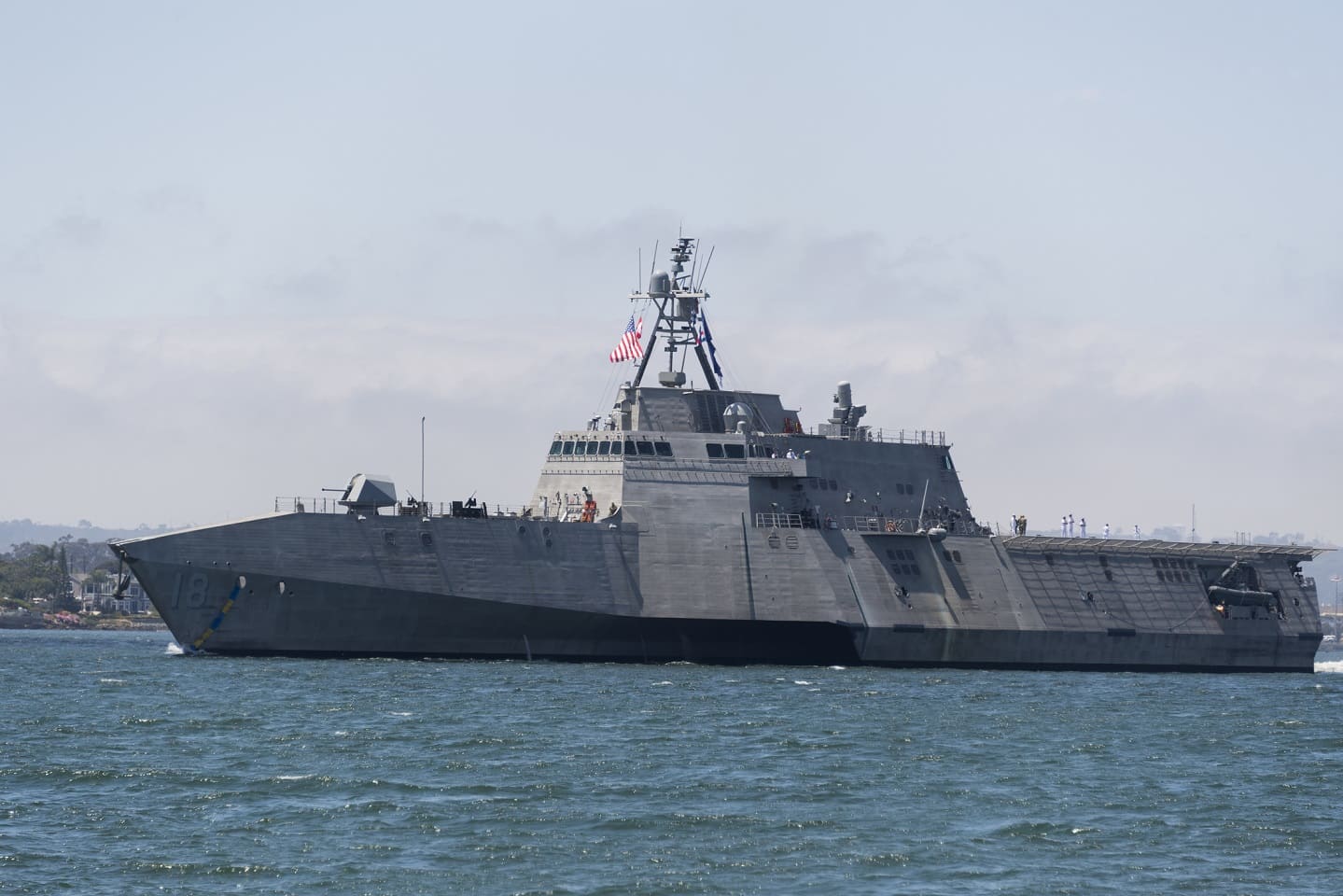
The Independence-variant littoral combat ship USS Charleston (LCS 18) arrived at its San Diego homeport April 19 after completing its maiden voyage from the Austal USA shipyard in Mobile, Alabama.
Lt.j.g. Jasmine Spencer has reported that prior to arriving in San Diego, Charleston officially joined the fleet March 2 when it was commissioned in Charleston, South Carolina. During the sail-around, the ship made port calls to Mayport, Florida; Little Creek, Virginia; Guantanamo Bay, Cuba; and Mazatlan, Mexico. The ship also completed a successful transit through the Panama Canal.
“I’m proud to say that the crew did a phenomenal job during Charleston’s maiden voyage, working many long hours to execute the voyage safely,” said Cmdr. Christopher K. Brusca, Charleston’s commanding officer. “To get Charleston ready for delivery, we’ve been away from our families for nine months, but during that time the crew maintained an infectious positivity throughout every aspect of bringing this ship to the Fleet.”
The ship falls under Commander, Littoral Combat Ship Squadron One (COMLCSRON ONE) control until the future LCS Mine Countermeasures Division is established on the West Coast.
“Charleston is a first-class ship with a first-class crew,” said Capt. Matthew McGonigle, commander, COMLCSRON ONE. “With Charleston’s arrival, we now have 11 littoral combat ships homeported in San Diego and we couldn’t be more proud of the hard work and positivity our LCS crews continue to demonstrate every single day.”
The LCS is the most advanced high-speed military craft in the world and is intended to operate in coastal areas around the globe. As a key part of the U.S. Navy fleet, they are highly maneuverable and configurable to support mine detection/elimination, anti-submarine, and surface ship warfare.
The trimaran hull form provides the ship with superior seakeeping, fuel efficiency, survivability and the capacity to carry a large, modular cache of weapons packages.
As part of the surface fleet, LCSs have the ability to counter and outpace evolving threats independently or within a network of surface combatants. Paired with advanced sonar and mine-hunting capabilities, LCSs provide a major contribution, as well as a more diverse set of options to commanders across the spectrum of operations.