

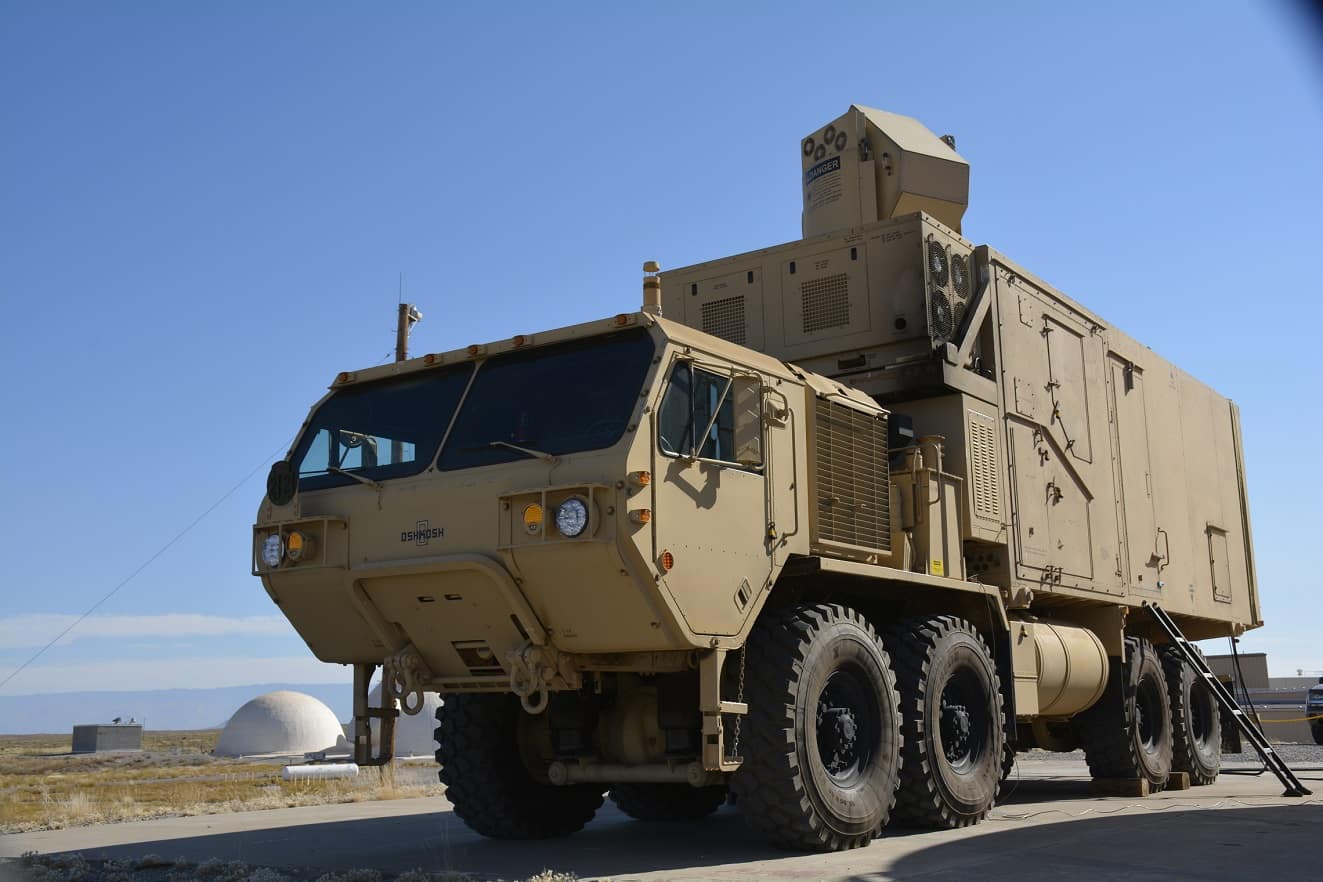
In February, the U.S. Defense Department issued a call for information in support of the aptly titled High Energy Laser Weapon Subsystem Technologies.
According to a new request for information (RFI) published on 6 February, the Pentagon asked the defense industry to pitch a more compact and militarized laser weapon system for use on the battlefield.
Reported that the directive was formulated by the U.S. Strategic Command Space and Missile Defense Agency. The Pentagon plans to improve the efficiency of high-energy laser (HEL) devices, which are particularly interested in controlling laser beams and cooling laser weapons.
“High Energy Laser (HEL) and beam control technologies have matured over the past decades to become viable battlefield assets,” said in a request. “The second generation HEL systems are more compact and militarized for use on the battlefield, the HEL Tactical Vehicle Demonstrator (HEL TVD) will be integrated onto a Family of Medium Tactical Vehicles (FMTV) and the Multi-Mission HEL (MMHEL) on the Stryker platform.”
According to expectations from the U.S. Army Space and Missile Defense Command, the next phase of HEL development is leaning towards ruggedized and condensed packaging of HEL weapon systems to be mounted on even smaller platforms used in future HEL platforms, along with improving their lethality.
The new mobile laser weapon system will be designed to counter unmanned aerial system (UAS), and intelligence, surveillance, and reconnaissance (ISR) threats, as well as provide ISR.
RFI highlights that the objective HEL subsystem must be capable of conducting a safe shutdown within 0.02 seconds, and commence firing within 0.02 seconds from cease fire. The objective beam control system will need to be agile, with low jitter and high slew acceleration.The objective HEL and BCS subsystems should support a startup time of less than 5 minutes, be operated by 2 persons or less, and have a magazine depth greater than 45 seconds. The threshold subsystems will support a startup time of less than 15 minutes, be operated by 3 persons or less, and have a magazine depth greater than 30 seconds.
Also added that innovative technologies sought through this RFI are requested for 2025 and out-years; these technologies are not for and are not intended to affect current Army-funded efforts.