

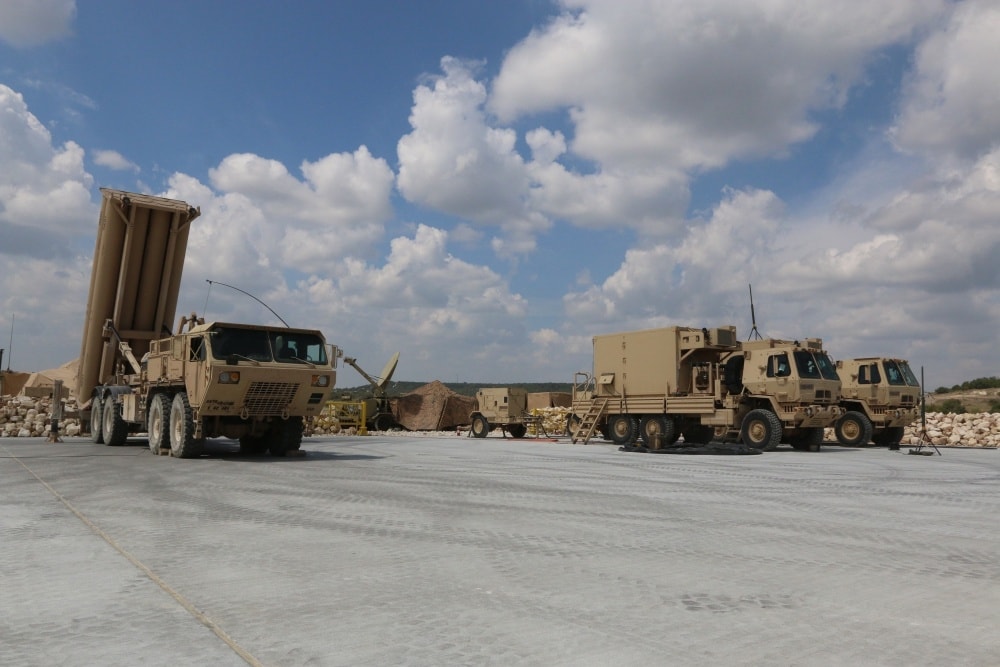
Lockheed Martin delivered the 300th interceptor for the Terminal High Altitude Area Defense (THAAD) system, the only system in the world designed to intercept threats both inside and outside the atmosphere.
The production maturity milestone comes as demand for the company’s hit-to-kill missile defense system and interceptors continues to grow.
“The Missile Defense Agency, industry and Lockheed Martin team of men and women who engineer and produce the THAAD interceptor have remained steadfast in their commitment to excellence as global demand for this system has grown year after year,” said Richard McDaniel, vice president for the THAAD system. “The 300th interceptor delivery is a reflection of that dedication and our continued focus on providing high-quality, reliable system capabilities to maintain overmatch against our adversaries.”
A key element of the Ballistic Missile Defense System (BMDS), THAAD protects America’s military, allied forces, citizen population centers and critical infrastructure from short and medium-range ballistic missile attacks. THAAD is proven, with 100 percent mission success in flight testing, is rapidly deployable, interoperable with other BMDS elements including the PAC-3 Missile, Aegis, forward based sensors and the Command, Control, Battle Management and Communications (C2BMC) system.
The U.S. Army activated the seventh THAAD battery in December 2016 and the system is currently forward deployed with U.S. troops in Guam and South Korea. Lockheed Martin delivered the 200th THAAD interceptor in September of 2017. The United Arab Emirates was the first international partner to procure THAAD with a contract awarded in 2011.
The THAAD element provides a globally-transportable, rapidly-deployable capability to intercept ballistic missiles inside or outside the atmosphere during their final, or terminal, phase of flight.
THAAD is strictly a defensive weapon system. The system uses hit-to-kill technology where kinetic energy destroys the incoming target.