

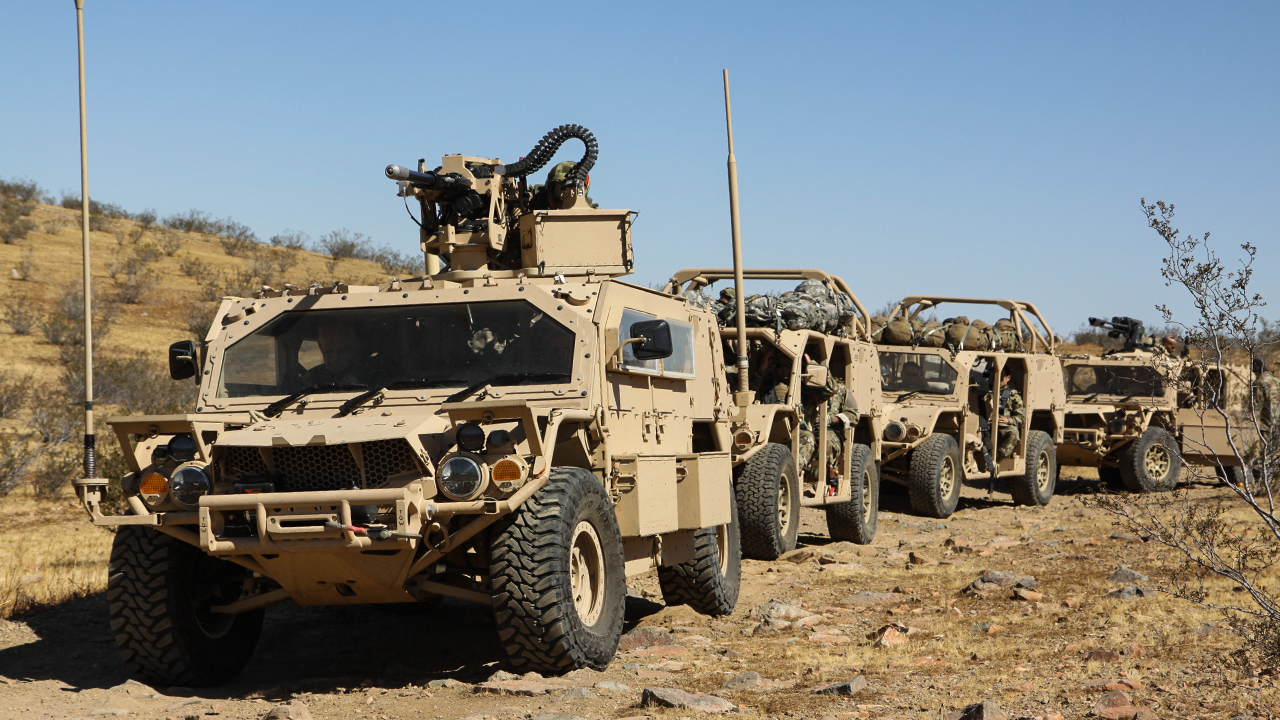
The US Army has awarded General Dynamics Ordnance and Tactical Systems a USD33.8 million contract for the production of Army Ground Mobility Vehicles (AGMV) and associated kits.
According to General Dynamics announce, General Dynamics Ordnance and Tactical Systems was awarded a $33.8 million contract on May 22, 2018, by the U.S. Army Contracting Command, Warren, Mich., for the production of Army Ground Mobility Vehicles (AGMV).
Based on the GMV1.1 vehicle the company is currently delivering to the U.S. Department of Defense, the AGMV configuration carries an airborne infantry squad with a payload capability of over 5,000 pounds. It shares approximately 90 percent parts commonality with the GMV1.1 and meets the same strategic lift requirements. The AGMV’s open design provides the ability to readily modify the vehicle to accept already developed kit configurations such as remote and manned turrets, armor and arctic kits.
“The AGMV brings the right capability and performance to the Army for their immediate need and future requirements due to its highly reliable, adaptable and versatile design,” said Steve Elgin, vice president and general manager of armament and platform systems for General Dynamics Ordnance and Tactical Systems. “By leveraging the GMV1.1 program, the Army can take advantage of the engineering, development and testing that has already been completed by Department of Defense. This significant time savings, along with the proven performance of the deployed GMV1.1 vehicles, gives the Army the ability to get this urgently needed capability into the warfighter’s hands now.”
Estimated completion of this contract is March 2019.
The company also noted that, a family of unique modular, Internal Air Transport (IAT) compliant, military grade, mission-ready vehicles that bring superior capability to the warfighters’ ever-changing mission needs. Built for speed, mobility and maneuverability, the Flyer vehicles allow operators to access previously denied terrain in demanding environments. These versatile vehicles can be reconfigured to support multiple crew and mission profiles, from three to nine operators with full payload and mission profile kits.