

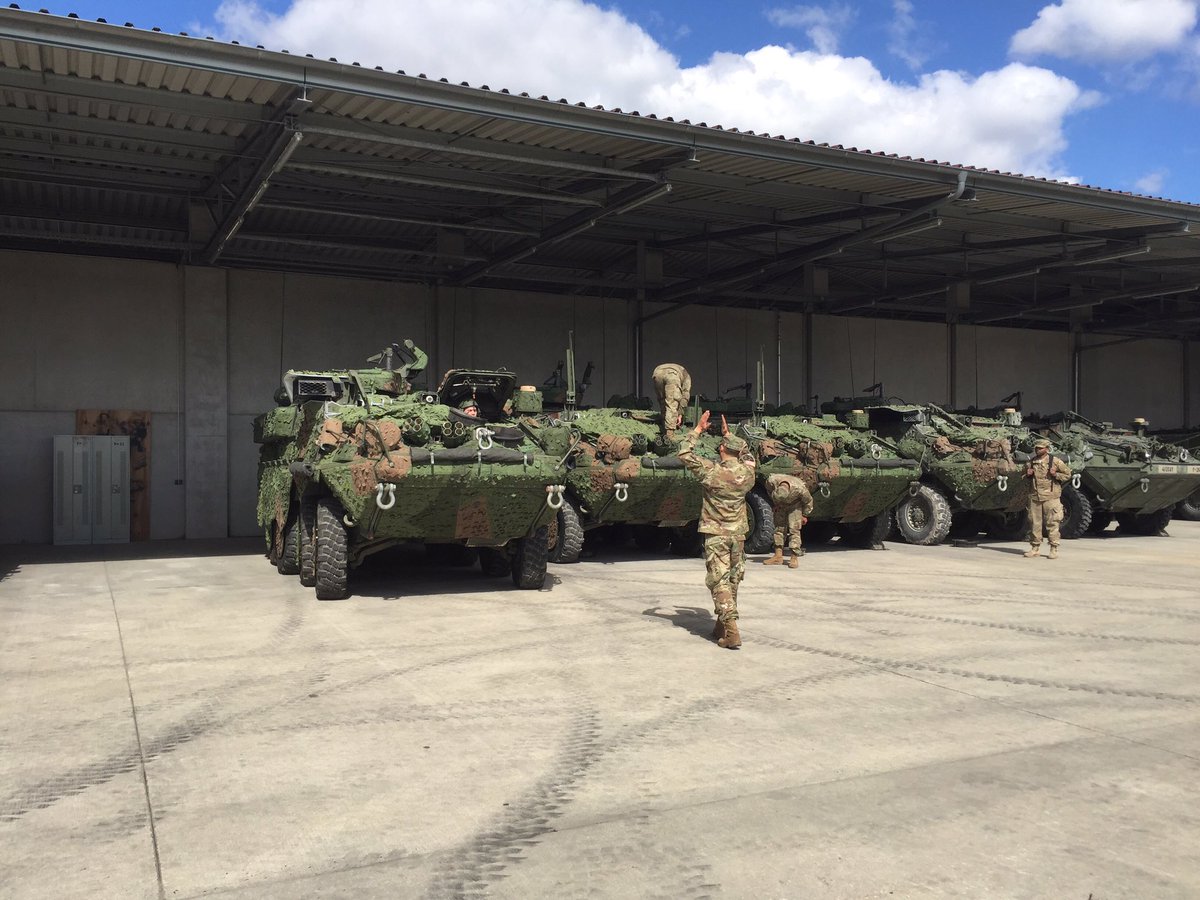
The U.S. Army´s 2nd Cavalry Regiment, stationed in Vilsek, Germany, is now evaluating Saab’s Barracuda Mobile Camouflage System (MCS) on their Stryker fighting vehicles. This is the first field evaluation of the MCS conducted by the U.S. Army.
That was reported by
The MCS, from Saab’s business unit Barracuda, provides constant protection to vehicles when stationary, while on the move, and during combat operations. MCS is now being evaluated by the U.S. Army’s 2nd Cavalry Regiment during its operational training in Hohenfels, Germany. This training and evaluation, conducted alongside other NATO Allies is in support of Operation Atlantic Resolve and the Enhanced Forward Presence missions.
“Mobile camouflage and signature management is more important now than at any time in the last 15 years, especially in the European theatre. The fact that our systems are now being evaluated by the U.S. Army in Europe is a testament to Saab’s dedication to support the soldier and continued cooperation with the U.S. military”, says Scott Caldwell, director of marketing and sales at Saab business unit Barracuda.
“Saab has been the leading provider of state-of-the-art camouflage to the U.S. Army for over 20 years and we are proud to continue supporting the U.S. Army with world-leading and technologically advanced systems“
The MCS provides wheeled-vehicle and combat vehicle platforms with multi-spectral signature management properties that enable the platform to blend in with environmental surroundings. It significantly reduces the probability of detection visually and by sensors such as Near Infrared (NIR), Short-wave Infrared (SWIR), Long-wave Infrared (LWIR), Mid-wave Infrared (MWIR) and radar. Each system is engineered to fit like a second skin to the vehicle and not interfere with operations, vehicle performance or maintenance.
“Current efforts to support U.S. Army Europe with MCS are ongoing and could eliminate field-improvised vehicle camouflage and negate the need to re-paint vehicles to match operational environments. The general feedback from U.S. Army soldiers was that the MCS successfully reduces the overall signature of their vehicles, is very durable and easy to use. They also stated they enjoyed working hand-in-hand with Saab to develop a signature management system given it helps to increase survivability”, says Scott Caldwell.