

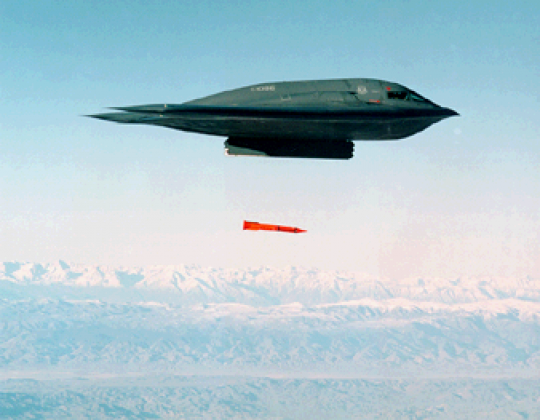
In collaboration with the U.S. Air Force Global Strike Command, NNSA conducted successful surveillance flight tests using joint test assemblies (JTA) of the B61-7 and B61-11 nuclear bombs earlier this month. Analysis and flight recorder data from the tests indicate that both were successful.
JTAs are mock weapons containing sensors and instrumentation that allow scientists and engineers from national laboratories to assess their performance. The assemblies contain no nuclear materials and are not capable of nuclear yield. These assemblies also include a flight recorder that stores bomb performance data for each test.
The primary objective of flight testing is to obtain reliability, accuracy, and performance data under operationally representative conditions. Such testing is part of the qualification process of current alterations and life extension programs for weapon systems. NNSA scientists and engineers use data from these tests in computer simulations developed by Sandia National Laboratories to evaluate the weapon systems’ reliability and to verify that they are functioning as designed.
“The B61 is a critical element of the U.S. nuclear triad and the extended deterrent,” said Brig. Gen. Michael Lutton, NNSA’s Principal Assistant Deputy Administrator for Military Application. “The recent surveillance flight tests demonstrate NNSA’s commitment to ensure all weapon systems are safe, secure, and effective.”
Flight testing is performed jointly by the applicable Department of Defense military service and NNSA. The B61-7 and B61-11 test assemblies were released from two separate B-2A Spirit stealth bombers from the 509th Bomber Wing of Whiteman Air Force Base in Missouri. The tests were conducted at the Tonopah Test Range in Nevada.
The B61 assemblies are jointly designed by Sandia and Los Alamos national laboratories. Their components are manufactured at the Kansas City National Security Campus and assembled at the Pantex Plant in Amarillo, Texas.