

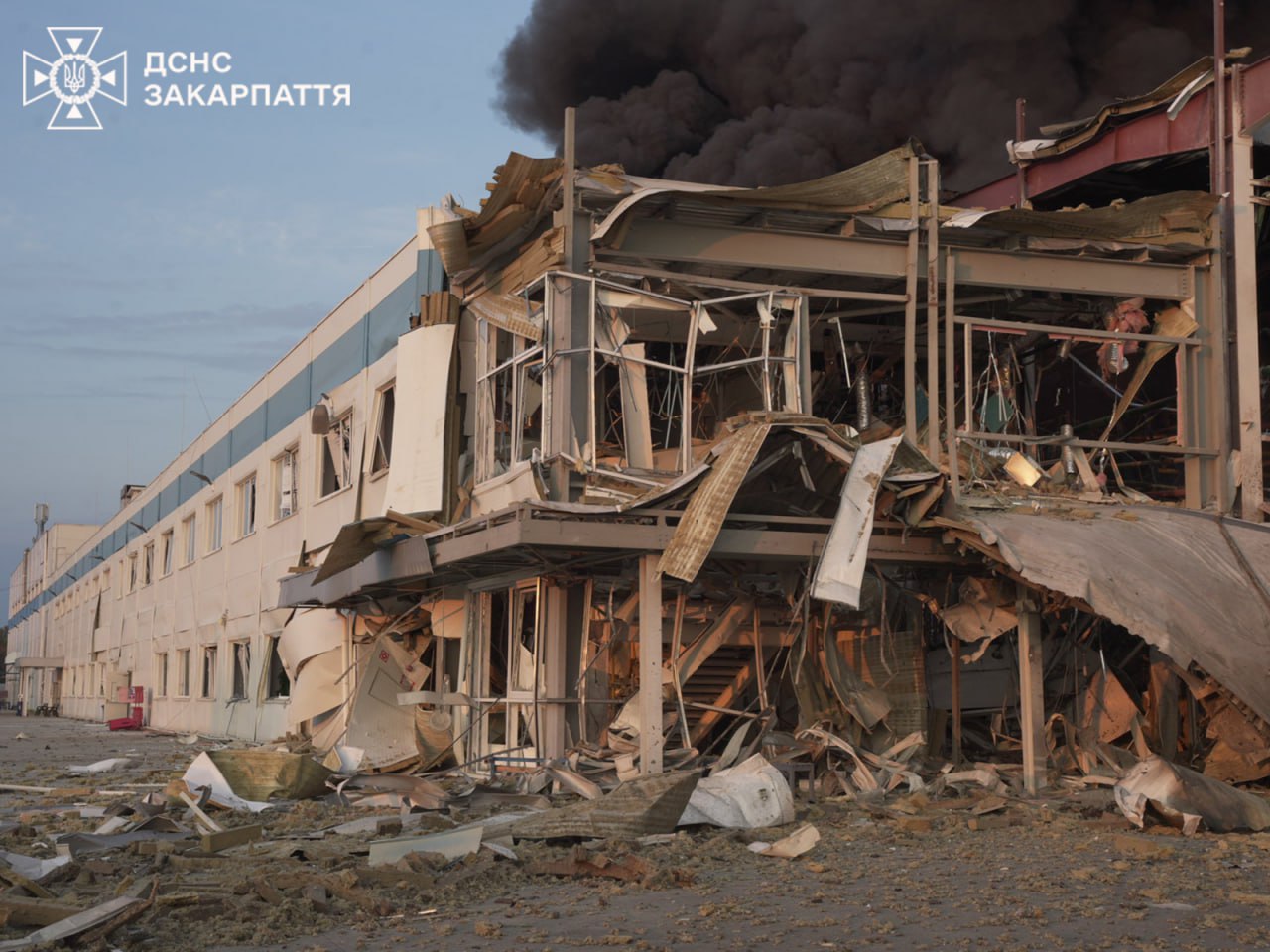
Russia carried out one of its largest air assaults of the summer in the early hours of August 21, launching hundreds of drones and dozens of missiles across Ukraine. The Ukrainian Air Force said more than 600 weapons were employed, including ballistic, cruise, and air-launched systems alongside swarms of attack drones.
According to Ukraine’s Air Force, the attack included four Kh-47M2 “Kinzhal” aero-ballistic missiles, two Iskander-M/KN-23 ballistic missiles, 19 Kh-101 cruise missiles, 14 Kalibr cruise missiles launched from the Black Sea, and 577 attack drones. Most of the drones were Iranian-designed Shaheds, repurposed by Russia as part of its campaign to overwhelm air defenses.
Ukrainian President Volodymyr Zelensky condemned the scale and intent of the strikes.
“This night the Russian army set one of its insane anti-records,” he said. “They struck civilian infrastructure, residential buildings, our people. They spent several cruise missiles against an American enterprise in Zakarpattia. It was an ordinary civilian business with American investment. They produced everyday things like coffee machines.”
The strike on western Ukraine underscored a recurring pattern of Russian attacks against foreign companies operating inside the country.
Ukraine’s Foreign Minister Andriy Sybiha wrote on X that one of the missiles struck “a large American electronics manufacturer in our westernmost region, causing serious damage and casualties. There is no military logic or necessity, only terror against people, business, and normal life in our country.”
Sybiha also recalled earlier Russian strikes against U.S. companies in Ukraine, including attacks on Boeing offices in Kyiv earlier this year. Other American businesses have also come under fire, among them a McDonald’s franchise.
The latest assault comes just months after President Donald Trump publicly vowed that Russian forces would not target U.S. assets in Ukraine. In May, Trump praised the signing of a bilateral agreement on rare earth minerals and natural resources, saying the deal would “protect” U.S. investments and the financial assistance Washington provides to Kyiv. Trump has repeatedly emphasized that Moscow would not dare strike American-linked facilities.
Despite those assurances, Ukraine has documented repeated cases of Russian missiles and drones hitting U.S.-connected enterprises. The overnight strike in Zakarpattia is the most recent example, and it has already drawn concern in Kyiv about Moscow’s willingness to escalate.
Ukraine’s air defense network reportedly intercepted the vast majority of the incoming drones and missiles, but officials acknowledged that the sheer scale of the assault made complete protection impossible. Across multiple regions, air raid sirens sounded for hours as residents sheltered underground. Damage was reported in several cities, and authorities confirmed casualties.
The Ukrainian government described the attack as an attempt to exhaust the country’s air defense resources by mixing high-speed ballistic missiles with large numbers of inexpensive drones. Analysts in Kyiv said the tactic is aimed at penetrating defensive layers and striking critical targets, including those tied to Western investment.
The repeated targeting of U.S. businesses in Ukraine could add pressure on Washington to respond.