

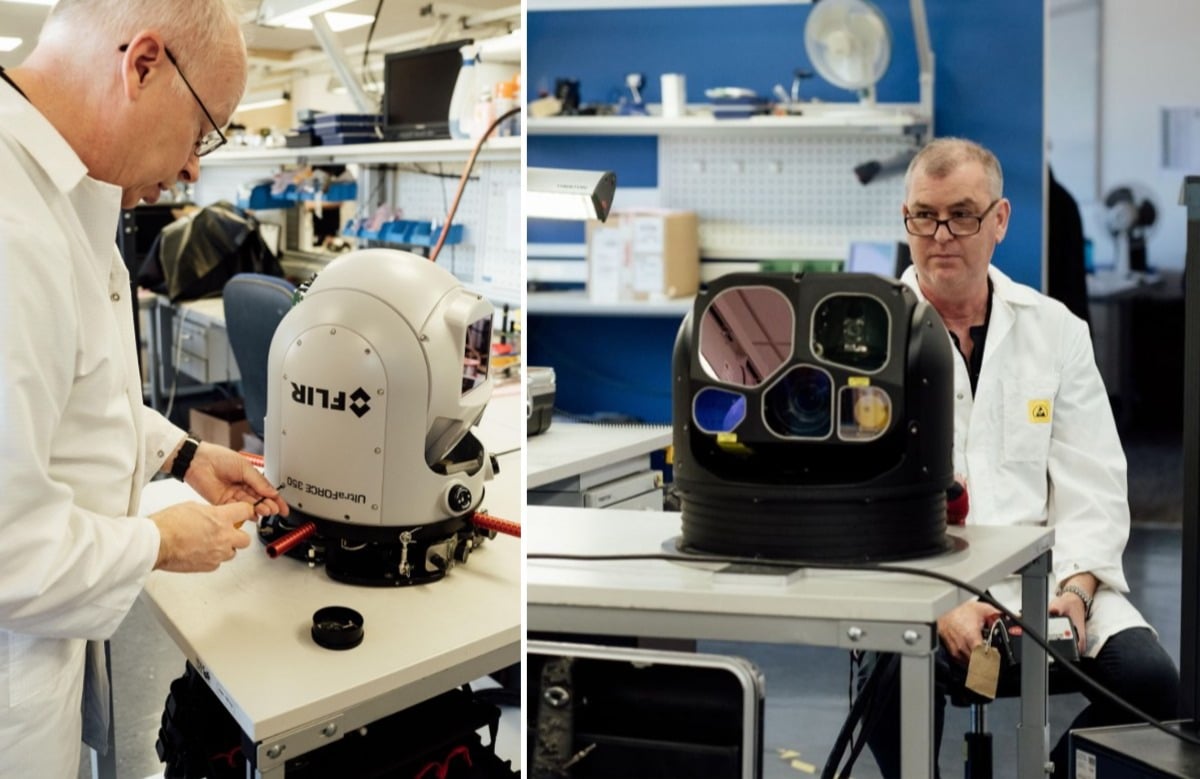
- Teledyne FLIR Defense will begin building Star SAFIRE thermal imaging systems at its West Malling, Kent facility for the UK Ministry of Defence.
- The West Malling site currently employs more than 60 skilled technicians and has supplied airborne cameras to UK police for more than 30 years.
Teledyne FLIR Defense announced it will begin assembling its Star SAFIRE line of thermal imaging camera systems at its facility in West Malling, Kent, after more than two years of planning and formal approval to produce the advanced surveillance systems locally for the UK Ministry of Defence.
Star SAFIRE is a family of gimbal-mounted camera turrets, meaning the system houses its sensors inside a stabilized, rotating ball mounted beneath an aircraft’s fuselage, letting the camera stay locked on a target and produce a steady image even while the helicopter or fixed-wing aircraft carrying it maneuvers or vibrates. Each turret combines thermal imaging, which detects heat rather than visible light and lets operators spot people or vehicles through darkness, smoke, or light fog, alongside high-definition color cameras and, on some variants, a laser rangefinder or designator used to precisely measure distance to a target or mark it for a guided weapon. Teledyne FLIR has described the Star SAFIRE 380-HLD specifically as the world’s most widely deployed single system of its kind for intelligence, surveillance, reconnaissance, and targeting missions, and the broader Star SAFIRE product line has flown on more than 35 different aircraft types across military, police, and search and rescue operators worldwide.
Craig Cooper, Director and Site Lead at Teledyne FLIR Defense, framed the West Malling production decision as a direct response to political pressure Britain has placed on defense manufacturers to invest domestically.
“We’ve seen growing demand in the UK, from the Defence Secretary on down, to promote greater investment in Britain’s industrial base, as well as in Europe,” Cooper said. “We’re proud to respond by manufacturing our world-renowned Star SAFIRE systems in West Malling, which has long been the airborne centre of excellence for Europe and a major regional service centre providing operational flexibility for customers in the UK, Europe, and beyond.”
That pressure traces back to two overlapping policy pushes reshaping how European governments buy military equipment. The UK Ministry of Defence’s Defence Investment Plan sets explicit expectations around workforce development and job creation tied to defense spending, essentially asking contractors to show that British defense pounds translate into British jobs and manufacturing capacity rather than simply flowing to factories overseas. The broader European Defense Agenda applies similar logic across the continent, part of a wider shift among European governments toward favoring domestic and regional production over importing finished military hardware, a trend that has accelerated as European nations rebuild stockpiles and modernize equipment amid heightened concern over Russian aggression.
West Malling is not a new site for Teledyne FLIR’s UK operations, and the decision to locate Star SAFIRE production there builds on infrastructure the company has operated for decades rather than starting from scratch. The facility serves as the hub for Teledyne FLIR UK’s European Airborne Surveillance business and employs more than 60 skilled technicians and support staff, and for more than 30 years the company has held accredited supplier status providing airborne observation cameras to the UK National Police Air Service, maintaining active Maintenance Service Agreements with that agency while also supporting the UK Search and Rescue helicopter fleet operated on behalf of the Maritime and Coastguard Agency. That established civilian and law enforcement customer base gives Teledyne FLIR a domestic manufacturing and support foundation that predates this specific defense production decision by many years, a track record the company is now leveraging to expand into building the actual hardware locally rather than only servicing systems assembled elsewhere.
Teledyne FLIR has continued refining the Star SAFIRE product line even as it moves production to the UK. The company unveiled an International Traffic in Arms Regulations-free version of the system, called the Ultraforce 380-HDc, at a recent Farnborough International Airshow, a variant built with substantially the same capability as the export-controlled American version but designed specifically for defense forces and security agencies that cannot obtain a waiver from U.S. arms export rules, widening the pool of international customers who can access the technology without navigating American export restrictions.
The company has also introduced newer 380X electronics packages across its camera lineup, adding features like automated moving target detection and multi-tile video management that let operators track several points of interest simultaneously rather than manually panning between targets one at a time.
Teledyne FLIR’s announcement extends beyond this single UK production line as well, with the company confirming it is separately working on plans to assemble surveillance systems for customers across continental Europe in direct response to the European Defense Industrial Strategy, the European Union’s own framework for strengthening domestic defense manufacturing capacity across member states. Taken together, these moves describe a company recalibrating its production footprint to match a genuine shift in how European governments now expect their defense suppliers to operate, prioritizing companies willing to build critical surveillance and targeting hardware on the same continent where that hardware will ultimately fly, rather than shipping finished systems in from factories thousands of miles away.