

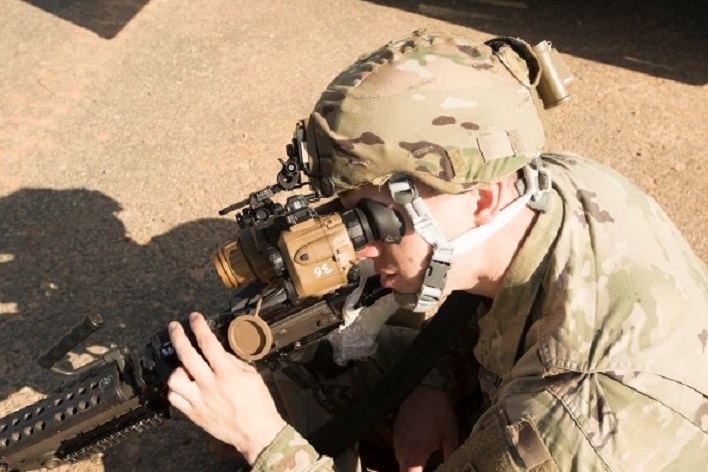
The U.S. Army is moving closer to creating serial-modification of a next-generation weapon sight able to quickly locate and identify targets, especially during nighttime operations.
According to the report by Mr. Mike Shelton, Airborne and Special Operations Test Directorate, U.S. Army Operational Test Command Public Affairs, U.S. Army is conducting tests of new Family of Weapons Sights-Individual (FWS-I) as a part of program which modernizes direct fire optics for small arms platforms, including medium and heavy machine gun systems.
In today’s battlefield environment, it is critical for soldiers to be able to quickly locate and identify targets, especially during nighttime operations or when visibility is compromised.
The FWS-I program will provide Soldiers with thermal enablers/sights for the individual, crew served and sniper weapons. They give Soldiers the capability to see deep into the battlefield, increase surveillance and target acquisition range, and penetrate day or night obscurants. Also, next-generation weapon sight eliminates the need to switch between night vision goggles and weapon mounted thermal sights when acquiring or engaging threats, improving soldier safety and mission effectiveness.
In the new phase of the FWS-I’s testing, paratroopers with the 82nd Airborne Division began working with the Airborne and Special Operations Test Directorate (ABNSOTD) on the FWS-I, using tactics the parachutists are most renowned for.
“American paratroopers are infamous for attacking when and where least expected and always at night,” said Mike Tracy, branch chief of the Personnel Special Operations Test Branch (POSTB).
“Conducting forced entry operations during daylight hours leaves paratroopers exposed to enemy ground fire and counterattack during airborne assault,” Tracy added. “That’s why mastering night vision devices is a critical skill for Army paratroopers and vital to mission accomplishment.”
The core question for military equipment employed by Army paratroopers is “can the system survive airborne insertion?”
“Individual paratroopers as well as vehicles and cargo delivery systems are bristling with technology and technology than can be frail at times,” Tracy said.
“To ensure these systems are both suitable and effective for issue to airborne forces often requires a technical approach,” Tracy added. “To properly test performance parameters of the FWS-I, the ABNSOTD decided to think outside the box while showcasing internal test capabilities.”

While all other facets of a standard airborne operational test remained in place, Soldiers from the 5th Squadron, 73rd Calvary Regiment, 3rd Brigade Combat Team conducted nearly 50 static line airborne test trials with the FWS-I, jumping two separate rigging configurations. After the airborne operations, the Soldiers performed function checks on the systems and confirmed bore sighting was maintained.
While soldiers participating in testing were largely unfamiliar with the process, Spc. Patrick Garrity of Bethel, Conn., was impressed with being part of the test. “Participating in this test showed me the Army’s efforts to increase soldier survivability and lethality,” he said.
“Having Soldiers involved in testing helps catch the little things that can be addressed early in the testing process and save both money and time prior to fielding,” added Garrity.
The FWS-I test also exposed many of the veteran paratroopers to conducting over-the-ramp operations (OTR) for the first time. The aircraft used as the test’s jump platform was the CASA-212 Aviocar turboprop-powered medium aircraft.
“I received more airborne training jumping from the CASA and received instruction on the Army’s newest weapons sights,” said Spc. Ethan Mabry of Big Rapids, Mich.
Encouraged by the reduced size and weight of the FWS-I, he said, “The FWS-I is durable and small enough to pack.”
To help the Army test the FWS-I, Mabry and his fellow Cavalry Scouts conducted over 40 static line iterations during daylight conditions on Fort Bragg’s Sicily Drop Zone over two weeks.
During post drop operations, jumpers assembled for accountability and to ensure all sights were fully mission capable by performing a system functions check following the procedures learned during New Equipment Training.
The sight mated to the host weapon was then evaluated for shock induced bore sight reticle movement which would signal a potential loss of the weapon zero.

The new sight system provides the sharpest image quality in a smaller and lighter package, allowing soldiers to identify and engage targets day or night, and in smoke, dust, haze, or fog.
New Integrated thermal targeting solution provides dismounted soldiers with a solution that allows them to navigate and rapidly acquire and engage targets in all light levels and conditions. With both units integrated, weapon sight imagery and aim point can instantly transmit into the goggle – for a tactical edge during close combat missions.