

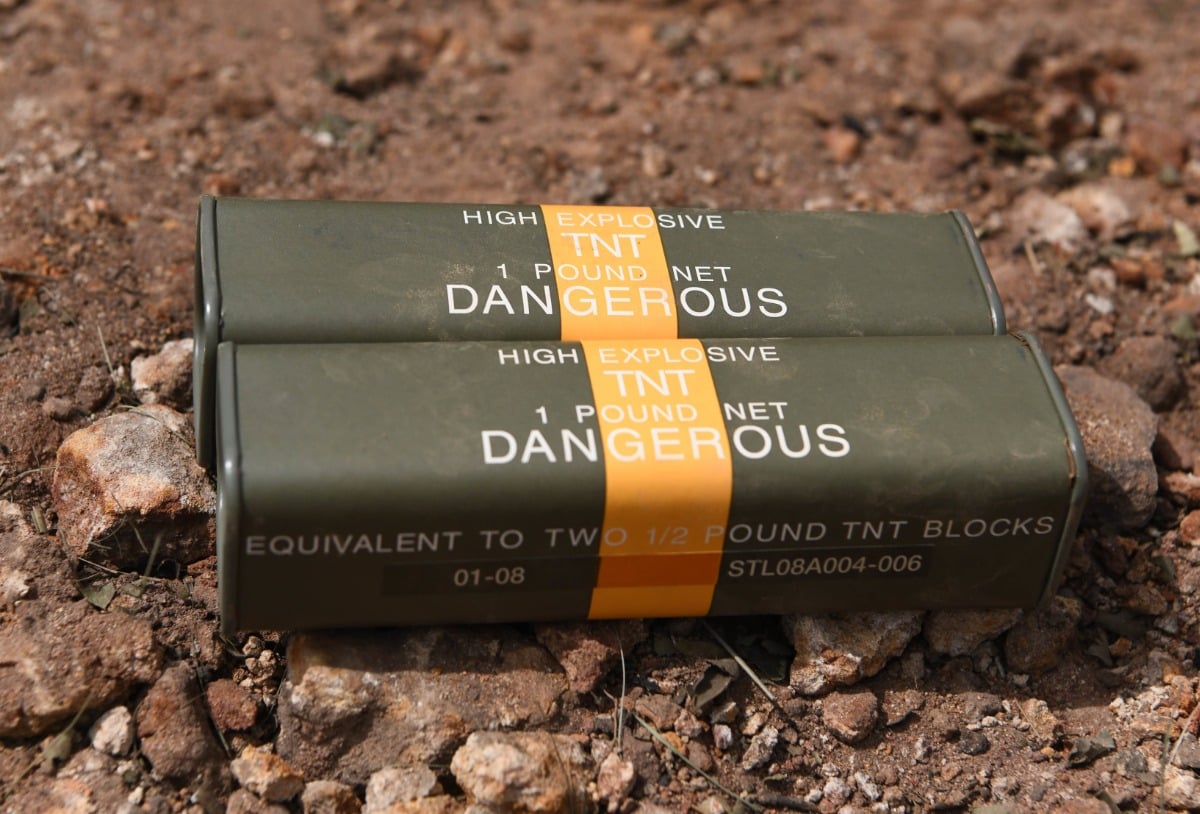
- According to a June 4 contract notice, the Army awarded Repkon USA a $77.9 million modification, bringing total TNT facility funding to $404 million.
- The TNT production facility in Graham, Kentucky will be America's first domestic source of the explosive since the 1980s, with completion set for February 2029.
The United States has not produced its own TNT since the 1980s, relying entirely on overseas allies to supply the explosive that fills its artillery shells, bombs, and grenades. That four-decade gap in domestic production is now being closed, and according to a June 4 contract notice, the Army awarded Repkon USA a $77.9 million modification to deepen its financial commitment to one of the Army’s more closely watched munitions infrastructure projects.
The modification brings the total cumulative value of the TNT facility contract to $404 million, with work continuing at Graham, a small community in Muhlenberg County in western Kentucky, approximately 219 km (136 miles) southwest of Louisville. The modification pushes the estimated completion date to February 15, 2029. The overall program ceiling for the project remains $435 million, established when the contract was first awarded in November 2024.
Repkon USA is the American subsidiary of Repkon, a Turkish defense and precision manufacturing firm that specializes in metal forming technologies including flowforming, cold rotary forging, and hot forging, with products serving the defense, aviation, and space sectors. The company’s selection to build America’s first domestic TNT production facility in roughly four decades reflects both the specialized nature of energetics manufacturing and the increasingly international character of U.S. defense industrial base investments. Prior to this award, Repkon had already signed contracts to supply munitions and design explosives for the U.S. military, and separately agreed to set up an artillery shell production plant in Texas, making the Kentucky TNT facility one piece of a broader American manufacturing footprint the Turkish firm is building.
TNT, trinitrotoluene, is not a single-use explosive. It serves as the primary explosive fill for 155 mm artillery shells and is essential for ammunition, bombs, and grenades across multiple military applications, making it one of the most foundational materials in the entire munitions supply chain. U.S. 155 mm production has depended on foreign sources for TNT used in key shell types, meaning that every round filled with the compound and fired by American forces, supplied to Ukraine, or transferred to any other ally has relied on imported material for that critical component. A country that cannot produce its own TNT cannot independently control the supply chain for the artillery rounds that form the backbone of its ground combat capability, and the United States has been in exactly that position since the last domestic TNT plant closed in the 1980s.
Army acquisition chief Doug Bush said the award “will reestablish TNT production swiftly and at scale on U.S. soil for the first time in decades,” adding that “reshoring TNT production gives us the ability to control and secure our supply chain for this vital component, especially in an era of increasing global challenges.” Bush had told Defense News earlier in 2024 that once a contract was in place the Army planned to build the facility within 48 months, a timeline broadly consistent with the February 2029 completion date now attached to the modified contract.
Major General John Reim, the Army’s joint program executive officer for armaments and ammunition, stated that the contract returns a capability the United States had not held since 1986, and framed the investment explicitly within the Army’s Joint Program Executive Office Armaments and Ammunition’s mission to patch potential supply chain vulnerabilities. The vulnerability being patched is not hypothetical. The war in Ukraine exposed in dramatic and public fashion the degree to which Western nations, including the United States, had allowed their munitions production infrastructure to atrophy during three decades of post-Cold War optimism.
Artillery shell production rates that seemed adequate for peacetime deterrence proved completely insufficient when a land war in Europe began consuming shells at rates not seen since World War II, and TNT supply was one of the materials the Army identified as important to securing the munitions supply chain.