

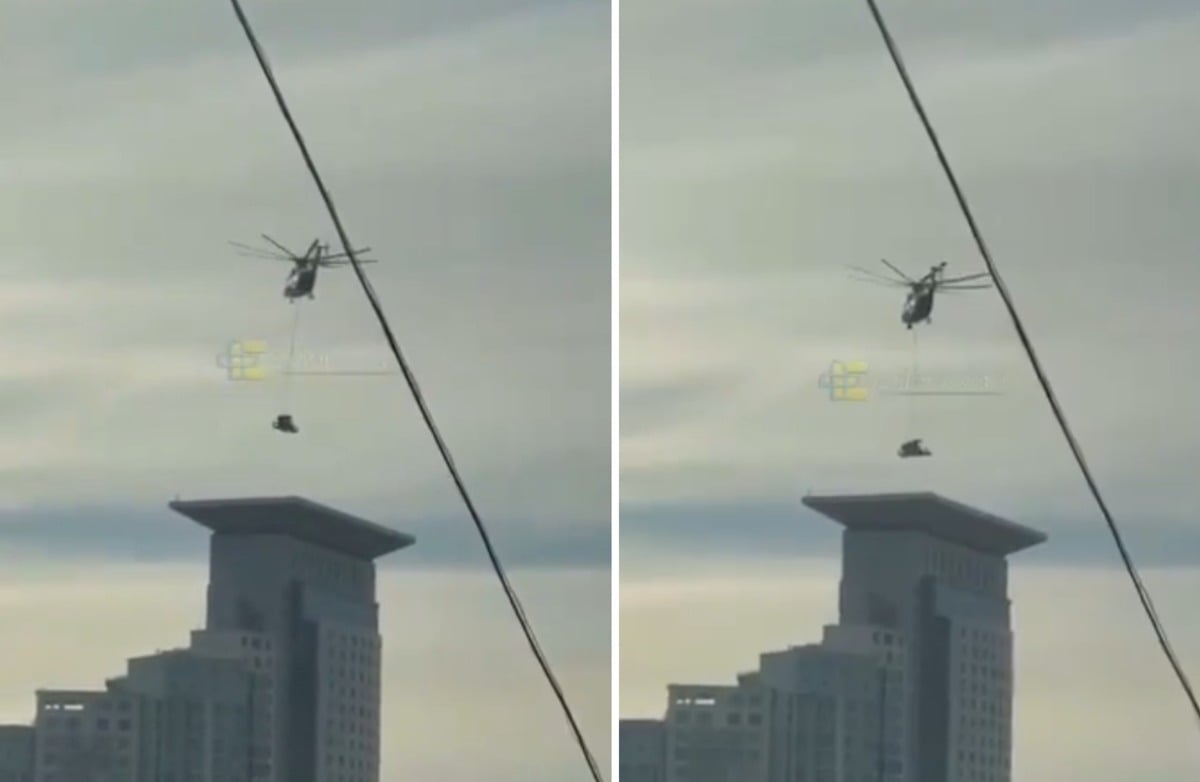
- OSINT analyst Zeldamic geolocated a Pantsir-SMD-E deployment by Mi-26 helicopter onto a building in Moscow's Sokolniki District at coordinates 55.78822, 37.677713.
- At least four Pantsir systems are now confirmed on Moscow rooftops, with the SMD-E variant carrying up to 48 TKB-1055 anti-drone missiles per battery.
A heavy transport helicopter lowered an anti-drone missile system onto the roof of a high-rise building in Moscow’s Sokolniki District, adding another node to a defensive network that Russia has been rapidly expanding across the capital’s skyline as Ukrainian drones have penetrated deeper and hit targets that Russian air defenses were previously assumed to protect.
The deployment, geolocated by OSINT analyst Zeldamic to coordinates 55.78822, 37.677713 in the Sokolniki District, follows a series of similar installations that have placed at least four Pantsir air defense systems on rooftops across Moscow since late May 2026.
The system being airlifted in the footage is the Pantsir-SMD-E, the latest variant of Russia’s Pantsir family of short-range air defense systems and a significant departure from the original Pantsir-S1 in both design philosophy and intended mission. Where the Pantsir-S1, which has appeared on Moscow rooftops since early 2023, combines a radar, two 30 mm automatic cannons, and a battery of surface-to-air missiles on a single combat module, the SMD-E strips out the cannons entirely and replaces them with a much larger missile loadout optimized for the specific challenge of intercepting drones in large numbers. A single Pantsir-SMD-E battery can carry up to 48 TKB-1055 mini-missiles or up to 12 of the larger 57E6-E missiles, or any combination of the two, giving it dramatically more magazine depth against drone swarms than the original Pantsir-S1, and the system can simultaneously track 40 targets and engage threats traveling at speeds up to 1,000 meters per second.
The helicopter performing the airlift is the Mil Mi-26T, the world’s largest production helicopter and the only rotorcraft capable of lifting a Pantsir combat module to rooftop height on a tall building without the structural support of a crane. One of the earlier deployments in the same campaign involved a Mi-26T helicopter lowering a Pantsir-SMD-E system onto the roof of the 42-story Nordstar Tower business center on Begovaya Street in Moscow’s Northern Administrative District, with footage of that installation published on May 27, 2026. The Sokolniki District deployment confirmed by Zeldamic represents a continuation of the same operational pattern, extending the rooftop missile network from Moscow’s commercial north toward the district east of the city center that takes its name from the historic Sokolniki Park, one of Moscow’s largest green spaces.

With the newly spotted system at the Nordstar business center and additional deployments identified since, at least four Pantsir systems are now known to be deployed on rooftops in Moscow, according to Defence Express, the Ukrainian defense analysis outlet that has been tracking the installations. The confirmed rooftop locations include the Nordstar Tower, a commercial office building southeast of the Kremlin, the headquarters of Russia’s Ministry of Internal Affairs north of the city center, and now the Sokolniki District building. Military analysts have strongly condemned the deployment of heavy weaponry onto non-military urban structures, with Defense Express pointing out that mounting active air defense assets on top of standard civilian office blocks constitutes a direct violation of international humanitarian law.
An air defense missile system operating from a civilian rooftop places that building within the category of military objectives under the laws of armed conflict, potentially exposing its occupants and the surrounding neighborhood to legal targeting by an adversary. Russia has not addressed that legal dimension publicly, and the deployments have continued regardless of the criticism. The operational logic driving them is straightforward: a rooftop perch provides a safer firing location, extended reaction time, and a much wider range of firing angles, while ensuring a clear line of sight for the radar, according to analysis published by The War Zone. A missile system on the ground in central Moscow is hemmed in by surrounding buildings, limited in its radar coverage, and vulnerable to masking by terrain that drones can exploit. A system on the fortieth floor of a skyscraper sees the approach geometry that matters.
The Pantsir-SMD-E’s two missile types address the threat spectrum that Ukraine’s drone campaign presents at different ranges. The system is equipped with standard 95Ya6 missiles with a target engagement range of up to 20 km (12 miles), and compact TKB-1055 missiles designed to intercept small targets at ranges of up to 7 km (4 miles). The TKB-1055 is the weapon specifically designed for the small, low-observable commercial-derivative drones that Ukraine has been launching against Moscow in growing numbers, drones that are cheap enough to field in quantity but small enough that larger interceptor missiles represent a poor economic exchange. Rostec confirmed in June 2025 that the TKB-1055 mini-missiles had completed state testing and entered serial production, with the company stating that “one Pantsir-SMD-E can destroy dozens of unmanned aerial vehicles.”
The rooftop deployment strategy first introduced in January 2023, when Russia began placing Pantsir-S1 systems on elevated structures including the Russian Defense Ministry headquarters on Frunzenskaya Embankment, has expanded significantly since then, with military analysts estimating that more than 100 Pantsir-S1 and related systems have been integrated into Moscow’s defensive ring, including installations on specialized towers, landfill mounds, government sites, and civilian infrastructure, and more than 40 Pantsir systems were reportedly repositioned from other Russian regions to reinforce the Moscow area in 2025 alone.
The technical evolution of the Pantsir family itself reflects the lessons Russia has absorbed from the drone threat. When Pantsir-S1 systems first appeared on Moscow rooftops in 2023, they were the same configuration used in Syria, where their performance against small drones had been criticized as inadequate. The SMD-E variant represents a fundamentally different design philosophy: pure missile defense optimized for mass drone interception, with a magazine that can absorb a sustained swarm attack rather than running dry after twelve shots.