

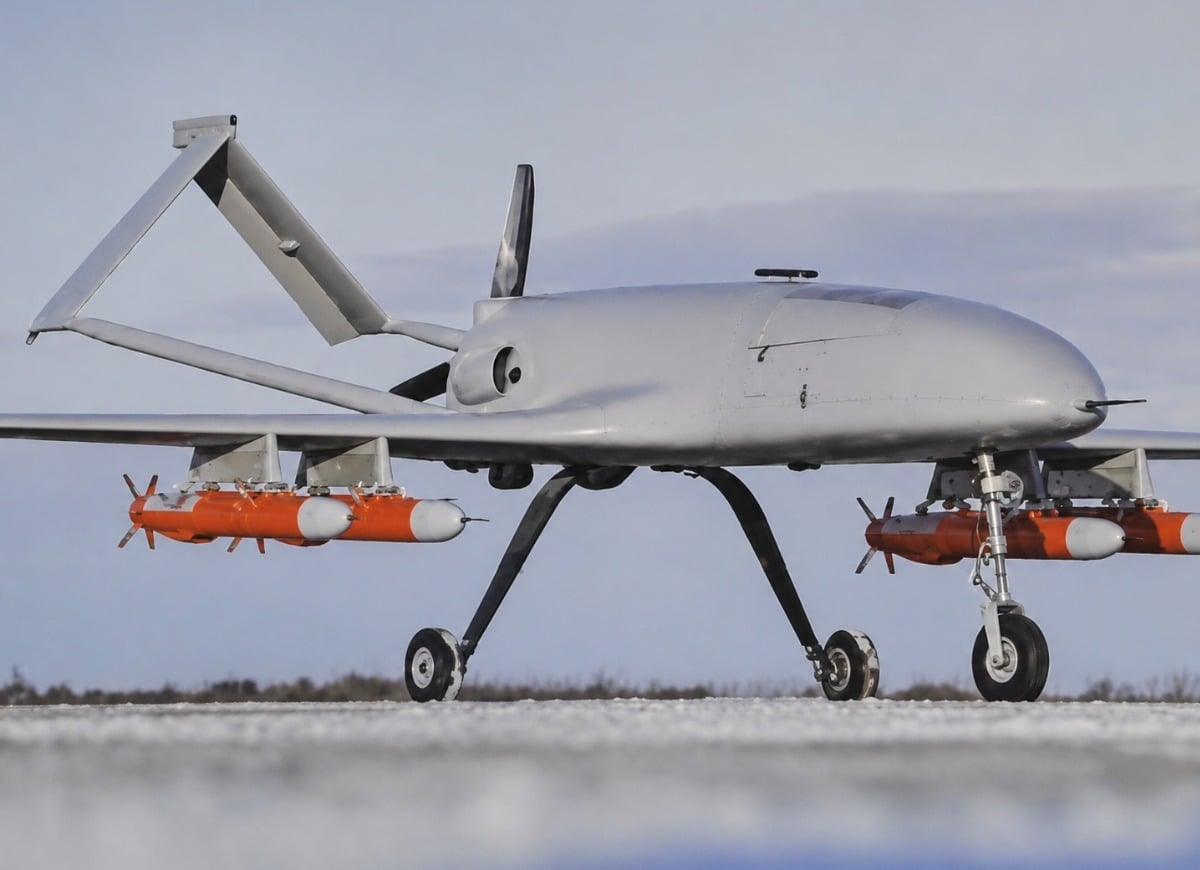
- Oboronka reported that Ukraine displayed a missile-armed An-196 Liutyi drone carrying four missiles at the Farnborough International Airshow.
- The missiles have a declared range of up to 200 kilometers (124 miles) and a flight speed of about 500 kilometers per hour (311 miles per hour).
Ukraine has turned its signature long-range kamikaze drone into something considerably more dangerous: a standoff strike platform. The outlet Oboronka reported that its correspondent, present at the Farnborough International Airshow in the United Kingdom, saw an An-196 Liutyi drone displayed on a Ukrainian stand carrying four missiles mounted beneath its airframe, a configuration that would let the drone deliver standoff strikes from range rather than detonating itself directly against a single target.
The Liutyi, whose name translates from Ukrainian as “fierce” or “furious,” has served since 2022 as Ukraine’s primary long-range one-way attack drone, a category of weapon designed to fly deep into enemy territory and destroy itself on impact with the target rather than returning to base. Developed by the state defense conglomerate Ukroboronprom in partnership with the Antonov design bureau, the fixed-wing drone weighs between 250 and 300 kilograms (550 and 660 pounds), carries a warhead of roughly 50 to 75 kilograms (110 to 165 pounds), and has repeatedly demonstrated a range extending well past 1,000 kilometers (621 miles), with confirmed strikes reaching targets as far as 1,700 kilometers (1,056 miles) inside Russian territory. Ukraine’s 14th Regiment of Unmanned Aerial Systems has used the platform extensively against Russian oil refineries and fuel infrastructure, a campaign that Re:Russia, a research group tracking the war, credited with accounting for up to 80 percent of Ukraine’s successful deep strikes on Russian targets in 2024.
Arming that same airframe with four separate missiles rather than a single fixed warhead fundamentally changes what the Liutyi can accomplish on a single mission. According to Oboronka’s reporting, the missiles carry a declared strike range of up to 200 kilometers (124 miles) and fly at speeds around 500 kilometers per hour (311 miles per hour), meaning the Liutyi itself no longer has to reach the final target directly. Instead, the drone could release its missiles from well outside the range of many short-range air defense systems, letting each individual missile close the final distance while the drone itself, or whatever remains of its fuel and structure, could theoretically survive the mission rather than being consumed in a single detonation the way the standard kamikaze configuration requires.
The Liutyi shown at Farnborough did not appear to be fitted with its own electro-optical targeting system, the camera and sensor package that would normally let a human operator visually identify and guide a weapon onto a specific target in real time. Without that onboard guidance capability, the missiles the drone carries are most likely designed to strike fixed, pre-programmed coordinates rather than targets an operator selects and tracks during the mission itself, a limitation that suits striking stationary infrastructure like fuel depots or industrial facilities far better than it would suit engaging a moving target such as a vehicle or a ship.
This missile-armed variant extends a pattern of continuous upgrades Ukraine has applied to the Liutyi platform since its combat debut, moving the drone from a straightforward, single-warhead attack weapon toward something closer to a flexible strike system.
None of this confirms exactly when, or whether, this missile-armed Liutyi variant will actually reach frontline units, and Ukrainian officials have not publicly detailed a production timeline or specified which unit would field the system first. What the Farnborough display does confirm is a clear signal of intent: Ukraine’s defense industry is not content to keep building faster or longer-range versions of the same one-shot kamikaze drone that made the Liutyi famous, but is actively working to turn that same proven, mass-produced airframe into a reusable delivery platform capable of striking multiple targets in a single mission, a shift that, if it reaches real production, could meaningfully change how much damage a single Ukrainian sortie can inflict deep inside Russian territory.