

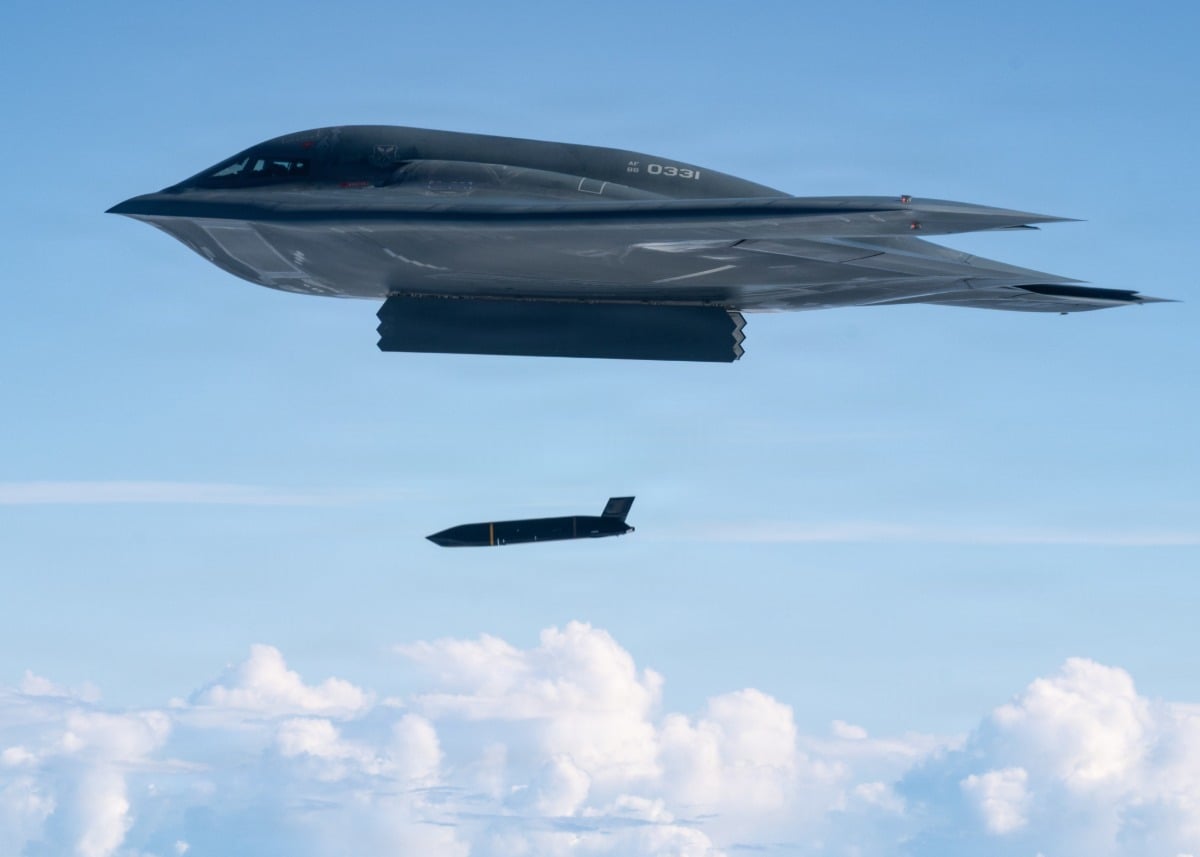
- The Air Force increased planned JASSM and LRASM missile production from 11,200 to 16,450 units in an amended notice.
- The sole-source production covers JASSM Lots 27 through 33 and LRASM Lots 13 through 19, built exclusively by Lockheed Martin.
The U.S. Air Force has told its biggest missile maker to build thousands more long-range weapons than it planned even a week ago, and the jump says a lot about how worried the Pentagon has become about running out of precision missiles in a real war. An amended government notice posted Wednesday raised the planned production quantity for the Joint Air-to-Surface Standoff Missile and the Long Range Anti-Ship Missile from 11,200 to 16,450 units, a roughly 47 percent increase over a notice that had itself only been published five days earlier, on July 10.
The two missiles at the center of this expansion share a common design lineage but serve different purposes on the battlefield. The Joint Air-to-Surface Standoff Missile, known as JASSM, is a stealthy cruise missile the Air Force and Navy launch from aircraft to strike heavily defended or high-value targets from what the military calls standoff range, meaning far enough away that the launching aircraft can avoid flying directly into an enemy’s air defenses. The Long Range Anti-Ship Missile, or LRASM, is a variant of that same missile family built specifically to sink enemy warships rather than strike targets on land, and both missiles are manufactured exclusively by Lockheed Martin, the Pentagon’s largest weapons contractor.
The Air Force’s Armaments Directorate, the unit within Air Force Materiel Command responsible for managing precision munitions programs, said the expanded quantities will cover JASSM production Lots 27 through 33 and LRASM Lots 13 through 19, with deliveries spread across a five to seven year window and expected to begin roughly 27 months after the government finalizes a contract. That lag matters because it reflects how long it actually takes to convert a production commitment into missiles sitting in a bunker ready for use, a timeline driven by the specialized manufacturing lines, guidance systems, and rocket motors that go into a modern cruise missile rather than something a factory can simply speed up by adding a second shift.
A separate government notice, also updated Wednesday, raised a different, earlier batch of JASSM and LRASM production, covering Lots 22 through 26 and Lots 9 through 12, from 5,510 units to 6,645 units, meaning the Pentagon has now moved to expand production across two overlapping sets of lot ranges within the same week. Taken together, the two notices point to a defense industrial base scrambling to rebuild missile stockpiles that have been strained by years of steady combat use and by continued support flowing to Ukraine, a drawdown that became especially visible during Operation Epic Fury, the American military campaign against Iran earlier this year. A May report from the Center for Strategic and International Studies, a Washington-based think tank that tracks defense supply chains, estimated the Pentagon expended more than 1,100 JASSMs during 39 days of airstrikes in that campaign alone, a consumption rate that would take years for existing production lines to replace at their prior pace.
The notice states the work will go sole source to two Lockheed Martin divisions, Lockheed Martin Missiles and Fire Control in Orlando, Florida, and Lockheed Martin Rotary and Mission Systems in Mount Laurel, New Jersey, citing a federal acquisition rule that allows the government to bypass competition when only one contractor is capable of meeting a requirement. The justification leans heavily on the fact that Lockheed Martin’s Orlando facility already runs the only production complex capable of building both missile families at full rate, complete with an established supply chain, experienced engineering staff, and manufacturing equipment purpose-built for these two systems, while Lockheed’s New Jersey facility holds exclusive access to specialized mission planning software neither the government nor any competitor currently possesses in a form that could be handed to another company. The notice also states plainly that no government-owned technical data package exists that could let a rival manufacturer step in, closing off what would otherwise be the government’s usual fallback option for opening a program to competition.
Lockheed Martin has spent the past several years positioning itself to meet exactly this kind of demand surge. The company told Naval News it has invested more than $7 billion since 2017 to expand capacity across its priority weapons programs, including roughly $2 billion specifically dedicated to accelerating munitions production, investments in facilities, tooling, suppliers, and workforce the company says are now letting it produce at higher rates and greater scale. That spending followed a 2024 contract worth $3.2 billion that set JASSM and LRASM production on a path running through July 2032, and Lockheed Martin CEO Jim Taiclet told investors in April that new multiyear framework agreements signed with the Department of War are expected to support production rate increases of three to four times current levels across its priority missile programs.
National Security Journal reported in August that a former intelligence officer warned a separate $7.8 billion JASSM and LRASM deal, though a meaningful step forward, likely would not be enough to sustain a prolonged conflict with a major power like China, given how quickly modern precision munitions get consumed once a real air campaign begins. The Pentagon has also started looking beyond its traditional missile manufacturers entirely for help closing that gap. General Motors and Lockheed Martin disclosed in June that they were exploring a partnership that would have GM Defense manufacture missile subcomponents, including machined housings, structural assemblies, and electronic enclosures, part of a broader push President Trump accelerated on June 11 when he invoked the Defense Production Act specifically to address bottlenecks in solid rocket motors, igniters, and guidance systems across the munitions supply chain.