

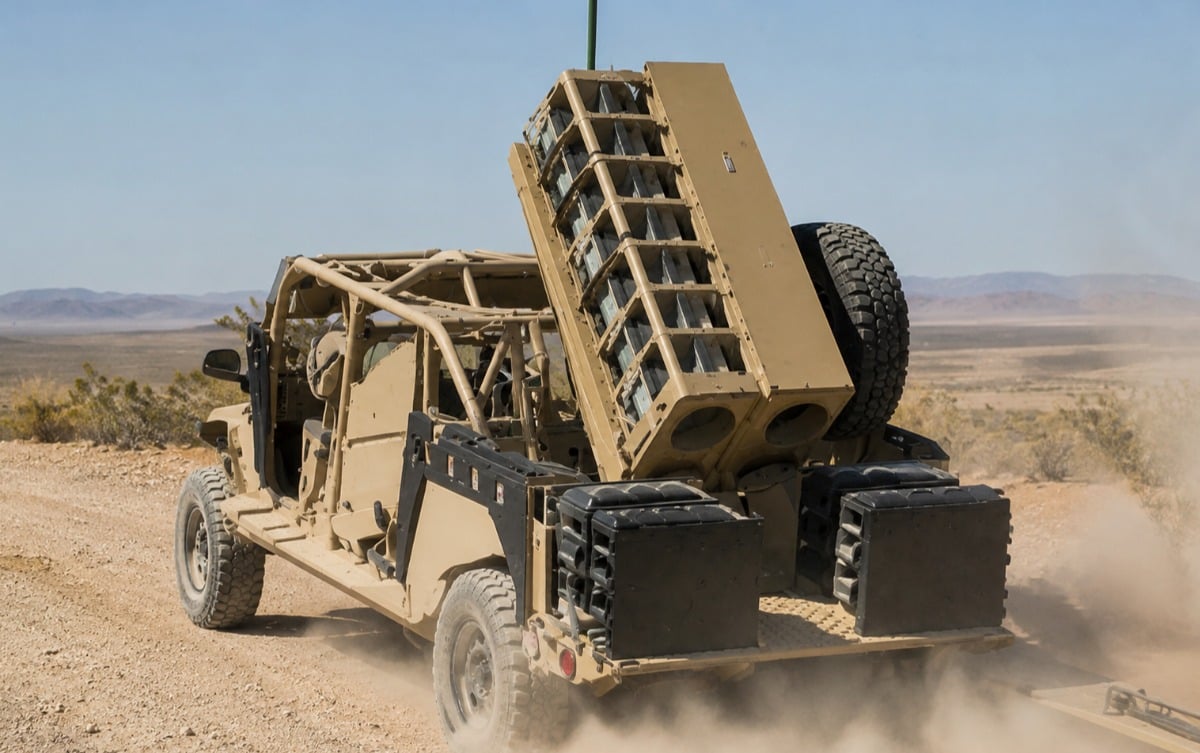
- Auriga Space and the U.S. Army's DEVCOM Armaments Center signed a three-year research agreement to develop electromagnetic accelerators for counter-drone defense.
- Auriga plans the first outdoor flight test of its Hermes electromagnetic launch platform this summer, following existing Department of War contracts.
The U.S. Army has agreed to help test a weapon that fires interceptors using magnets instead of gunpowder or rocket fuel, betting that ditching traditional propulsion might finally solve a math problem that has been quietly draining America’s missile stockpiles.
Auriga Space, a California company building electromagnetic launch technology, and the Army’s Combat Capabilities Development Command Armaments Center, known as DEVCOM AC, signed a three-year research partnership called a Cooperative Research and Development Agreement, or CRADA, to explore whether electromagnetic accelerators can offer a cheaper, faster-firing alternative to conventional missile interceptors for shooting down drones. A CRADA is essentially a formal research handshake between a company and a government lab, letting both sides share data and technical expertise without any money changing hands or a product actually being purchased, a structure the Army frequently uses to test emerging technology before committing real procurement dollars to it.
Drone swarms built from cheap, mass-produced aircraft can now overwhelm air defenses simply by being numerous and disposable, forcing defenders to burn through expensive, slow-to-replace interceptors just to knock down machines that cost a tiny fraction of the price. That imbalance played out starkly during this year’s U.S. military campaign against Iran, when American forces fired more than 1,000 Patriot interceptors but received only 172 new ones back in return, according to an analysis by the Center for Strategic and International Studies, a Washington-based think tank that tracks defense supply chains. Each PAC-3 Patriot interceptor costs roughly $4 million to build, and the Center’s analysis found that American stockpiles will not fully recover from that deficit until 2029 at the earliest, a gap that has pushed military planners to search for fundamentally different approaches rather than simply asking factories to build conventional interceptors faster.
Solid rocket motors, the kind that power interceptors like the Patriot and the THAAD terminal defense system, rely on ammonium perchlorate as their primary oxidizer, and the United States has only one domestic producer of that chemical, a concentration of supply chain risk that limits how quickly the entire American interceptor production base can scale no matter how much money Congress throws at the problem. Auriga’s electromagnetic approach sidesteps that constraint entirely by removing the solid rocket motor from the equation. Instead of burning propellant, the company’s launchers use magnetic levitation, the same basic principle behind maglev trains, to accelerate a projectile down a track using electricity and precisely controlled magnetic fields rather than a chemical explosion, eliminating the physical contact between the projectile and the barrel that traditional guns and rocket launchers depend on.
That difference in physics translates directly into a difference in economics and speed. Because there is no barrel to clear and no propellant to replace after every shot, an electromagnetic launcher can reload and fire again within seconds, giving operators what the industry calls a deep magazine, meaning the ability to engage target after target in rapid succession without waiting on resupply trucks or months-long manufacturing backlogs. Once the launcher itself is built, the ongoing cost of each shot drops to little more than the price of the interceptor’s warhead and guidance components, since the expensive, reusable part of the system, the launcher, persists across hundreds or thousands of engagements rather than being consumed with every single shot the way a rocket motor is.
Auriga’s specific answer to the counter-drone mission is a system called Hermes, a containerized, transportable electromagnetic launch platform built to be moved wherever a deployable defense against drone swarms is needed most, whether that turns out to be a forward operating base, a naval vessel, or a fixed installation guarding critical infrastructure. The company is preparing Hermes for its first outdoor flight test this summer, a milestone that will move the platform from laboratory validation toward proof that the technology can actually perform in real-world field conditions rather than only in a controlled test environment.
Winnie Lai, Auriga’s CEO and founder, framed the partnership as validation of a problem the company has been racing to solve since well before this agreement.
“Attritable drones cost adversaries far less and are far easier to deploy and replenish than present interceptors, and it’s one of the most timely and urgent challenges in modern warfare,” Lai said. “Electromagnetic propulsion solves for the structural issues with economics and cadence, it’s a working technology we at Auriga are already actively testing, and partnering with DEVCOM AC on further research will bring it that much closer to a deployable capability.”
This CRADA is not Auriga’s first work with the Department of War. The company already holds active contracts including a Missile Defense Agency research award and a $1.25 million Small Business Innovation Research grant from AFWERX, the Air Force’s innovation arm, both aimed at maturing electromagnetic accelerator technology, and it has separately built hypersonic ground-testing infrastructure for the department under systems it calls Thor and Prometheus, outdoor and indoor accelerator tracks respectively used to test how materials and vehicle components hold up at extreme speeds. Founded in 2022 by Lai, a former vice president at the electromagnetic launch startup SpinLaunch, Auriga has raised more than $12 million combined from venture investors and defense grants as it has built out a vertically integrated research facility in Southern California where the company designs, builds, and tests its own hardware in-house.