

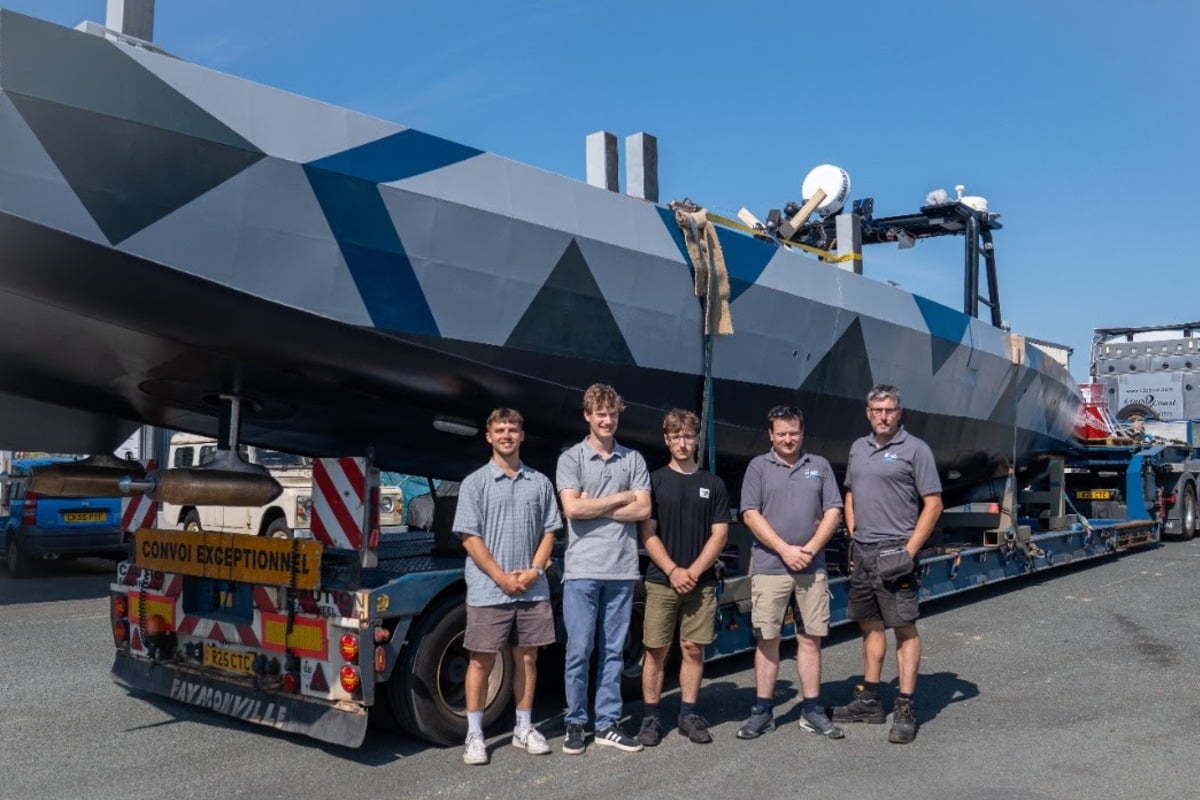
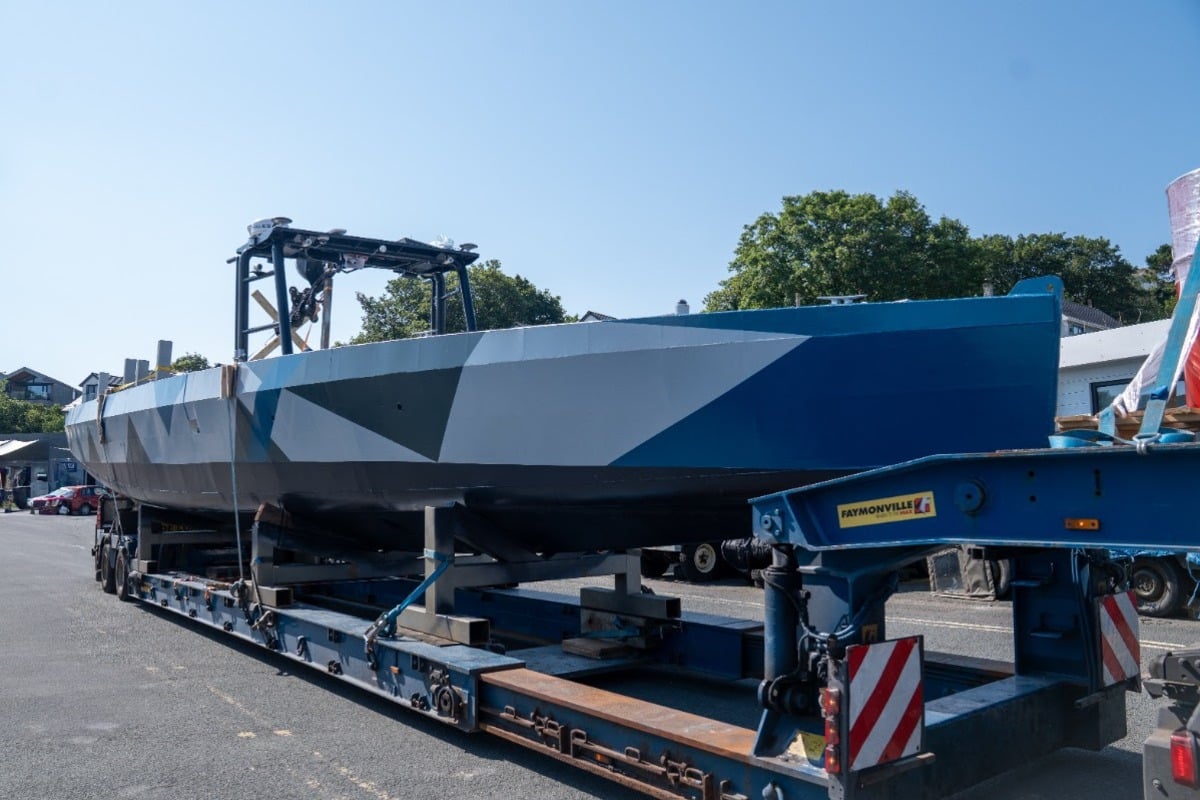
- ZeroUSV completed construction and factory acceptance testing of its Oceanus17 uncrewed surface vessel, built at Manor Marine's shipyard in Portland, England.
- The 17-meter vessel offers more than 50 days of endurance, over 5,000 nautical miles of range, and a 4,000-kilogram payload capacity.
A 17-meter robotic ship built to patrol the ocean alone for nearly two months at a stretch has just rolled off a British production line, and its arrival says as much about where naval technology is headed as it does about the vessel itself.
ZeroUSV, a Plymouth-based maker of uncrewed surface vessels, confirmed that its new Oceanus17 has completed construction and passed its factory acceptance tests, the formal round of checks a vessel must clear before it can move from the shipyard toward active service.
Workers built the Oceanus17 at Manor Marine’s shipyard in Portland, on England’s south coast, before shipping it to ZeroUSV’s headquarters at Turnchapel Wharf in Plymouth, where technicians will spend the coming weeks on final fitout and payload integration, the process of installing and calibrating whatever sensors or equipment a specific mission requires. The company plans an official naming ceremony next month timed to coincide with the opening day of the British National Firework Championships, an annual event held on Plymouth Hoe that draws large crowds to the city’s waterfront, giving the vessel’s public debut a built-in audience before it heads into operational service.
At 17 meters (55.8 feet) long, the Oceanus17 is the largest vessel yet in ZeroUSV’s growing Oceanus lineup and a significant step up from its predecessor, the Oceanus12, an 11.55-meter (37.9-foot) vessel the company launched in early 2025 that carries roughly 2,000 nautical miles (3,700 kilometers) of range and up to one tonne (2,205 pounds) of payload. The Oceanus17 more than doubles that payload capacity to 4,000 kilograms (8,818 pounds) and extends the range past 5,000 nautical miles, roughly 9,260 kilometers (5,755 miles), while pushing operational endurance beyond 50 days at sea without needing to return to port for fuel, maintenance, or crew changes, a figure that matters because most uncrewed vessels still on the market today measure their endurance in days or weeks rather than months.
That kind of endurance only matters if the vessel can actually carry something useful once it gets there, and the Oceanus17 addresses that with a 20-foot (6.1-meter) payload bay built to the same ISO shipping container standard used across the global freight industry, meaning operators can swap in pre-built, standardized equipment modules rather than custom-engineering new hardware for every mission. The bay comes with 30 kilowatts of dedicated power, roughly the output of 40 horsepower, available specifically to run whatever sensors, communications gear, or scientific instruments a customer installs, and that combination of standardized space and reliable power is what lets the vessel pivot quickly between a defense patrol mission one month and an offshore survey job the next.
Steering all of that falls to what the industry calls Level 4 autonomous navigation, a classification borrowed from the same scale used to describe self-driving cars, where the vessel can handle nearly every aspect of navigation on its own within defined operating conditions, stepping in only rarely for human oversight rather than requiring constant remote piloting. ZeroUSV built that capability using GuardianAI, an autonomy software suite developed by MarineAI, a sister company that grew directly out of the software behind the Mayflower 400, an uncrewed vessel that completed a fully autonomous transatlantic crossing in 2022 and remains one of the most closely watched proof points in maritime robotics. That lineage matters to potential customers because GuardianAI has already demonstrated it can make real-time navigation decisions across open ocean without a human at the wheel, the exact capability an operator needs when a vessel is meant to stay out over the horizon, meaning beyond the direct line of sight or short-range remote control of any support ship or shore station, for weeks at a time.
Reliability at that distance depends on more than software, and ZeroUSV built the Oceanus17 with what it calls a dual redundant system architecture, essentially doubling up critical systems so a single component failure cannot strand the vessel or force an expensive, time-consuming recovery mission in open water far from shore.
Matthew Ratsey, Managing Director of ZeroUSV, framed the milestone as proof the company can iterate fast without cutting corners.
“The completion of the first of class Oceanus17 USV marks a very significant milestone for ZeroUSV, and demonstrates the company’s ability to react to market demand and iterate proven designs and deliver proven world class USV technology at pace,” Ratsey said.
He pointed to the company’s own timeline as evidence of that speed, noting how quickly the design matured from its predecessor into a substantially larger and more capable platform.
“Just over a year ago Zero USV was launching the first Oceanus12 class USV, and 15 months on the results of being able to iterate at pace are clear for all to see, from design through to construction in such a short timeframe demonstrates ZeroUSV ability to deliver at pace,” Ratsey said.
He also framed the vessel’s flexibility as its core selling point across the mix of defense, security, and scientific customers ZeroUSV is targeting.
“Oceanus17 significantly expands what operators can achieve at sea. Its combination of endurance, range, payload capacity, available payload power and ISO-compatible modularity creates a highly flexible platform that can be rapidly configured for defence and commercial missions, while providing the resilience and autonomy required for persistent, over-the-horizon operations,” Ratsey said.