

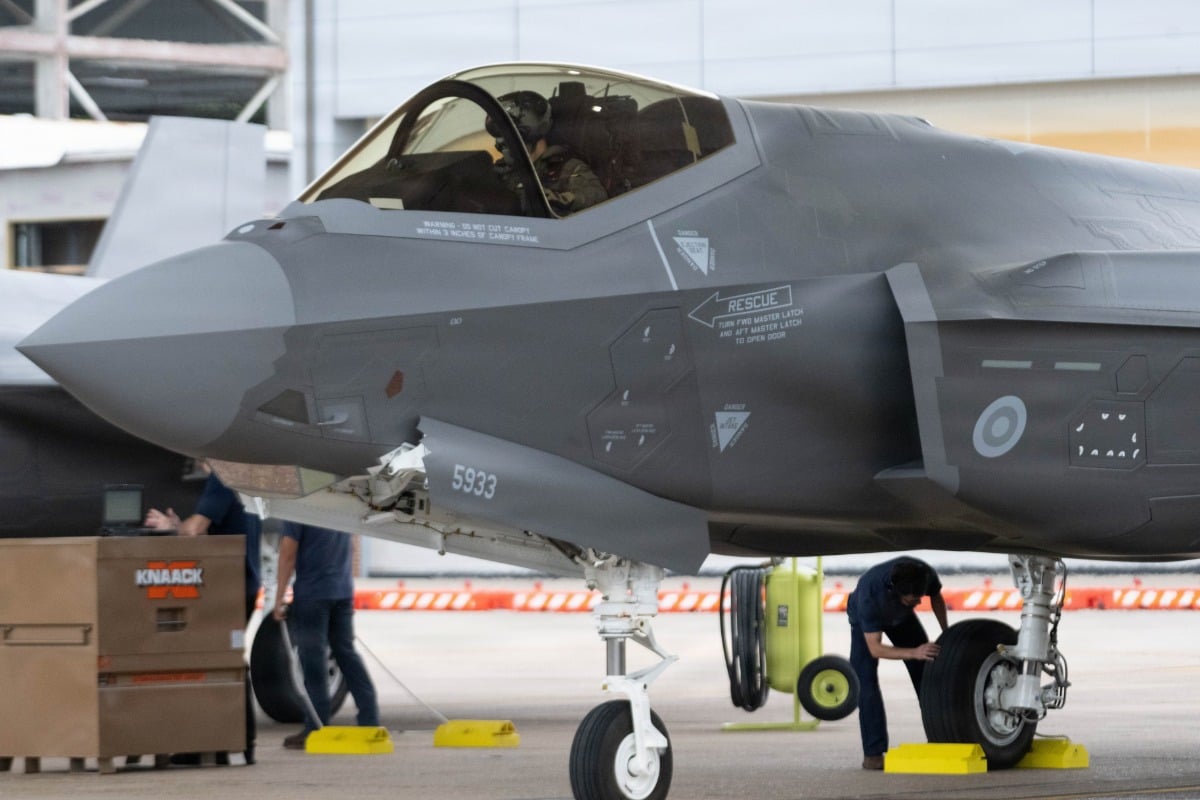
- Patria began assembling F-35 forward fuselages and engines in Finland in 2026, becoming Lockheed Martin's first forward fuselage partner outside the United States.
- Patria will produce 400 forward fuselages and landing gear door sets for F-35 fighters between 2026 and 2042 under a framework agreement.
A Finnish factory floor in the small town of Jämsä, roughly 220 kilometers (137 miles) north of Helsinki, has started building parts for the most advanced fighter jet in NATO’s arsenal, and the milestone puts Finland in a club that includes almost no other country outside the United States.
Patria, the Finnish state-controlled defense manufacturer, confirmed it has begun assembling forward fuselages and engines for the F-35 Lightning II, the stealth fighter built by Lockheed Martin that Finland is buying to replace its aging fleet of F/A-18 Hornets, and the company says it stands as the first partner anywhere outside the United States to manufacture forward fuselage sections for the jet.
The forward fuselage is the nose section of the aircraft, the part that houses the cockpit, the pilot’s ejection seat, and a dense cluster of sensors and avionics that feed the F-35’s famous situational awareness systems, and building it to the tolerances the F-35 program demands is not a task Lockheed Martin hands out casually. Patria’s work happens at an upgraded production facility in Halli, in the town of Jämsä, where the company began manufacturing forward fuselages in early March and started producing landing gear doors that same spring, all destined to be shipped roughly 7,300 kilometers (4,500 miles) across the Atlantic to Lockheed Martin’s final assembly line in Fort Worth, Texas, where F-35s for customers around the world come together.
That arrangement did not happen overnight. Finland selected the F-35A as the winner of its HX fighter program in December 2021, choosing Lockheed Martin’s jet over competitors from Boeing, Saab, and Dassault to replace a Hornet fleet Finland bought from McDonnell Douglas back in 1992, and the country committed to buying a total of 64 F-35A aircraft. Petri Hepola, Patria’s Executive Vice President of Sales and Marketing and Chief Program Officer for the F-35 effort, has led that piece of the program for nearly seven years, and he frames the current production ramp as the payoff for years of groundwork most outsiders never saw.
“Good cooperation between all those involved in the programme has ensured that, after a long planning phase, we are now able to begin production,” Hepola notes.
Under the framework agreement Patria signed as part of Finland’s industrial participation deal, the company is set to build a total of 400 forward fuselages and landing gear door sets for F-35s stretching from 2026 through 2042, supplying not just Finland’s own 64 jets but Lockheed Martin’s broader global supply chain for customers around the world. That kind of arrangement, where a partner nation’s domestic industry manufactures structural components that flow into every country’s F-35s rather than just its own, is standard practice for the F-35 program, which spreads production across more than a dozen nations specifically so that no single supply chain disruption can ground the entire fleet, but it also means Finnish workers are now literally building pieces of fighter jets that will eventually fly for other NATO allies.
The company is also assembling the F135 engine, the single powerplant that drives every version of the F-35 and that Pratt & Whitney designs to produce roughly 191 kilonewtons (43,000 pounds) of thrust in afterburner, among the most powerful fighter engines ever put into production. To handle that work, Patria built new facilities at Linnavuori in Nokia, a separate Finnish town from the country’s phone-making namesake company, engineered specifically to meet security requirements set by the U.S. government and Pratt & Whitney for handling sensitive engine technology, a standard that reflects how tightly Washington controls the export of F-35-related manufacturing knowledge.
“Our aim is to deliver the first completed engines during 2026,” says Hepola.
Patria is contracted to handle maintenance and overhaul of Finland’s F135 engines for the entire lifespan of the country’s F-35 fleet, a service window the company currently projects will stretch into the 2060s, meaning the investment at Linnavuori is really a bet on four decades of steady work rather than a short-term production contract. That kind of long-tail sustainment business is precisely what made Finland’s F-35 industrial package unusual in the first place, since the transfer of F-35 technical data out of the United States is governed by strict export licensing controls that most countries never get anywhere close to this level of access to.
The company previously built the General Electric engines that power Finland’s Hornet fleet and has spent decades handling structural repairs, lifecycle upgrades, and demanding maintenance work on those aircraft, giving Patria three decades of hands-on fighter jet experience before it ever touched an F-35 component.
“Over three decades, we have built up first-class technical expertise in fighter aircraft. Of course, the F-35 programme has required us to learn many new aspects, both in forward fuselage production and engine assembly. We have received substantial know-how from Lockheed Martin and Pratt & Whitney for these operations.”
Finland’s broader F-35 timeline is already in motion elsewhere. A Finnish Air Force pilot flew the country’s first F-35A sortie in April 2026 out of Ebbing Air National Guard Base in Fort Smith, Arkansas, where roughly 150 Finnish personnel, including around 20 pilots, are completing initial training that runs in groups through early 2028. Finland’s own aircraft are scheduled to start arriving at the Lapland Air Command base in Rovaniemi by the end of 2026, with the Lapland Air Wing expected to reach initial operational capability in early 2028 as it finishes retiring the Hornet fleet, followed later that year by the Karelia Air Wing.
The Patria F-35 program currently employs 120 people, a number the company expects to grow past 200 in the coming years as production ramps up alongside the sustainment work that will follow it, and Hepola argues that scale is building something more durable than a single contract.
“Patria’s close involvement provides an excellent foundation for developing expertise in F-35 design solutions, components, and the overall system. This broad-based expertise will serve us well in future aircraft sustainment and related technologies.”
For a country of 5.6 million people sitting on NATO’s newest and longest border with Russia, that expertise carries weight far beyond factory jobs. A domestic industrial base that can build, maintain, and overhaul the fighter jets defending Finnish airspace means Helsinki does not have to rely entirely on foreign depots thousands of miles away when a jet needs major repair work, a form of self-sufficiency that becomes considerably more valuable the closer a country sits to a border where tensions have only risen since Finland joined the alliance in 2023.