

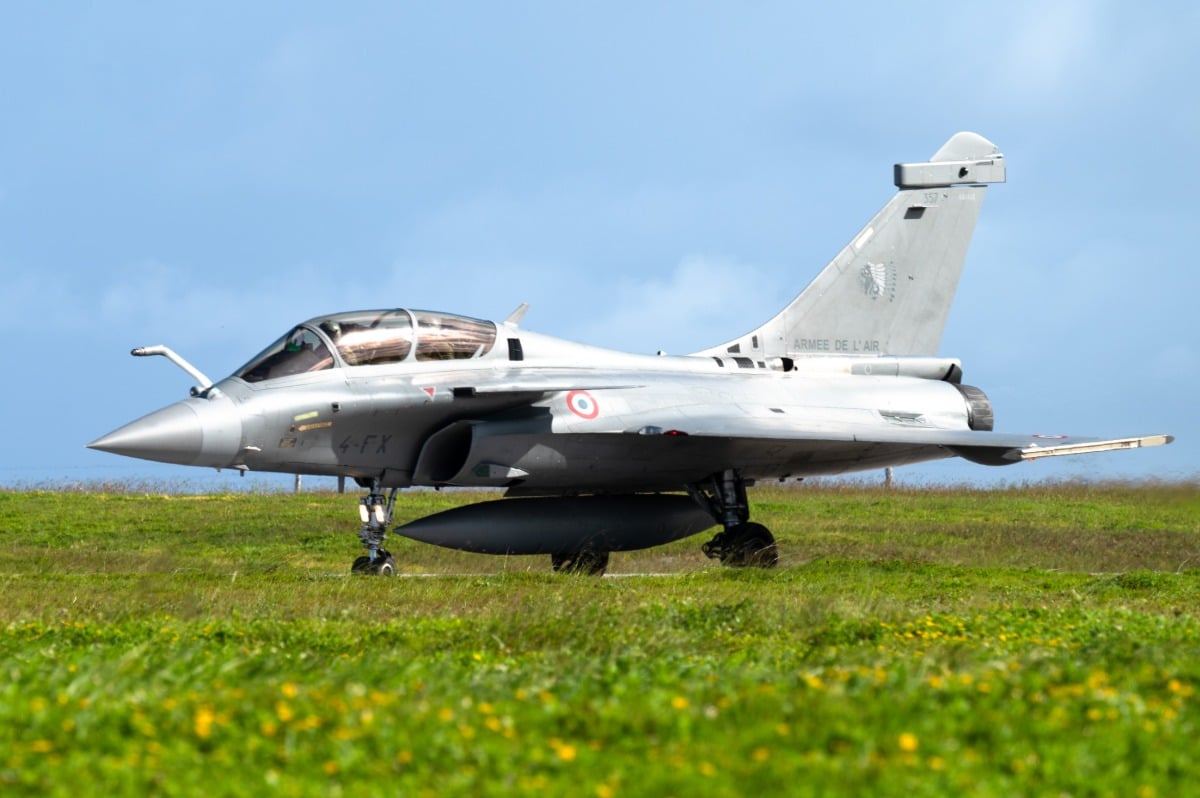
- France will license Ukraine to produce SCALP missiles, AASM bombs, and Aster-30 interceptors, and confirmed delivery of 16 Rafale jets starting 2028.
- Ukraine and nine European nations formed an Integrated Anti-Ballistic Missile Coalition in Paris on July 13, 2026, tied to a new system called Freyja.
France will let Ukraine build its own French-designed cruise missiles, guided bombs, and air defense interceptors on Ukrainian soil, President Emmanuel Macron announced Monday, an offer Reuters reported came alongside confirmation that Ukraine will receive 16 Rafale fighter jets starting in 2028, the first specific delivery window French officials have ever attached to Kyiv’s long-standing ambition to fly the aircraft.
Macron made the announcement in Paris following a meeting of roughly 25 world leaders under what participants call the Coalition of the Willing, a grouping of Ukraine’s Western backers that has met repeatedly throughout the war to coordinate military and financial support.
“Earlier this afternoon President Volodymyr Zelenskiy and I agreed on a roadmap between our two countries, implementing what had been agreed in principle last November regarding our bilateral defense cooperation,” Macron said at a news conference following the meeting.
The licensing agreement marks a genuine shift in how France has supported Ukraine’s war effort. Rather than continuing to draw down its own limited stockpiles of cruise missiles and guided bombs to send abroad, a practice that eventually runs up against the finite size of any nation’s arsenal, Paris is instead handing Ukraine the blueprints to manufacture these weapons domestically, an approach that could let Ukrainian factories keep producing SCALP cruise missiles, AASM Hammer precision-guided bombs, and Aster-30 interceptor missiles indefinitely rather than waiting on shipments from France. The Aster-30 in particular arrives with a genuine combat record behind it, since Ukrainian SAMP/T batteries armed with the missile have already intercepted Russian ballistic and cruise missiles defending Kyiv in real operational conditions, a track record The Defence Blog has covered as France and Italy expanded deliveries of the system over the past year.
“This involves a project to acquire 16 Rafale aircraft and their accompanying weapons systems. The first flights could take place as early as 2028 to 2029, and personnel training will begin in the coming months,” Macron said.
The 16-jet figure represents a concrete first tranche of a much larger ambition Kyiv and Paris first floated in November 2025, when Ukrainian officials signed a defense declaration opening the door to purchasing up to 100 Rafale F4 fighters by 2035, a number that would represent one of the largest single fighter jet commitments any Western nation has made to Ukraine. Monday’s announcement gives that broader framework its first hard delivery date and firm aircraft count, moving the Rafale relationship from a stated intention toward an actual acquisition timeline, even as the training pipeline needed to get Ukrainian pilots and ground crews ready to operate a fourth-generation French fighter will need to begin well before the jets themselves arrive.
Macron’s decision followed a similar move by the United States just days earlier, when President Donald Trump announced Washington would license Ukraine to manufacture interceptor missiles for the Patriot air defense system domestically, the same general strategy France is now applying to its own weapons. That parallel matters because Patriot interceptors currently cost around $4 million each, according to figures Ukrainian President Volodymyr Zelenskyy has previously cited, and Ukraine’s air defense network has struggled throughout 2026 with insufficient interceptor stockpiles against the sheer volume of nightly Russian missile and drone barrages, a shortage that has pushed both Washington and Paris toward licensing production rather than simply shipping more finished missiles that neither country can manufacture fast enough to keep pace with demand.
Beyond the Rafale and missile licensing news, the same Paris gathering produced a second major announcement tied to Ukraine’s ballistic missile defense gap, according to United24 Media. Zelenskyy told participants at a meeting of what organizers called the Anti-Ballistic Coalition that Ukraine and its European partners are actively developing a joint anti-ballistic missile system named Freyja, which he said could become operational within the next twelve months. Ten nations, including Germany, Italy, Spain, the Netherlands, Sweden, Norway, and Denmark alongside France and Ukraine, formally joined an Integrated Anti-Ballistic Missile Coalition at the summit, a grouping aimed at building a shared defense architecture against a ballistic missile threat that Zelenskyy warned would only intensify as military cooperation deepens between Russia, Iran, and North Korea.
Zelenskyy framed that warning starkly, telling the coalition that Russia was placing what he described as its final bet on ballistic missile strikes against Ukrainian cities and villages, a strategy aimed at breaking civilian morale and stripping Ukraine of its ability to defend itself once conventional front-line gains slow. That assessment lines up with reporting The Defence Blog has previously covered on Ukraine’s persistent shortage of anti-ballistic capability, since the Franco-Italian SAMP/T system remains one of the only Western platforms with a documented record of intercepting the specific Russian ballistic missiles, including Iskander and Kinzhal variants, that have proven hardest for Ukraine’s broader air defense network to stop.