

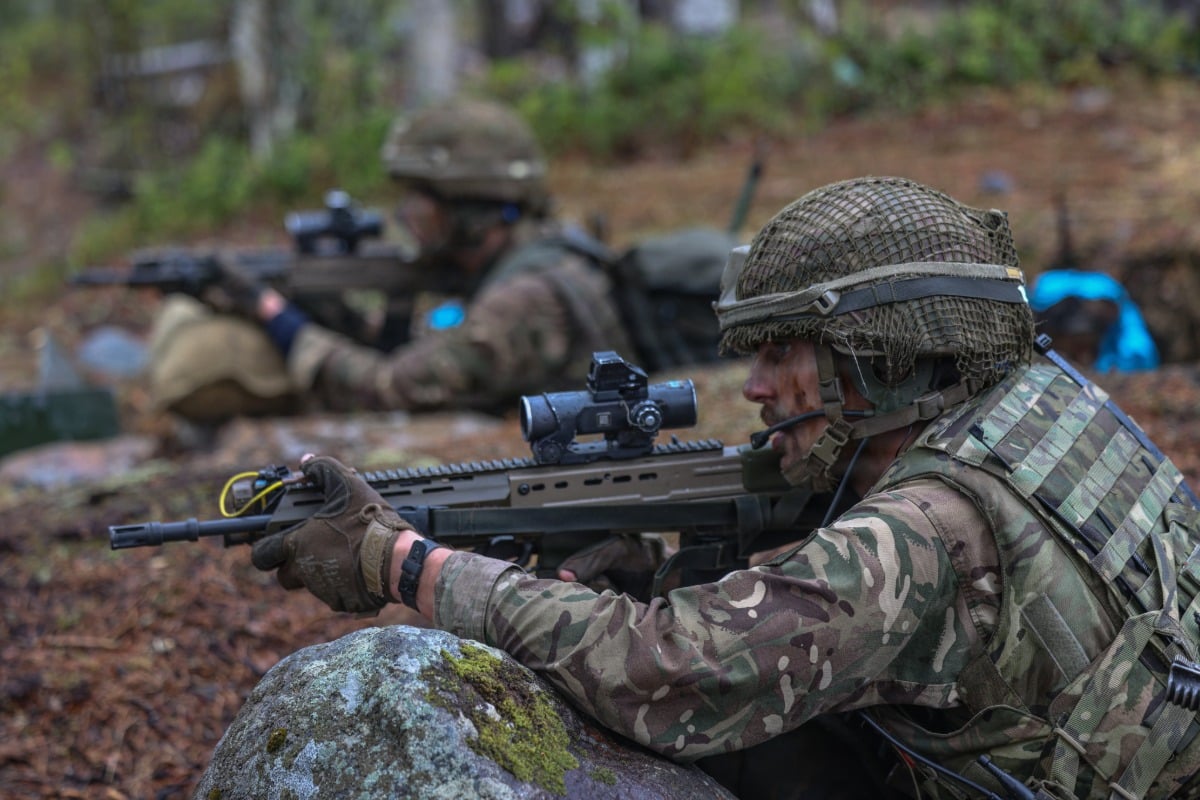
- The UK Ministry of Defence awarded the £2 billion Army Collective Training Service contract to the Raytheon UK-led Omnia Training consortium on July 10, 2026.
- Rheinmetall's share of the 15-year contract is worth just under €1 billion, and the program will support around 400 jobs across the United Kingdom.
German defense giant Rheinmetall has secured a contract worth just under €1 billion (roughly $1.1 billion) for its role in overhauling how the British Army trains its soldiers, part of a broader £2 billion (approximately $2.7 billion) government program that will replace traditional live exercises with a blended system of virtual, synthetic and data-driven training environments over the next 15 years.
The contract sits inside the Army Collective Training Service, known as ACTS, which the UK Ministry of Defence awarded on July 10 to Omnia Training, an industrial consortium led by Raytheon UK and including Capita, Cervus, Rheinmetall Electronics UK and Skyral. Rheinmetall’s specific share of the award covers its work as what the company calls the Land Collective Training Partner, a role that puts it in charge of designing and delivering key elements of the program alongside managing the physical training infrastructure, system configuration and logistics that keep large-scale military exercises running. Operational implementation begins this summer, and the service contract itself runs for 15 years, a duration that reflects how the Ministry of Defence structured the program as a long-term partnership rather than a one-time equipment purchase.
What ACTS is actually meant to fix traces back to a persistent problem in modern military training: live field exercises are expensive, slow to set up, and inherently limited in how complex or unpredictable an enemy scenario can be made to feel. The program, previously known as the Collective Training Transformation Programme before the Ministry of Defence renamed it, is built around combining live training with virtual simulation, where soldiers operate real or simulated equipment inside computer-generated environments, and constructive simulation, where computer-generated forces and scenarios run independently to create larger, more complex battlefield conditions than any live exercise could replicate on a training ground. That blended approach, often referred to in defense circles as live-virtual-constructive training, lets the Army stage scenarios involving forces, terrain and threats that would be impractical or prohibitively costly to recreate physically every time soldiers need to train for them.
“We launched Omnia Training over three years ago to deliver cutting-edge training systems to help the British Army effectively prepare for operations,” said James Gray, Managing Director and Chief Executive of Raytheon UK.
Raytheon UK first assembled the Omnia Training consortium in November 2022, when the program was still called CTTP and the team included a different lineup of partners before Skyral eventually replaced Improbable Defence in the final grouping. The Ministry of Defence ran the competition through several stages, downselecting to two finalist consortia in February 2025, Omnia Training and a rival team led by Elbit Systems UK, before ultimately selecting the Raytheon-led group more than a year later. That multi-year procurement timeline is not unusual for a program of this scale and duration, but it does mean the consortium’s partners spent roughly two years working as what the companies describe as a co-located, integrated team even before the contract was formally signed, a structure meant to compress the ramp-up period once work actually begins.
Rheinmetall said the contract’s size and scope will let it expand its local sites, workforce and industrial supply capacity in the country, with effects reaching beyond its Rheinmetall Electronics UK headquarters on the Isle of Wight and its Southampton site into other locations including Bristol and Warminster, where the company expects to create new employment opportunities over the life of the 15-year deal. Across the full Omnia Training consortium, the Ministry of Defence has said the program will support around 400 jobs nationwide, including 270 newly created skilled roles and 100 apprenticeships, drawing on a supply chain of more than 44 UK-based businesses spread across counties including Wiltshire, Leicestershire and Hampshire.
Rheinmetall’s position in British defense contracting extends beyond this single award. The company also operates Rheinmetall BAE Systems Land, a joint venture that plays a central role in the British Army’s vehicle platform modernization programs, giving Rheinmetall parallel footholds in both how the Army trains and what equipment it eventually trains on and fights with. That combination matters strategically because training systems and the vehicles or weapons they simulate increasingly need to be developed and updated together, particularly as forces adopt digitally networked equipment whose performance characteristics have to be modeled accurately inside a synthetic training environment for the training to be useful.