

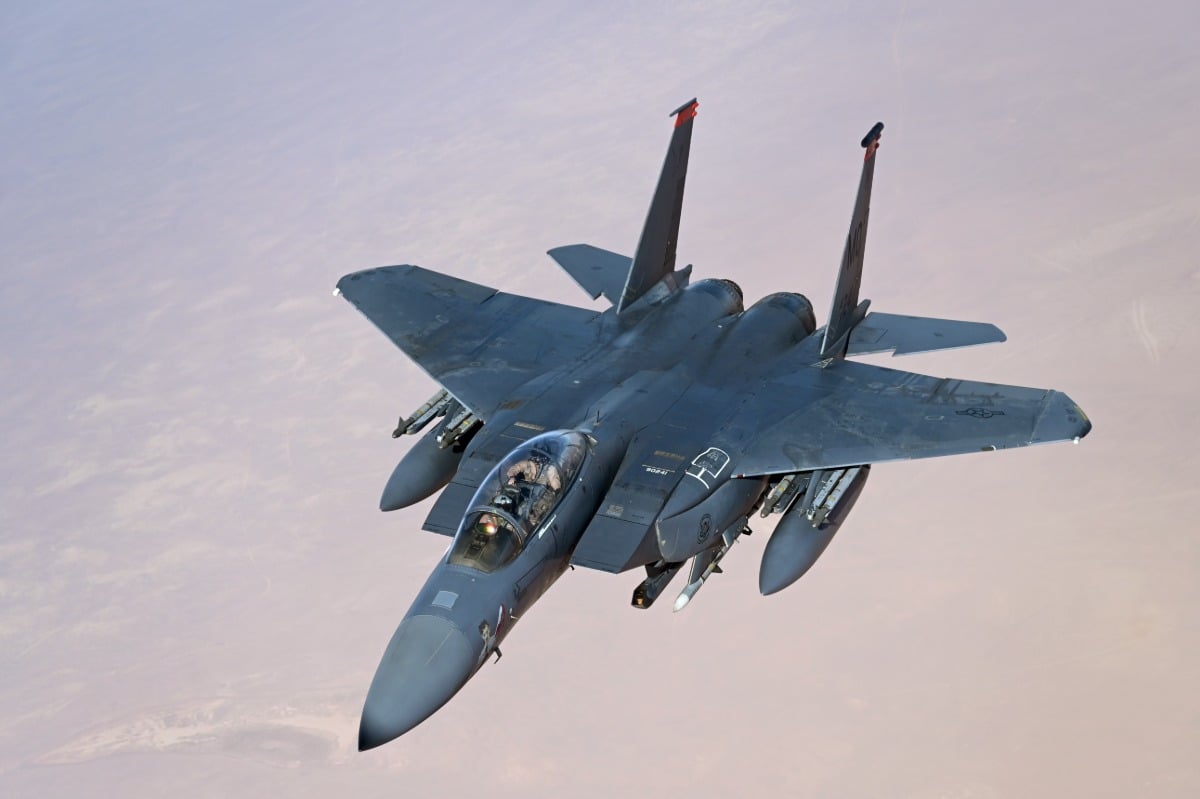
U.S. Central Command finished its third round of airstrikes against Iran in a single week on July 11, hitting roughly 140 military targets after Iranian forces attacked another commercial vessel transiting the Strait of Hormuz, the narrow waterway that carries a fifth of the world’s oil out of the Persian Gulf every day.
The strikes, carried out by land- and sea-based fighter aircraft, drones, and naval vessels, targeted Iranian missile and drone sites, naval capabilities, ammunition storage facilities, communication networks, and coastal surveillance locations, according to CENTCOM. Over three consecutive nights this week, the command said its forces struck more than 300 targets in total, an intensity of bombardment aimed squarely at stripping Iran of the ability to keep threatening tankers and container ships in one of the most heavily trafficked chokepoints in global shipping.
The immediate trigger for Sunday’s strikes was an attack on the Cyprus-flagged container ship GFS Galaxy, which Iran’s Islamic Revolutionary Guard Corps said it struck for using what it called an unauthorized route through the strait. The vessel suffered significant damage to its engine room and caught fire, and one crew member remains missing after the rest of the crew abandoned ship into a lifeboat, according to CENTCOM and the United Kingdom’s maritime security monitor UKMTO. Iran’s Revolutionary Guard framed the strike as a warning shot against a ship that ignored instructions to correct its course, while declaring the strait closed “until further notice,” a claim that has not stopped all traffic through the waterway but has sharply deepened the risk calculus for shipowners already paying war-risk insurance premiums that have climbed several-fold since the conflict began.
The Strait of Hormuz sits at the mouth of the Persian Gulf, narrowing to about 33 kilometers (21 miles) at its tightest point between Iran and Oman, and it functions as the single passage for crude oil leaving Saudi Arabia, Iraq, Kuwait, the United Arab Emirates, and Iran itself. CENTCOM’s press release credited U.S. forces with helping facilitate the transit of more than 800 commercial vessels and 400 million barrels of crude oil through the strait since early May, framing the strike campaign as protection for global energy markets rather than a standalone military operation against Iran. That framing matters because any prolonged closure or even partial disruption of the strait tends to ripple immediately into oil prices worldwide, which is why the Gulf states on Hormuz’s western shore have their own stake in how this plays out even though they are not formal parties to the fighting.
The Revolutionary Guard claimed it launched retaliatory strikes on Jordan’s Prince Hassan Air Base, saying it destroyed a command-and-control center and drone storage hangars there using ballistic missiles, though Jordan had not independently confirmed the extent of any damage. The United Arab Emirates said its air defense systems intercepted missile and drone threats, Qatar’s defense ministry said it shot down a missile aimed at the country, and Bahrain activated sirens and told residents to shelter in place. None of those governments are combatants in the U.S.-Iran conflict, and the spread of strikes into their territory illustrates how a fight that began between Washington and Tehran keeps drawing in the smaller Gulf states caught geographically between them.
Defense Secretary Pete Hegseth offered a blunt characterization of the latest round of strikes in a social media post, saying, “Iran made a poor choice. Now they pay.” The comment came as diplomatic efforts, led largely by Oman, continued in parallel with the bombing. Iranian Foreign Minister Abbas Araghchi met his Omani counterpart over the weekend to discuss the strait specifically, and Oman has floated a proposal that would allow ships to transit freely along a southern route while requiring permits, though not fees, for a northern route hugging Iran’s coastline, according to reporting that cited people familiar with the plan. U.S. officials have said talks with Tehran cannot move forward until commercial vessels are guaranteed safe passage, a condition Iran has yet to formally accept even as both sides keep exchanging fire.
The current round of fighting traces back to February 28, when a wave of opening strikes killed Iran’s longtime Supreme Leader, Ayatollah Ali Khamenei, according to reporting on the war’s origins. His son, Mojtaba Khamenei, has since assumed the role of Supreme Leader and issued his first public statement since his father’s funeral this weekend, vowing that revenge for the killing “must certainly be carried out.” That succession, layered on top of an already volatile military confrontation, has left outside analysts watching closely for signs of how a newly installed and largely unseen Iranian leader intends to balance retaliation against the risk of drawing even heavier American firepower.
A brief ceasefire had been in place before this week’s escalation, but President Trump declared it “over” over the weekend after the exchange of strikes resumed, and the diplomatic track now runs on a parallel and uncertain timeline alongside the military one. CENTCOM, one of the Pentagon’s regional combatant commands under the Department of War, has not indicated any pause in operations, and its own statement framed Sunday’s strikes as a continuation of an existing pattern rather than a new phase, saying Iran had been given repeated opportunities to honor a prior memorandum of understanding on shipping safety and had failed each time.