

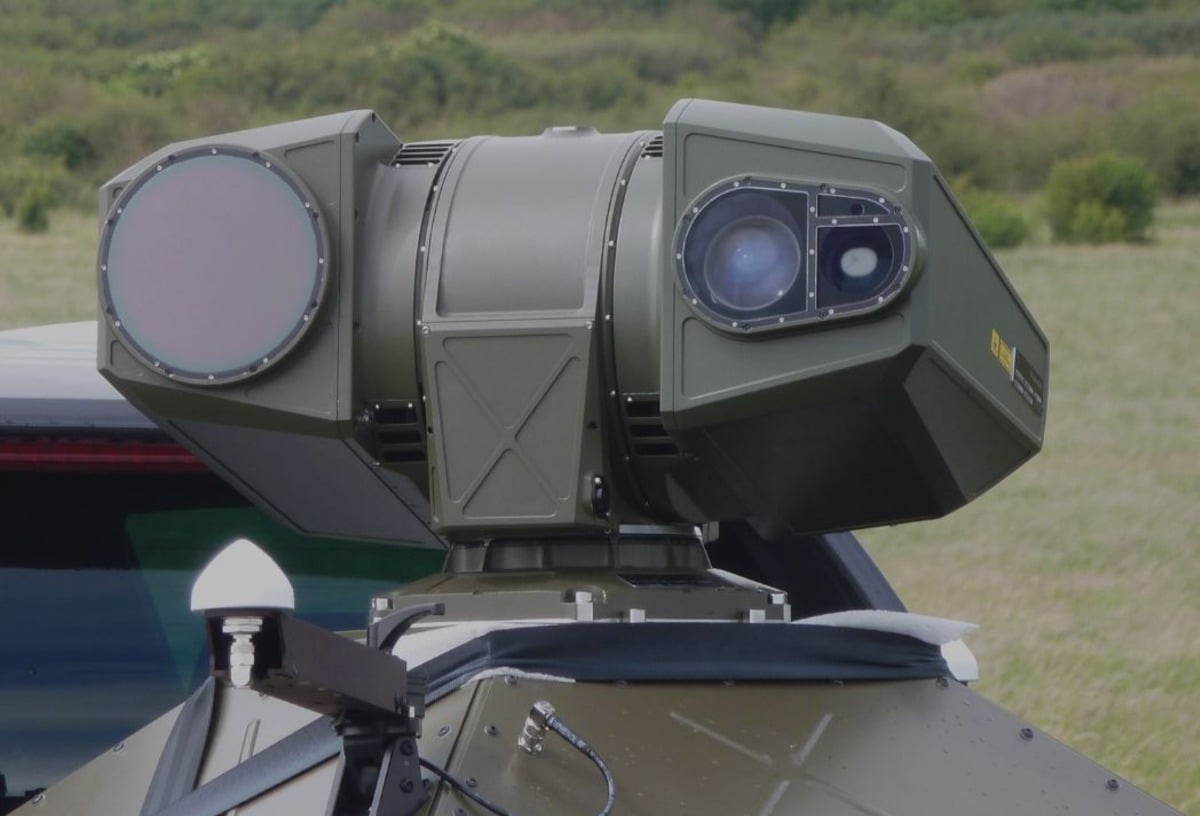
- OpenWorks Engineering demonstrated its Vision Pace counter-drone targeting system at a C-UAS industry event at Larkhill Garrison, the British Army's Royal Artillery headquarters.
- Vision Pace weighs about 70 kilograms (154 pounds) and supports SAPIENT and ATAK interfaces for integration with third-party sensors and weapons.
OpenWorks Engineering, a counter-drone specialist based in Northumberland, England, announced this week that it recently attended an industry-focused counter-unmanned aircraft systems, or C-UAS, event at the British Army’s Larkhill Garrison, where the company demonstrated its Vision Pace targeting system to defense and security partners.
Larkhill sits on Salisbury Plain in Wiltshire and has served as the headquarters of the Royal Artillery since 2003, making it the British Army’s center of gravity for everything related to finding and striking targets on the battlefield, a mission that increasingly includes shooting down small, fast-moving drones rather than just aiming heavy guns at distant enemy positions.
“We recently attended an industry-focused C-UAS event at the British Army’s Larkhill Garrison where we demonstrated Vision Pace and engaged with defence and security partners,” OpenWorks Engineering said. “It was a valuable opportunity to share thoughts on the evolving threat landscape, emerging technologies and the future of Counter-UAS capability,” the company said.
Drones have gone from a battlefield curiosity to one of the most persistent dangers facing troops and infrastructure alike, driven largely by their relentless, evolving use in the Russia-Ukraine war and by a steady stream of unauthorized drone sightings near military bases and critical infrastructure sites around the world. The challenge is not simply spotting a drone anymore. It is hitting one that might be flying erratically at high speed, low altitude, and close range, all while the platform trying to shoot it down could itself be moving across rough terrain or open water.
According to the company, the system delivers what it calls microradian-precision targeting for threat defeat, a level of accuracy measured in fractions of a degree so small that hitting a fast-moving drone becomes possible even from an unstable platform. Independent reporting from the European Security & Defence trade publication, which examined the system at the DSEI defense exhibition in London, found that Vision Pace’s positioner can achieve an actuator resolution of 0.0005 milliradians and stabilization better than 0.1 milliradians, figures that explain why the company frames the system as a genuine step change rather than an incremental upgrade to existing optics.
“As aerial threats become faster, smaller and more agile, the need for precision and speed has never been more apparent,” OpenWorks Engineering said. “Vision Pace has been engineered to meet that challenge, delivering microradian-precision targeting for threat defeat, and representing a significant step-change in layered air defence,” the company said.
Layered air defense is the operating concept behind that claim, and it explains why a single optics system matters even though it does not carry its own weapon. Modern air defense rarely relies on one sensor or one weapon to stop every threat. Instead, forces stack multiple systems, radar for early detection, optics for precise tracking, and a mix of guns, missiles, or other effectors for the actual kill, so that if one layer misses a fast or unusual target, another layer can catch it. Vision Pace is designed to sit in that stack as the targeting layer, the component that takes a detected threat and keeps a weapon locked onto it long enough to fire accurately, regardless of which sensor or weapon system it gets paired with.
That flexibility is central to how OpenWorks has positioned the product since its official unveiling in 2024. The system weighs roughly 70 kilograms (154 pounds) in its typical configuration, light enough that OpenWorks says it fits on small vehicles, vessels, and turret systems rather than requiring a dedicated heavy platform. It connects through a common interface that supports SAPIENT and ATAK, two data-sharing standards used across NATO militaries to let sensors, weapons, and command systems from different manufacturers talk to each other without custom software integration. In practice, that means a military customer is not locked into buying every component from OpenWorks alone. The company has already demonstrated Vision Pace paired with Thales’ TrueHunter sensor suite and Echodyne’s EchoShield radar, and separately integrated with weapons including General Dynamics’ 20mm revolver gun system and the Northrop Grumman Mk44 Bushmaster II 30mm automatic cannon, according to the company’s own published case studies.
OpenWorks also built the system for practical maintenance rather than just laboratory performance, describing Vision Pace as highly modular, with individual components, known in the industry as line replaceable units, that technicians can swap, repair, or upgrade quickly in the field rather than sending the entire unit back to a factory for service. That detail matters more than it might sound, because a counter-drone system that takes weeks to repair after a single damaged part is a system that leaves a gap in air defense coverage exactly when an adversary is most likely to exploit it.
The company’s appearance at Larkhill also reflects a broader pattern in how OpenWorks has scaled since it launched Vision Pace. The firm reported reaching its 100th employee earlier this year and separately confirmed that its related Vision Guard system was selected as part of Australia’s Land 156 program, a 10-year, $1.3 billion effort to acquire counter-drone capability for the Australian Defence Force. Those wins suggest that OpenWorks has moved from a niche supplier known primarily for its net-capturing SkyWall interceptor into a company competing directly for the optics and targeting layer of major national air defense programs.