

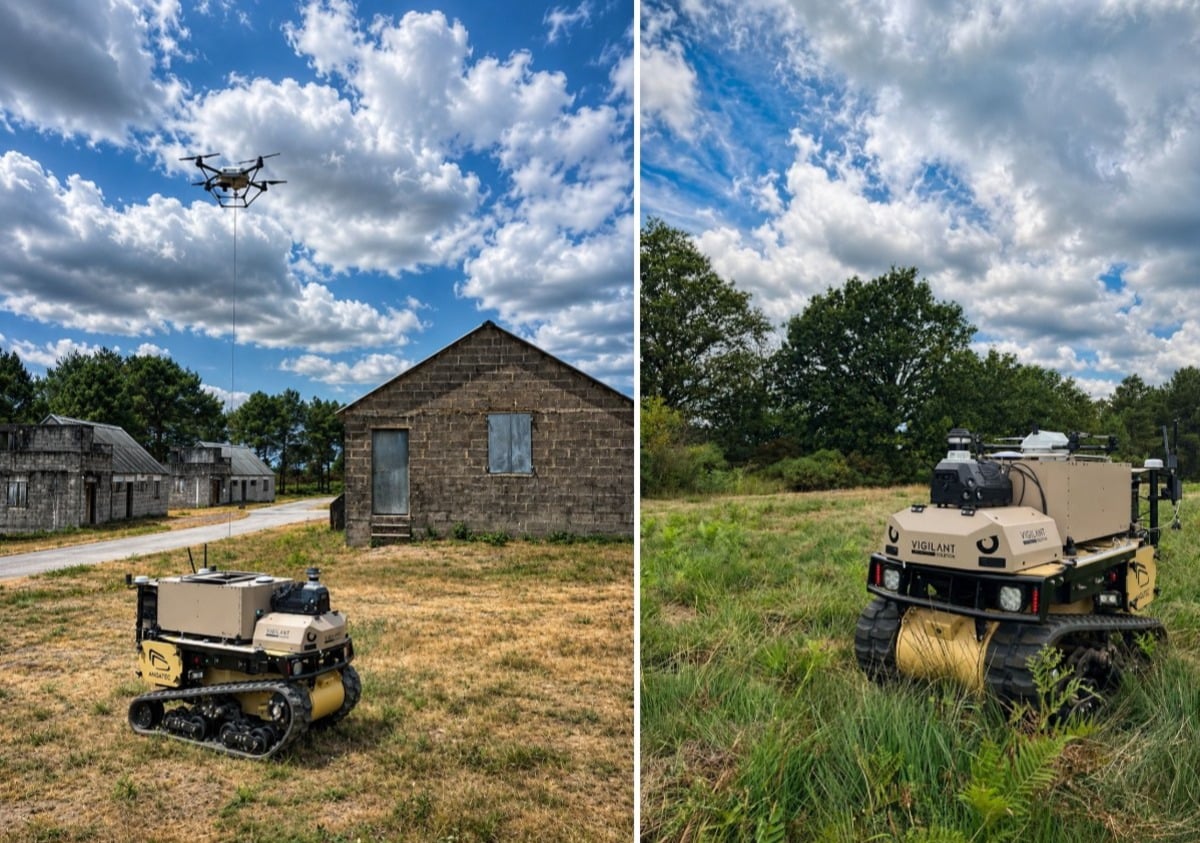
- Vigilant Solution completed testing for France's Pendragon program, validating its STRIX robotic kit and autonomous navigation software on the Angatec TEC800 robot.
- The company also integrated Elistair's Khronos tethered drone, part of France's effort to field a robotic combat unit by summer 2027.
Vigilant Solution, the robotics division of the French small business MP-SEC, announced that its team took part in a new round of trials last week for Pendragon, a French military program working to build the country’s first Robotic Combat Unit, known in French as the Unité Robotique de Combat, or URC.
The French Army launched Pendragon in March 2025 as a joint effort between two organizations: AMIAD, the Ministerial Agency for AI in Defense, which develops artificial intelligence tools for the French military, and the Future Combat Command, known as CCF, the branch of the French Army responsible for shaping how the force fights in the years ahead. Together, the two organizations are trying to build a unit that pairs ground robots, aerial drones, and artificial intelligence into a single fighting force capable of operating with minimal human input.
During the latest test campaign, Vigilant Solution said it validated every deliverable it had committed to for this stage of the program. That included the mechanical and software integration of its in-house robotic kit, called STRIX, a modular system built to convert existing ground vehicles into autonomous platforms using a network of cameras and sensors. The company also confirmed its autonomous, multi-robot navigation software, the code that lets multiple unmanned systems move and coordinate on their own, worked successfully on a ground robot called the TEC800, built by the French company Angatec. Rounding out the trial, Vigilant Solution integrated the Khronos tethered drone, a system built by the French manufacturer Elistair that stays connected to a ground vehicle by a cable rather than flying free, drawing continuous power through that tether to stay airborne for extended stretches without needing to land and recharge. According to Elistair’s own published specifications, Khronos can launch in under two minutes, hover at heights up to 60 meters (197 feet), and maintain a 10-kilometer (6.2-mile) surveillance radius for up to 24 hours at a stretch, all while continuing to operate even in environments where GPS signals are jammed or spoofed.
None of that integration work happens in isolation, and understanding why it matters requires stepping back to what Pendragon is actually trying to build. The French Army’s chief of staff, Gen. Pierre Schill, described the program’s purpose in terms that go beyond simple hardware procurement, saying the Army intends to anticipate and exploit what will amount to a cultural and tactical revolution on the battlefield. That framing reflects a broader shift already visible in Ukraine, where thousands of ground robots and drones have reshaped how both sides fight, forcing militaries worldwide to rethink how much of the close fight can be handed off to machines instead of soldiers. France wants a working robotic unit ready by the summer of 2027, according to reporting from the French outlet Forces Operations Blog, with an interim milestone expected as soon as this summer, when the program aims to demonstrate a functioning prototype built from roughly a dozen ground and aerial platforms carrying out a scripted mission, such as seizing an enemy position.
French officials have said the first fully realized version of the URC should include around 15 ground robots and roughly 60 aerial drones, all expected to carry out missions with full autonomy, according to comments from Gen. Schill reported by the French outlet Epoch Times. Rather than build every platform from scratch, the program has adopted an unusual acquisition model built around fast, iterative testing cycles that bring soldiers, engineers, and industry representatives together repeatedly rather than following the slower, sequential process typical of major weapons programs. Louis Tidey, who leads Vigilant Solution’s robotics division, described that collaborative process in comments to French media, explaining that AMIAD supplies the mapping data his team needs while Vigilant Solution builds the navigation algorithms on top of it, a division of labor that lets a small company plug directly into a state-run AI effort rather than developing every component independently.
The finished robotic combat unit is expected to follow a specific composition, with 40 percent of its platforms treated as fully consumable, 40 percent as expendable if the mission requires sacrificing them, and the remaining 20 percent reserved as specialized, higher-end systems carrying more capable sensors and greater firepower. That ratio signals something important about how French planners view the unit’s role: this is not meant to be a fleet of exquisite, irreplaceable machines, but a force built to absorb losses the way infantry units historically have, freeing commanders to send robots into the kind of high-risk reconnaissance and assault roles that would otherwise put soldiers directly in the line of fire.
Pendragon’s next major test will be whether all these individually validated components, built by different companies with different specialties, can function together as a coherent unit under real operational pressure rather than in the more controlled conditions of a training exercise. If France’s timeline holds, soldiers stationed at Saint-Cyr Coëtquidan and other training grounds may soon find themselves rehearsing alongside a company’s worth of machines instead of fellow troops, a shift that will test not just the technology itself but how willing commanders are to trust decisions, even limited ones, to an algorithm.