

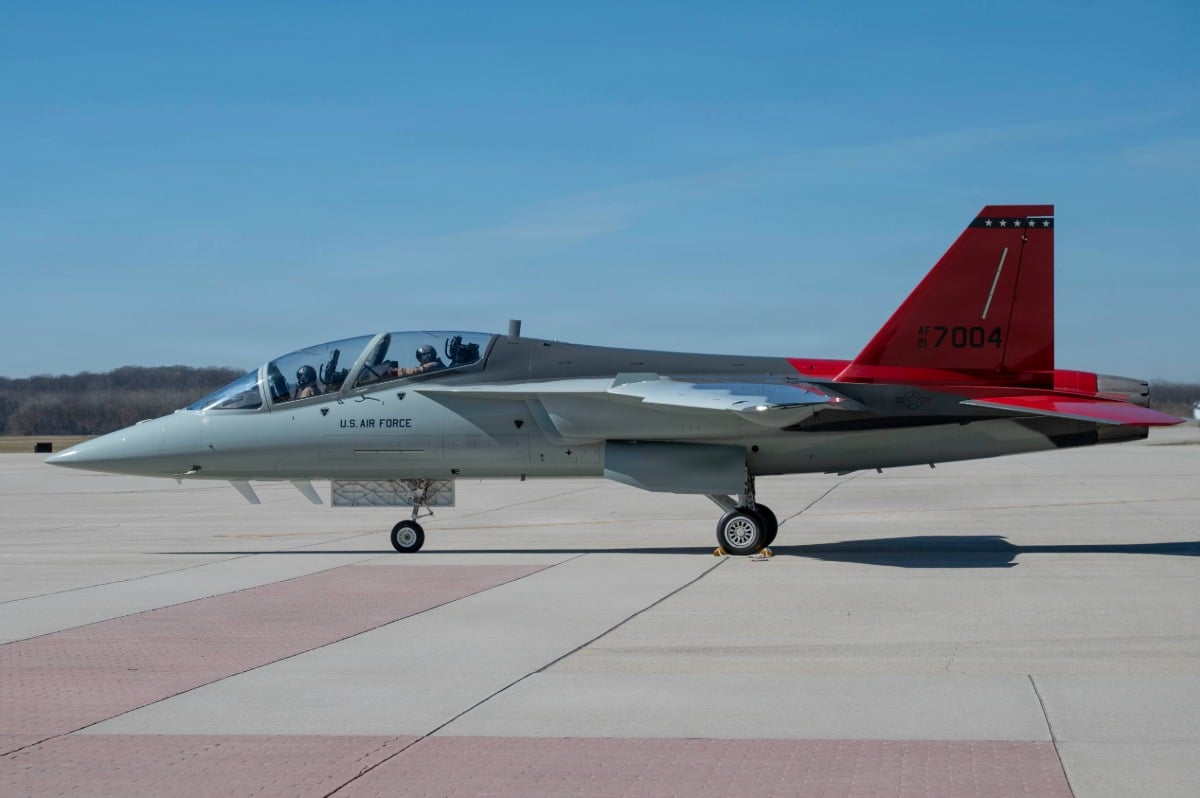
- The U.S. Air Force posted a Sources Sought Notice on July 8, 2026, seeking companies to modernize and sustain the T-7A Red Hawk training aircraft.
- GAO's annual weapon systems assessment found most T-7A developmental testing will not complete until April 2028, with lower-priority testing finishing by May 2029.
The U.S. Air Force jet meant to finally retire a training aircraft older than most of the pilots flying it is running years behind schedule, even as the service quietly started shopping for companies to upgrade the replacement before it has fully entered service. The Air Force posted a notice on July 8 seeking companies capable of modernizing and sustaining the T-7A Red Hawk, the aircraft meant to replace the Air Force’s T-38C Talon jets that have trained American fighter and bomber pilots since the 1960s, even as the Government Accountability Office’s newly released annual weapons assessment found the T-7A program is experiencing what auditors called “significant delays” in completing the testing required to prove the aircraft actually works as designed.
The T-7A itself represents the Air Force’s attempt to build something the T-38C never was: a trainer aircraft specifically engineered to prepare pilots for the demands of flying modern fourth and fifth-generation fighters and bombers, aircraft whose cockpits, sensors, and flight characteristics have evolved dramatically since the T-38 first entered service more than six decades ago.
Boeing is building the T-7A under a program that ultimately calls for 351 aircraft operating out of five training bases across the continental United States, paired with an associated Ground Based Training System covering flight simulators, classroom instruction, and maintenance training devices, all intended to give Air Education and Training Command the tools to prepare pilots for combat aircraft well into the rest of this century.
According to GAO’s assessment, the program has hit a string of interconnected problems that have pushed its testing timeline out considerably further than originally planned. Investigators found the delays stem largely from three sources: the need for additional engineering analysis beyond what officials originally scoped, lower aircraft availability than expected due to maintenance staffing shortages and a lack of spare parts, and software development requirements that have taken longer to finalize than the program anticipated. As a direct result, GAO reported that the majority of developmental testing, the phase where engineers confirm an aircraft actually performs as designed before it moves toward full production, will not wrap up until April 2028, with lower-priority testing requirements not completing until May 2029, years later than the T-7A program originally envisioned when it won its competitive source selection.
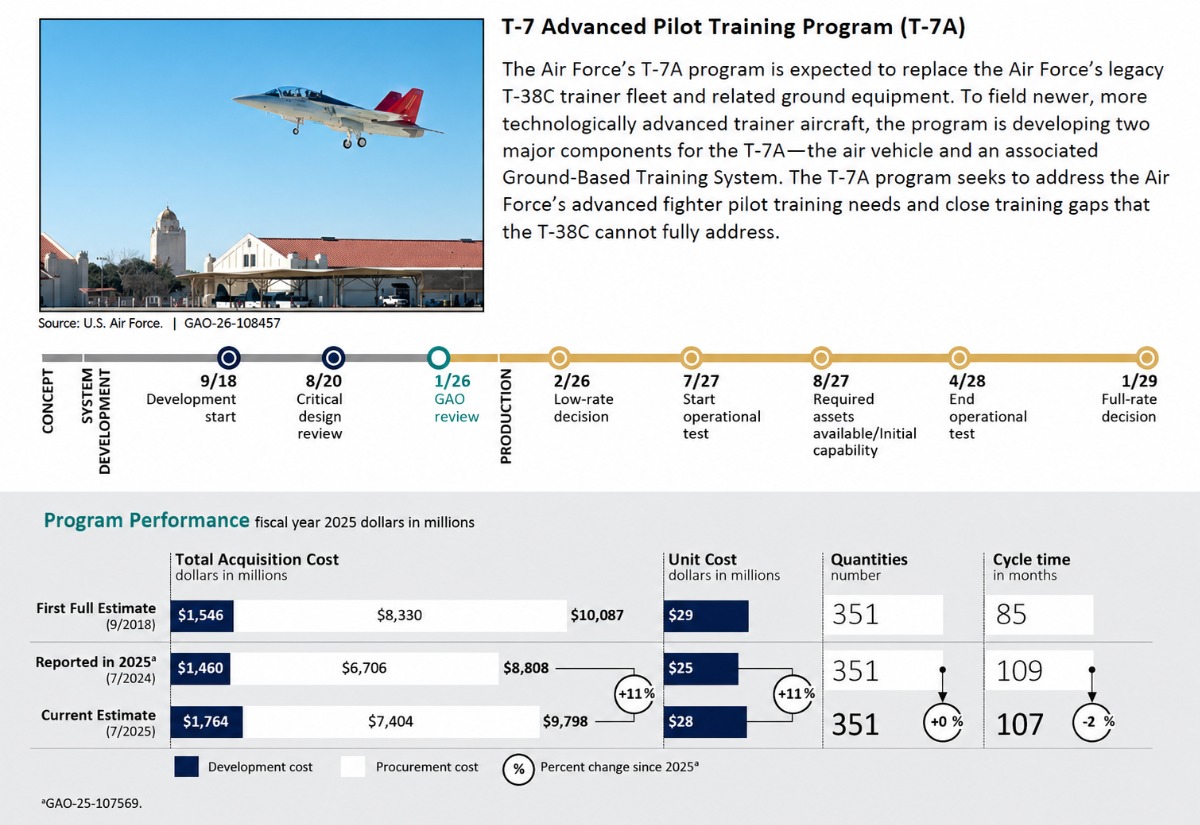
GAO’s report noted the program intends to make a low-rate initial production decision in April 2026, the point at which the Air Force starts building the first batch of aircraft for actual delivery, despite what auditors described as limited test information available to support that production contract award. Aviation and defense procurement experts have long warned that this kind of overlap between testing and production, known as concurrency, tends to drive up costs and extend schedules further, since problems discovered during ongoing flight tests can force expensive redesigns on aircraft that have already started rolling off the production line. GAO’s assessment found the T-7A program’s total estimated acquisition cost had already grown by 11 percent over the past year, with officials attributing much of that increase to contract changes including added incentives, higher support costs, and inflation adjustments.
GAO found that the T-7A’s ejection seat escape system, the equipment responsible for getting a pilot safely out of the aircraft during an emergency, has completed system-level testing but will not be fully qualified until after the April 2026 production decision has already been made, meaning the Air Force plans to start building aircraft before confirming the escape system meets its final safety requirements. Separately, the Ground Based Training System has run into projector problems significant enough that the program pivoted to a different, less mature projector technology, a switch that GAO’s assessment noted carries its own risk of design changes, cost growth, and further schedule delays given how recently the replacement system was adopted.
Against that backdrop of documented delays, the modernization notice the Air Force posted this week reads almost aspirational, outlining a lengthy wish list of upgrades the service wants to eventually add to an aircraft still struggling to finish its original testing program. The requested improvements include a terrain and air collision avoidance system designed to automatically prevent the aircraft from flying into the ground or colliding with other planes, a capability particularly important during high-intensity training maneuvers where student pilots or those experiencing G-force-induced loss of consciousness could lose control. The Air Force also wants a pilot-selectable G-limiter, informally described in the notice as a “Dial-A-G” capability, that would let instructors restrict how much gravitational force less experienced students can pull before gradually unlocking the aircraft’s full performance envelope as pilots gain experience. Additional requested upgrades cover pilot interface improvements to help students train on skills relevant to fourth and fifth-generation fighters, along with a navigation system upgrade that would replace the current GPS-dependent setup with an embedded inertial navigation system built around a ring-laser gyro, technology designed to maintain accurate positioning even when GPS signals are jammed or unavailable, a capability increasingly relevant given how routinely adversaries now target GPS signals in contested environments.
Notably, the Air Force’s notice makes clear that none of this represents a committed contract or funding decision. The document is what the government calls a Sources Sought Notice, a market research tool used purely to identify which companies might be capable of doing this kind of work, explicitly stating that responses will not be treated as proposals and that the government has made no commitment to actually award any contract based on the information gathered. Modernization work described in the notice would not begin before fiscal year 2029 at the earliest, according to the Air Force’s own timeline, putting any real T-7A upgrades roughly three years past even this week’s posting, and well beyond the extended testing schedule.