

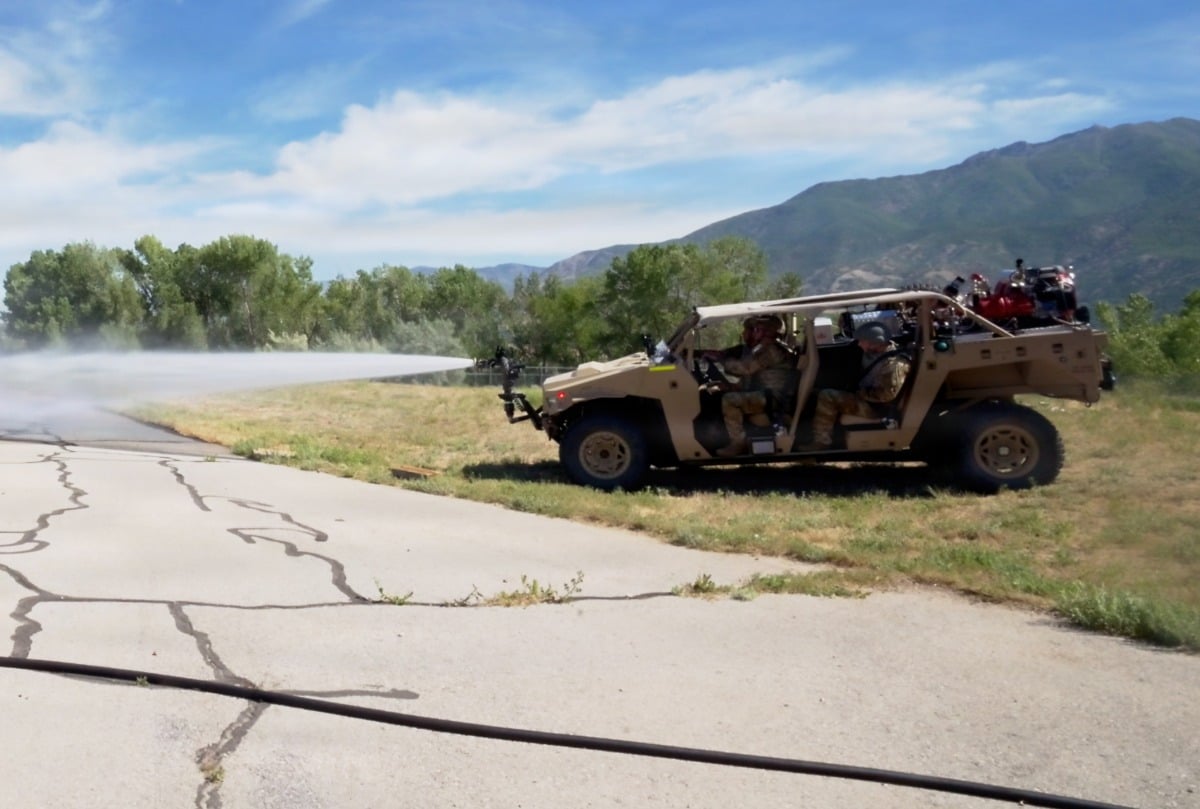
- Hill Air Force Base in Utah acquired a Polaris DAGOR vehicle retrofitted with the Ward Mobile Airfield Rescue Kit, or MARK-1, for off-road firefighting.
- Hill is one of only three Air Force installations with a MARK-1 permanently assigned to its fire department, according to Staff Sgt. Daniel Ray.
A fighter pilot crashes not on a runway, but somewhere out in the sagebrush and lava rock of Utah’s high desert, miles from pavement. Traditional airfield crash trucks, built to sprint down smooth concrete, sink or stall the moment the ground turns to sand, mud, or broken terrain, leaving a dangerous gap in how fast rescuers can actually reach someone.
Firefighters at Hill Air Force Base in Utah just closed that gap with a stripped-down, off-road buggy that looks more at home racing through the desert than fighting fires, and they showed off exactly what it can do during a live-fire training exercise on the base in June.
The vehicle is a Polaris DAGOR, an ultra-light tactical buggy originally built for special operations troops who needed something small enough to sling underneath a helicopter yet tough enough to survive rough terrain at speed. Polaris designed the DAGOR with a trophy-truck-inspired suspension and a lightweight frame that keeps its curb weight under roughly 8,500 pounds (3,856 kg) fully loaded, a fraction of what a standard airfield crash truck weighs, which is exactly why it can go places those bigger trucks cannot. The base version can carry up to nine troops and their gear, and it is certified for internal transport aboard a CH-47 Chinook helicopter, sling loading beneath a UH-60 Black Hawk, and even low-velocity airdrop from a cargo plane, meaning the vehicle can get to a remote location almost as fast as the emergency itself develops.
What turns that buggy into a firefighting apparatus is a add-on kit called the Ward Mobile Airfield Rescue Kit, or MARK-1, developed after the Air Force asked manufacturer ADS and fire apparatus builder Ward Apparatus to design something that could handle aircraft mishaps and wildland fires away from paved surfaces. The kit adds 150 gallons (568 liters) of water storage, a pump capable of moving 95 gallons (360 liters) per minute, a bumper-mounted turret that can switch between high and low water flow, hoses and a sump pump for drafting water from streams or ponds, and a large-diameter hose for hooking into a fire hydrant when one happens to be nearby. It also carries the specialized tools a crew needs to cut into a downed aircraft and pull a pilot out, plus a litter basket to carry an injured person to safety, all while still fitting inside a C-130 cargo plane or hanging beneath a helicopter for rapid deployment to a contingency site anywhere in the world.
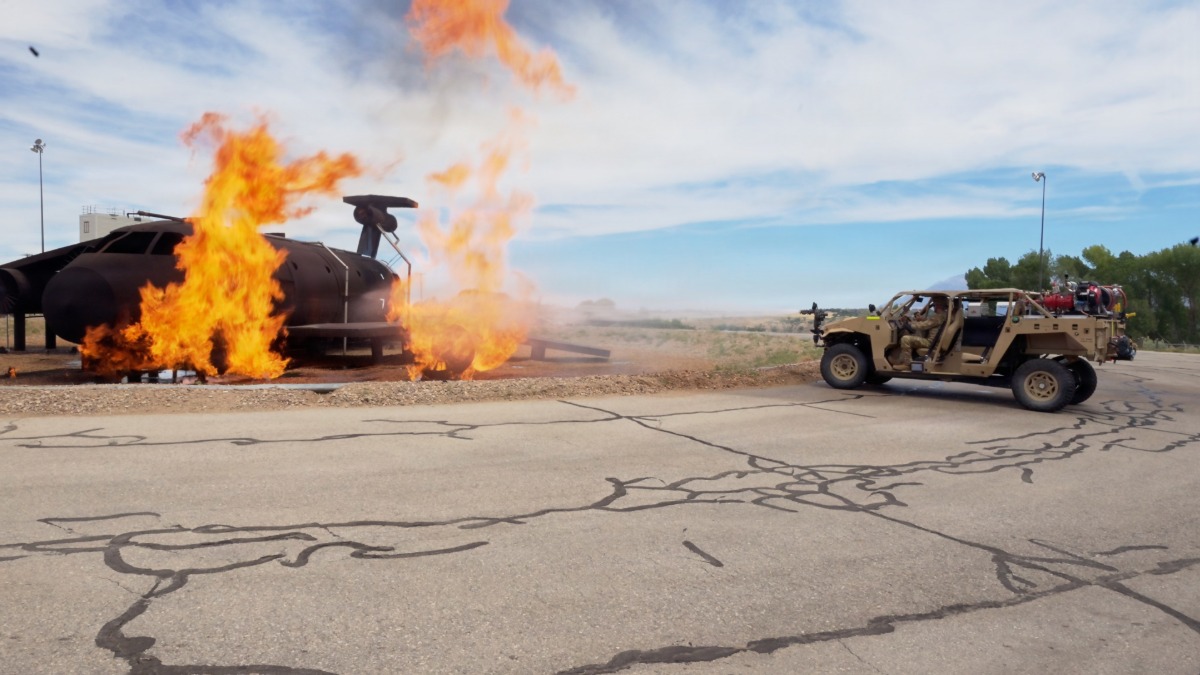
“The MARK-1 firefighting vehicle and our mobile F-35 propane training prop are our newest expeditionary equipment that allow us to bring high-fidelity, realistic combat training directly to the flightline,” said Lt. Col. Cory McCart, 775th Civil Engineer Squadron commander. “This will ensure our teams are fully prepared to sustain operations and save lives under both home station and wartime conditions.”
Hill Air Force Base is one of only three installations across the entire Air Force with a MARK-1 permanently assigned to its fire department, according to Staff Sgt. Daniel Ray, a lead firefighter with Hill’s Fire and Emergency Services. Most Air Force units that have access to the vehicle only get it temporarily, either during a specific training rotation or while deployed overseas, which means those crews are learning the vehicle’s quirks on the fly in high-stakes situations. Hill’s permanent assignment flips that arrangement, letting local firefighters fold the DAGOR into their everyday training routine so that by the time they might actually need it during a real emergency, operating it is second nature rather than something they are figuring out for the first time under pressure.
That distinction matters in Utah more than it might elsewhere, because Hill sits next to the Utah Test and Training Range, a sprawling military training area covering thousands of square miles of remote, rugged terrain used for live munitions testing and aircraft training exercises. A jet in trouble over that range could go down anywhere from dry lakebed to rocky canyon, far from any road a conventional crash truck could use, which is precisely the scenario the DAGOR and its MARK-1 kit are built to handle.
“During UTTR operations it can be utilized on the rough terrain for fast extraction of patients or fast evacuation from danger,” Ray said.
Wildland fires present a similar challenge, since a fast-moving brush fire does not wait for a heavy truck to find a way around a ravine or a stand of trees, and Ray said the DAGOR’s agility lets crews reach spots other apparatus simply cannot.
“He noted that during wildland missions, the vehicle’s versatility allows crews to access areas other trucks cannot reach to establish critical ‘wet lines’ using the bumper turret and handlines to stop spreading brush fires,” according to the account of the demonstration, illustrating how the same nimbleness that makes the DAGOR useful for aircraft rescues also pays off when the emergency is a fire racing across open desert scrubland rather than a downed jet.
Hill’s fire department is not treating the vehicle as a finished product either. Officials say they plan to work with local explosive ordnance disposal teams, who already operate similar tactical vehicles for their own missions, to trade notes on handling the DAGOR and to help shape future upgrades to the platform, a collaboration that could make the vehicle more capable across multiple specialties on base rather than staying siloed within the fire department alone.
Because Hill Air Force Base flies the F-35A Lightning II, the Air Force’s premier fifth-generation stealth fighter, the vehicle also came outfitted for a very specific rescue scenario: getting a pilot out of that particular aircraft as fast as possible. Ray said the DAGOR’s compact size lets a crew position it close to a burning aircraft while staying at a safer distance than a bulkier vehicle would allow, all while carrying the specialized tools needed to quickly access an F-35 cockpit and get a pilot out through hatches and canopy release systems that differ from older fighter designs.