

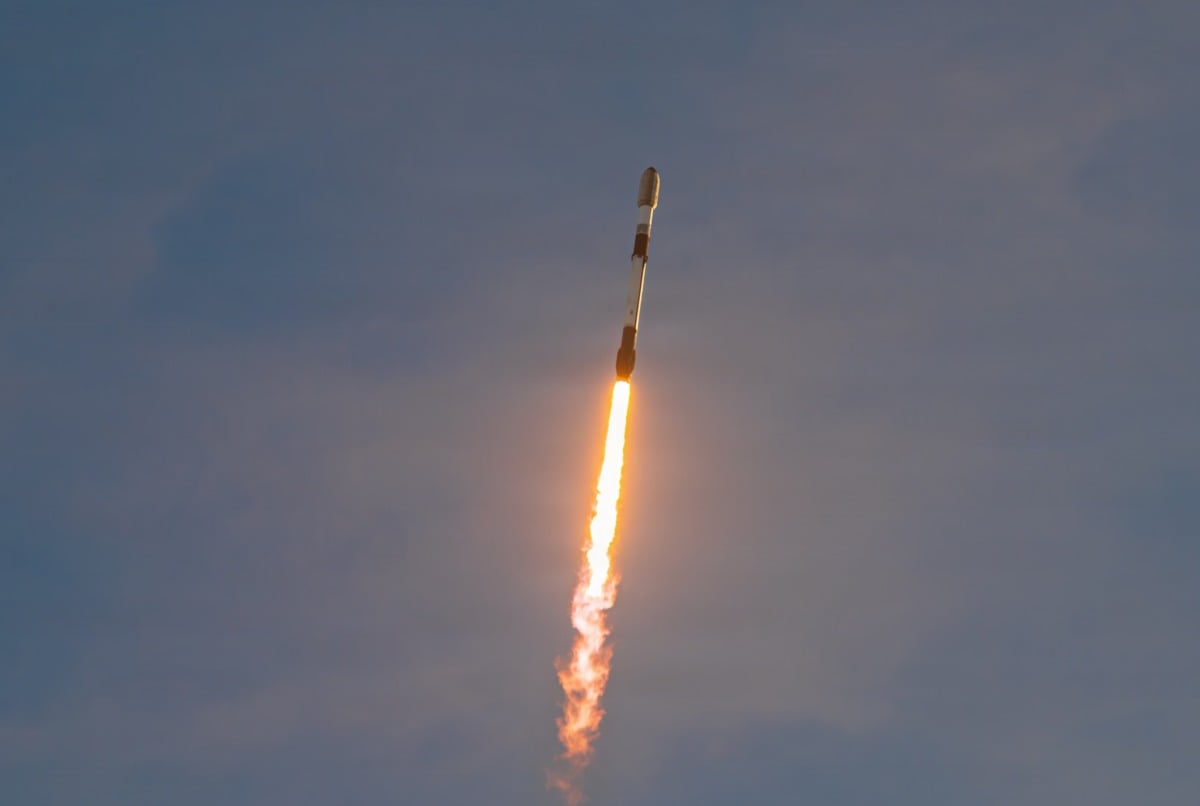
- Michael Hochberg told The Defence Blog that reusable spacecraft such as SpaceX's Starfall and Outpost Space's CarryAll Block 3 could reshape military logistics.
- Outpost Space's CarryAll Block 3 is designed to return payloads of up to 10,000 kilograms to within 25 meters of a target.
Ten minutes after liftoff, SpaceX cut its own live feed on the Starfall demonstration flight. No orbit confirmation, no payload description, no further commentary. It was the kind of silence usually reserved for national security launches, and it was enough to catch the attention of analysts tracking a parallel development: Outpost Space’s CarryAll Block 3, a vehicle designed to bring payloads of up to 10,000 kg back from orbit to within 25 meters of a target anywhere on Earth.
Both programs point to the same underlying shift. Reusable heavy-lift spacecraft are no longer just a way to get things into space. They are starting to look like logistics platforms, and that has implications for how militaries plan resupply, deterrence, and crisis response.
To unpack what that means, The Defence Blog spoke with Michael Hochberg, a technologist and strategist who writes on the intersection of technology, industrial capacity, and geopolitical power. Hochberg has published in The Wall Street Journal and The National Interest, and has co-authored two forthcoming books on geopolitics, security, and emerging technologies. The conversation covered orbital return capability, the limits of “deliver anywhere on Earth” as a military concept, and the risks of misreading a cargo launch during a crisis.
Q: You have argued that reusable heavy-lift spacecraft are evolving beyond launch vehicles into military-relevant logistics platforms. What specifically makes orbital return capability different from traditional space launch?
A: So this is really about: what does it cost to get to orbit?
Right now, if you want to deliver something to a far corner of the Earth, the cheapest way to do it is by sea, and doing it by air is much more expensive. Air may be faster but burns a lot more fuel and is just more expensive to operate. Air transport doesn’t benefit from buoyancy.
Right now, if you want to deliver something from space, it simply is not feasible unless you’re going to put it on the front of a ballistic missile, which is arguably the world’s most expensive way to deliver something, even if it is the fastest.
If space launch becomes really cheap, the way that Elon Musk is planning to do with Starship Heavy, all of a sudden the cost to put something in orbit isn’t that different from the cost to move it from point-to-point on Earth with an airplane. Air logistics is something that the military is designed to do pretty much all the time. Space logistics is coming next.
What that means is that, if you anticipate needing an object in the future, you can launch multiple copies, or multiple different objects, into orbit on a single rocket with many launches and leave them there until they’re needed. At a time of your choosing, they can be de-orbited to an unexpected location at an unexpected moment. It’s a way of achieving surprise.
With a ballistic missile, every time you want to put something in a particular place on Earth, you need a missile with a payload that you’re prepared to expend. The nice thing with these reusable launch platforms that SpaceX has built, and that other organizations are working on, is that you could use the same launch platform ten or a hundred or a thousand times to put a thousand different payloads into orbit and have those sitting in orbit ready to de-orbit when and where you need them.
That utterly alters the cost structure. As long as these things can be stored in space for weeks or months or years, you can just build an arsenal in space of munitions or satellites or of drones or of humanitarian supplies, whatever you think you’re going to need. By placing them in carefully selected orbits, you can keep them in reserve and rapidly deorbit them to a chosen location when needed. In effect, space becomes a pre-positioned logistics network, fundamentally changing the economics and speed of delivery.
Q: SpaceX’s Starfall demo drew attention because the company revealed little about the mission and ended the webcast about 10 minutes after liftoff. What should defense observers read into that level of secrecy, and what should they avoid over-interpreting?
A: Well, I mean, look, this is obviously something that’s meant for a defense application. By default, things for defense applications aren’t announced or broadcast. The fact that this was announced shows that it can’t be that much of a secret, right? There are plenty of space payloads that get launched when there is just no press about them at all. It’s clear this appears to be as much a strategic signal as a technical capability. The fact that it is being discussed publicly suggests its sponsors want potential adversaries to know it exists. Beyond that, I don’t think much can be inferred simply because the details haven’t been made public. That’s the wonderful thing about the unknowns, right? It’s really hard to know how to interpret them.
Q: Outpost Space describes its CarryAll Block 3 as a 10-ton-class vehicle for in-space manufacturing, Earth return, military resilience, and humanitarian aid. If systems like this mature, what military missions become realistic first: urgent resupply, spare parts, medical logistics, distributed basing, or special operations support?
A: The difficulty with using this approach for spare parts is the sheer diversity of components that would need to be stored in orbit. Just because something is in orbit doesn’t mean that you can immediately de-orbit it anywhere on Earth. If you want to be able to de-orbit something anywhere on Earth within a short amount of time, you’re going to need many versions of that thing moving in intelligently chosen orbits over the Earth. A typical orbit only covers a point on Earth within some short distance, maybe once a day. To do things where you want to deorbit something every half hour, you need 50 to 100 copies of that.
Now, there are ways to be smarter about that. For most applications, you don’t need the ability to deorbit an object anywhere on Earth, say in the middle of the Atlantic or the middle of the Pacific. You can pick orbits that cover the spots where you expect to need things.
The demand for manufacturing in space is not yet obvious. We really haven’t found an application that needs it yet. I don’t think humanitarian aid is going to drive this, fortunately or unfortunately. The technology is simply too expensive. The first applications are much more likely to be military: resilience, urgent resupply, medical logistics in contested environments, and special operations support are places where you’re going to see this, but to be honest I think the first application is going to be delivering munitions.
Another major application I see is the delivery of UAVs. That would let you conduct intelligence, surveillance, and reconnaissance below the cloud layer almost anywhere on Earth on very short notice and at very high resolution. That’s something satellites simply can’t do when there’s bad weather.
[Editor’s note: CarryAll Block 3 is Outpost Space’s flagship return vehicle, designed to carry payloads up to 10,000 kg (22,000 lbs) with landing accuracy within 25 m (80 ft) of a target.]
Q: The phrase “deliver anywhere on Earth” is powerful, but military logistics is constrained by launch cadence, landing permissions, weather, recovery teams, cost, and escalation risk. Which of those constraints is most likely to limit real operational use?
A: Well, the whole point of putting pre-positioning things in orbit is that none of these things is a constraint, right? You could spend years launching things inside the orbital window, when you have the weather windows and everything else. Launch the payloads, have them waiting in orbit, and then you don’t have to be constrained by anything when you have an urgent need to deliver something.
Of course, if you need to deliver something that you don’t have pre-positioned in orbit, that’s quite a different story. Then you’re subject to all of the constraints that you’re talking about.
Q: If a military orbital cargo mission is launched during a crisis, how might an adversary distinguish between a logistics payload, an intelligence payload, and a weapon-related payload? What are the risks of misinterpretation?
A: This is always a concern, right? There was a taboo around the use of ballistic missiles for military purposes for a very long time, but at this point that’s completely disappeared. The Iranians have been using ballistic missiles like they’re going out of style. The Israelis and others have used air-launched ballistic missiles. The Russians have been using ballistics and hypersonics. I think we’ve just normalized seeing things launched into space, and the assumption is that they’re not nuclear unless there’s a reason to believe that they are.
But yes, there is a huge risk of misinterpretation. There’s not really much to be done about that right now. One could imagine inspection regimes to ensure that commercial launch infrastructure isn’t being used to place nuclear weapons in orbit. But given the current level of distrust among the major powers, I don’t imagine that that’s very likely at this point.
Q: Looking 10 years ahead, what would convince you that space has become a real military logistics domain rather than a niche emergency option?
A: Yes, if we had constellations of tens of thousands of satellites in orbit that were being used for military logistics purposes on Earth. That is something that I think is perfectly within the bounds of what I expect.