

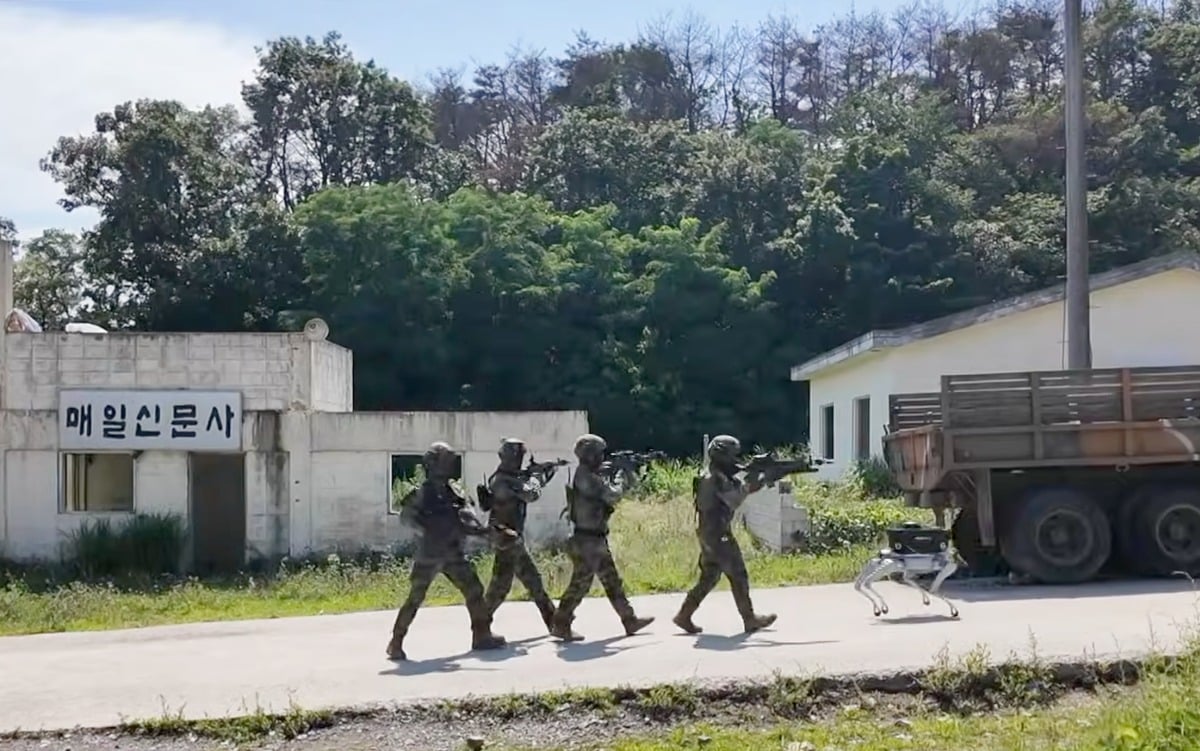
- South Korea's Marine Corps 1st Division Combat Experimentation Battalion tested K808 vehicles, drones, and quadruped robots in a combat exercise.
- The battalion, established January 29, 2024, compared combat performance between company and smaller team-sized units.
A South Korean Marine unit sent a robot on four legs walking point ahead of its own troops during a live combat exercise last week, a small but telling sign of how the country’s military is trying to solve a problem that has nothing to do with technology and everything to do with demographics.
The Republic of Korea Marine Corps’ 1st Division Combat Experimentation Battalion tested an integrated manned and unmanned combat system that combined K808 wheeled armored personnel carriers, aerial drones, and quadruped walking robots during a field exercise simulating real combat conditions, according to footage and reporting distributed by South Korean defense media. Drones scouted enemy positions from overhead while a command post monitored the battlefield in real time, and a quadruped robot moved ahead of the formation’s human troops, taking on dangerous reconnaissance duties specifically to keep Marines out of the most immediate line of fire.
The K808, sometimes referred to by its nickname White Tiger, is South Korea’s domestically produced 8×8 wheeled armored personnel carrier, a vehicle The Defence Blog has previously reported drew praise from an American Marine who trained alongside Republic of Korea forces earlier this year, describing the K808 as representing a generational leap in armored vehicle design compared to the U.S. Marine Corps’ own Stryker and Light Armored Vehicle platforms.
That vehicle formed the manned backbone of last week’s exercise, working alongside the unmanned systems rather than being replaced by them, reflecting South Korea’s current approach of integrating robots and drones into existing formations rather than attempting to substitute machines for soldiers entirely.
The exercise’s core purpose was comparing combat performance between traditional infantry company formations and smaller team or platoon-sized units equipped with these manned-unmanned combat systems, testing whether South Korea’s Marine Corps could restructure its future force organization around fewer troops supported by more capable equipment without sacrificing overall combat effectiveness. That comparison matters enormously to a country facing one of the world’s steepest demographic declines, since South Korea’s shrinking birth rate has already begun reducing the pool of young men available for compulsory military service, forcing planners across all branches of the armed forces to find ways of maintaining combat power with fewer available personnel rather than simply accepting a smaller, less capable military.
Troops participating in the exercise wore body cameras and smart glasses that transmitted footage of their actions directly back to the command post in real time, letting commanders issue tactical instructions based on what individual Marines were actually seeing and doing in the field rather than relying on delayed radio reports or after-action reconstruction. That setup represents what the exercise described as a hyper-connected command and control system, a network intended to compress the time between a soldier encountering a threat and a commander responding to it, a capability increasingly viewed as essential across modern militaries as battlefield information moves faster and decisions need to keep pace.
South Korea’s Marine Corps established the 1st Division Combat Experimentation Battalion on January 29, 2024, aligning the unit’s creation with a broader development plan from the country’s Ministry of National Defense aimed at preparing the armed forces for future battlefield conditions. Since standing up, the battalion has focused on collective training with new equipment and small-unit combat skill development through a range of live field exercises, using each iteration to refine both the equipment itself and the tactics needed to employ it effectively. Last week’s test represents one entry in that ongoing program rather than a one-time demonstration, with Marine Corps officials indicating plans to continue conducting scientific, systematic combat experiments and applying whatever lessons emerge to future battlefield environments as they evolve.