

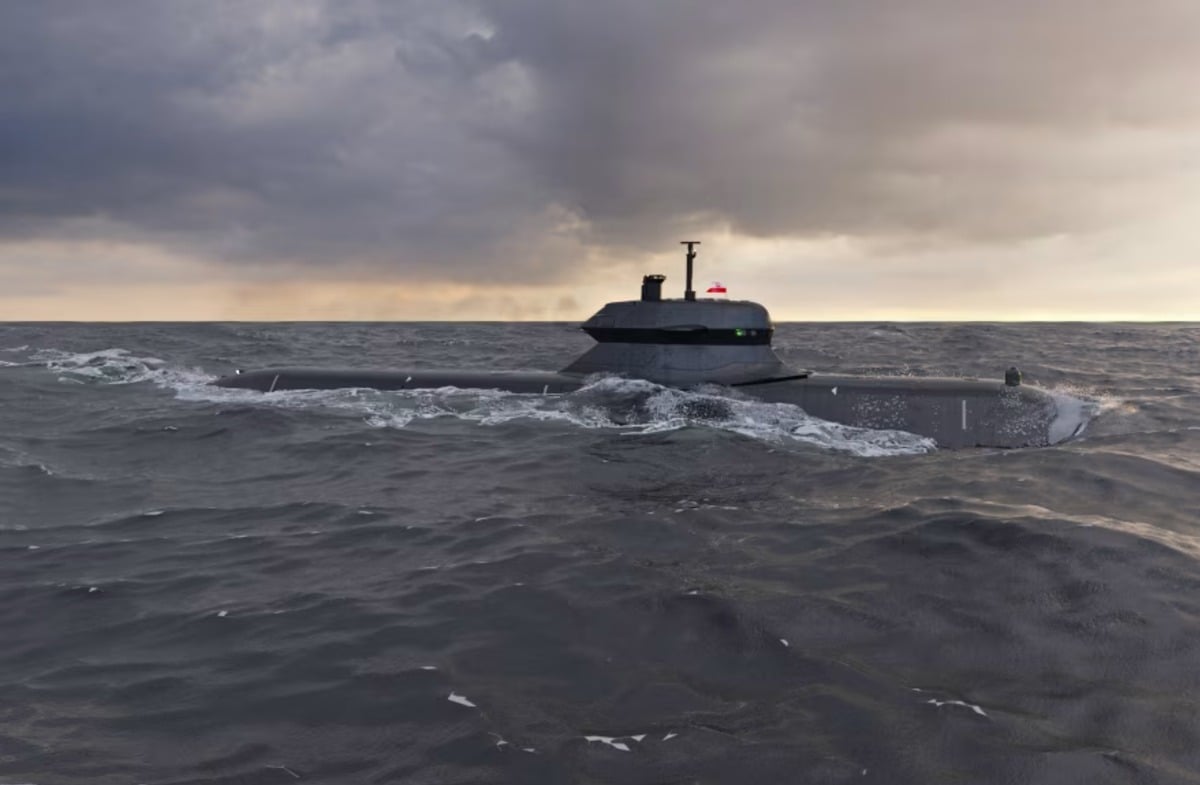
- Saab signed a $4.83 billion contract with Poland's State Treasury Armaments Agency on June 29, 2026, for three A26 submarines with weapons, training, and support packages.
- Final deliveries are scheduled for 2038, and Poland will borrow Swedish Navy submarine HMS Södermanland as a gap-filler during construction.
Poland signed a $4.83 billion contract with Sweden’s Saab on June 29, 2026, for three A26 Blekinge-class submarines under its long-running Orka program, completing seven months of tense negotiations that at several points threatened to collapse over industrial offset demands, and delivering NATO its most significant Baltic Sea undersea capability expansion since the Cold War.
The contract, signed with Poland’s State Treasury Armaments Agency, includes a weapons package, training, and long-term support, with final deliveries scheduled for 2038. Poland will also borrow the Swedish Navy submarine HMS Södermanland as a gap-filler to begin crew training while the new boats are under construction.
The A26 is not a conventional submarine competing on price. Saab markets it as the world’s first fifth-generation submarine, a designation it earns through a combination of capabilities that no previous conventionally powered design has assembled in a single platform. The boat measures approximately 62 m (203 ft) in length with a surfaced displacement of roughly 1,800 tonnes (3.97 million lb), carries a crew of 26 with capacity for up to 35 including special forces, and uses a Stirling-cycle air-independent propulsion system that burns liquid oxygen and diesel to generate electricity for both propulsion and battery charging without needing to surface or snorkel. The practical result is a submarine that can remain fully submerged for more than 18 days, moving silently through Baltic waters while Russian surface ships and anti-submarine aircraft search above it. Its acoustic signature management is specifically engineered for the Baltic’s exceptionally shallow, acoustically complex environment, where sonar conditions make detection both easier for hunters and more demanding for the hunted.
The A26 has the option of being fitted with vertical launch system cells compatible with Tomahawk land attack missiles, which would give Poland a submarine-launched conventional strike capability against land targets, a dimension that the Polish government has been publicly interested in as it builds out its long-range precision strike architecture. The submarines also carry long-range precision torpedoes for anti-submarine and anti-surface warfare, support the launch and recovery of unmanned underwater vehicles for seabed warfare and intelligence collection, and can conduct minelaying operations that are particularly relevant in the confined waters of the Baltic, where a well-placed minefield can dramatically complicate an adversary’s naval movement.
Swedish Prime Minister Ulf Kristersson welcomed the contract on X, saying: “It is a very large and long-term deal — it will make the Polish Navy one of the strongest in all of NATO. A strong Polish submarine force strengthens security in our shared Baltic Sea and across the alliance.”
The competition that Poland’s selection ended was genuinely global and intensely contested. Saab’s A26 design beat competing offers from France’s Naval Group, Germany’s ThyssenKrupp Marine Systems, Italy’s Fincantieri, South Korea’s Hanwha Ocean, and Spain’s Navantia, six of the world’s leading submarine builders, each of which had made substantial efforts to win the contract. The Polish selection of a Swedish design over German, French, Italian, and South Korean alternatives reflects both the A26’s specific optimization for Baltic Sea conditions and the broader strategic logic of a deepening Poland-Sweden partnership within NATO’s northeastern flank.
The contract’s path to signature was not smooth. As recently as mid-June 2026, reporting from Grosswald Signal indicated the deal was deadlocked over industrial offset demands Warsaw had made preconditions for signing: Poland wanted Sweden to purchase the Ratownik rescue vessel from the PGZ naval shipyard at Gdynia, a PGZ-Saab joint venture covering submarine maintenance and underwater drone production, and a defined technology transfer package. Deputy Minister Konrad Gołota of the Ministry of State Assets had set a hard deadline, publicly stating that a failure to reach agreement by end-June would reopen negotiations with Italy’s Fincantieri and South Korea’s Hanwha Ocean. The contract announced June 29 indicates those demands were resolved, though the specific terms of the industrial cooperation package were not detailed in the Saab announcement.
Saab CEO Micael Johansson, in the company’s press release, was appropriately measured about the significance of the moment for the program.
“We are deeply honoured that Poland has chosen Saab’s submarines to bolster its defence capabilities and strengthen the strategic partnership between our two nations,” Johansson said. “The three A26 submarines meet Poland’s current and future defence requirements and will play a pivotal role in enhancing security in the Baltic Sea region.”
The broader context is one of Poland emerging as one of NATO’s most aggressive defense investors by any per-capita or GDP-share measure. Warsaw is currently receiving FA-50 light combat jets from South Korea while preparing to receive 32 F-35A fighters, has signed major contracts for HIMARS rocket artillery, K2 tanks, and K9 howitzers from South Korea, is expanding its Patriot and SHORAD air defense networks, and has been financing significant portions of its defense spending through the EU’s SAFE loan program, which allocated €43.7 billion (approximately $50 billion) to Poland for arms purchases. The A26 contract, funded partly through that European mechanism, adds an undersea dimension to a force that has been growing primarily in land and air power.
Poland’s existing submarine force, which at the time of the Orka program’s award consisted of a single Soviet-era Kilo-class diesel-electric boat that dates to the Cold War era, provides essentially no meaningful deterrent or warfighting value against modern threats. Russia’s Kaliningrad enclave, which hosts a major naval base equipped with submarines and surface combatants, is one of only two Russian naval bases in the Baltic Sea, making the region a priority area for anti-submarine warfare planning. Three modern, extremely quiet A26 submarines capable of remaining submerged for weeks and striking targets on land with cruise missiles represent a qualitative transformation of Poland’s naval posture, not an incremental upgrade.
The A26 program itself has not been without difficulties. Sweden ordered two boats in 2015, but the program experienced significant delays and cost overruns, with the schedule slipping to 2031 and 2033 for the Swedish boats and total costs more than doubling from original estimates. Poland’s three-boat order, which expands the total production run to five submarines, provides the economies of scale that a two-boat program could never achieve and gives Saab Kockums’ Karlskrona shipyard the sustained production workload needed to stabilize costs and schedules across the full order book.