

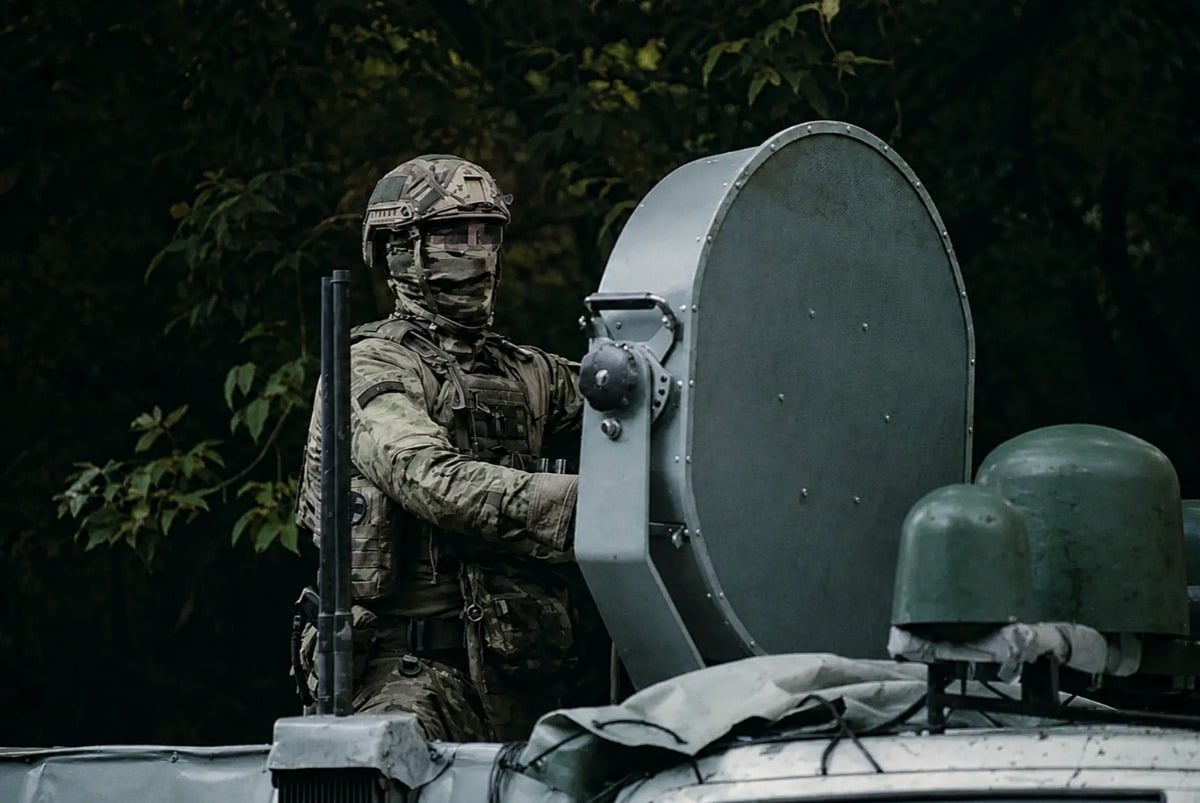
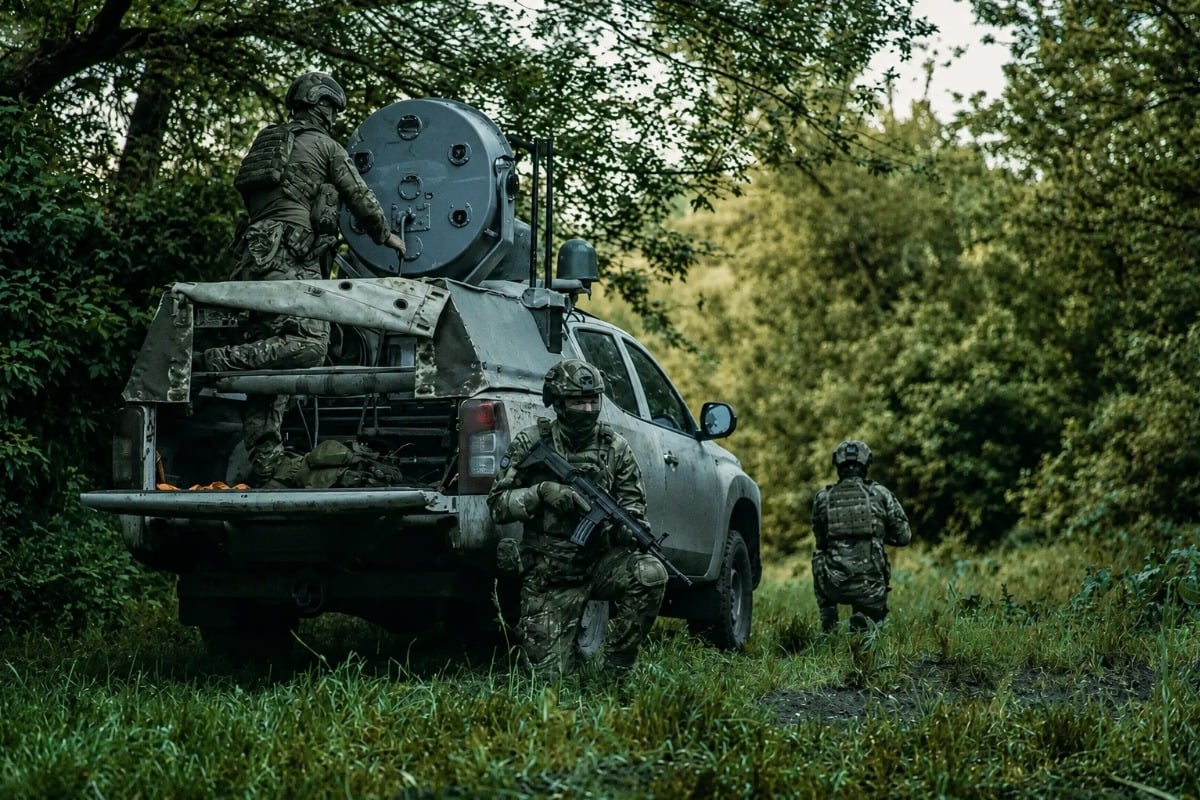
- Training photographs show Ukrainian Special Operations Forces exercising with what appears to be an LRAD 1950XL-RT acoustic hailing device mounted on a tactical vehicle.
- The LRAD 1950XL-RT broadcasts voice commands up to 5,000 meters range and generates 160 dB peak output; combat use by Ukrainian SSO has not been confirmed.
Training photographs circulating from a Ukrainian Special Operations Forces unit show what appears to be a large-format acoustic hailing device mounted on top of a tactical vehicle, a system that analysts assessing the images tentatively identify as consistent with the LRAD 1950XL-RT manufactured by California-based defense technology company Genasys. The images represent the first observed instance of Ukrainian SOF exercising with a vehicle-mounted long-range acoustic communication system of this class, though whether the equipment has been used in active operations remains unknown.
The LRAD 1950XL-RT, which stands for Long Range Acoustic Device, is the largest and most powerful single-head acoustic hailing system in the Genasys product line, designed to broadcast intelligible voice commands and alert tones at distances up to 5,000 meters (3.1 miles) in ideal conditions and up to 1,600 meters (1 mile) in environments with background noise levels of 88 decibels, roughly equivalent to the noise level of a heavy diesel truck at close range.
The head unit measures 91 centimeters by 99 centimeters by 31 centimeters (36 in by 39 in by 12 in), weighs 43.1 kilograms (95 pounds), and generates a maximum peak output of 160 decibels sound pressure level at 1 meter, a figure that places it well beyond the threshold of immediate auditory pain for unprotected human ears.
The system projects sound within a directional beam of plus or minus 15 degrees at 1 kilohertz, concentrating acoustic energy rather than broadcasting omnidirectionally, which allows operators to address specific targets or areas without saturating the surrounding environment with noise.
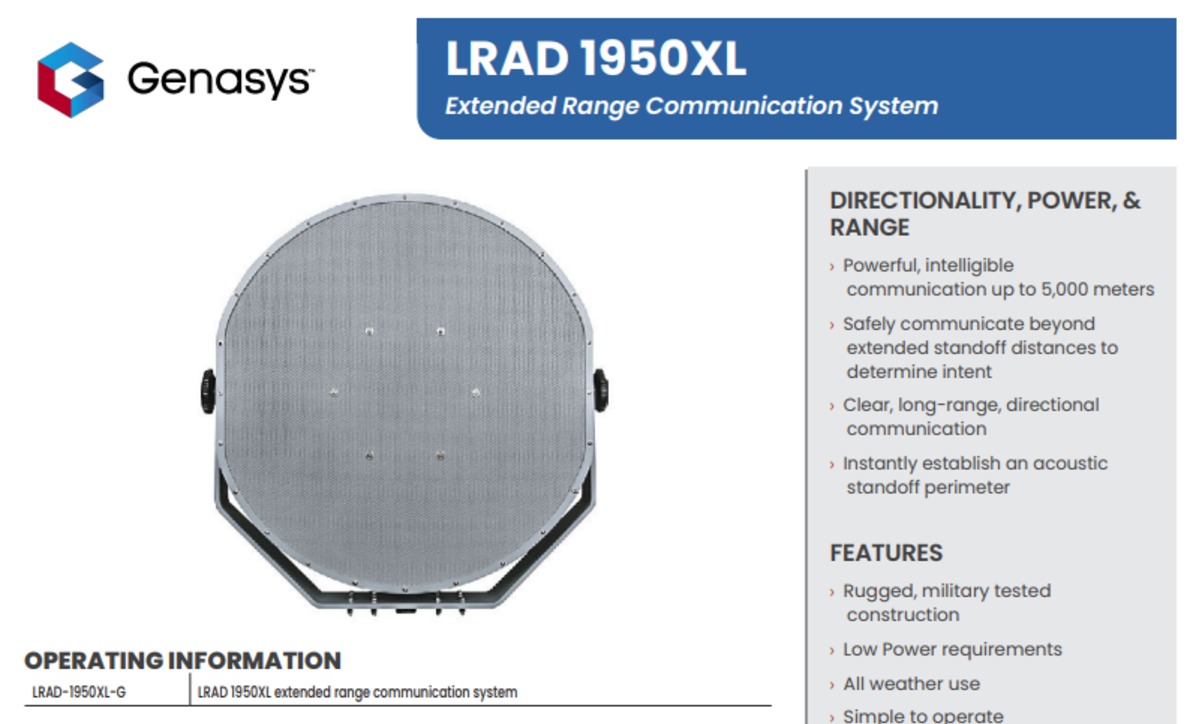
The 1950XL-RT variant visible in the training images, if the identification holds, incorporates a built-in Ethernet interface that enables both local and remote operation, meaning the system can be operated from a protected position inside the vehicle rather than requiring personnel to expose themselves to control the device manually. The electronics housing is a separate water-resistant case measuring 23 centimeters by 56 centimeters by 38 centimeters (9 in by 22 in by 15 in), and the system is designed to meet MIL-STD-810H environmental standards, the U.S. military specification covering performance across temperature extremes from minus 33 degrees Celsius to plus 60 degrees Celsius (minus 27 to 140 degrees Fahrenheit), blowing rain, salt fog, and shipboard shock and vibration, making it suitable for vehicle-mounted field use across the range of conditions Ukrainian forces encounter.
The Ukrainian Special Operations Forces, known by their Ukrainian abbreviation SSO and established as an independent military branch in January 2016, are tasked with unconventional warfare, deep reconnaissance, direct action behind enemy lines, and influence operations. According to a primer on Ukrainian SOF published in Joint Force Quarterly, the command operates as part of a broader interministerial special operations ecosystem that includes units under the Security Service, National Police, and Border Guard, with coordination frequently based on personal relationships rather than centralized command structures. The SSO has conducted operations ranging from sabotage inside Russian territory to targeting of high-value systems, and the appearance of a vehicle-mounted acoustic system in SSO training suggests the unit is exploring non-kinetic capability options that sit below the threshold of lethal force.
Vehicle-mounted acoustic hailing devices in other militaries have been used at checkpoints and road control points to issue stop commands to approaching vehicles at distances that allow lethal force responses if the commands are ignored, which is the escalation-of-force application the Genasys product documentation specifically describes. The system’s ability to broadcast clear voice commands in any language at standoff distances of up to 1,600 meters (1 mile) under realistic operational noise conditions could also support psychological operations, loudspeaker missions aimed at inducing surrender or reducing enemy cohesion, a function that SOF units have historically performed using less capable vehicle-mounted public address systems. A third possibility is border security or checkpoint enforcement in areas under Ukrainian control, missions that the SSO and associated forces perform in addition to their conventional special operations tasks.
What none of these applications requires, it is worth stating directly, is the 160-decibel peak output of the 1950XL-RT. The system’s maximum acoustic output, if directed at personnel at close range, produces conditions that can cause immediate auditory pain and, with prolonged exposure, hearing damage. Genasys markets the LRAD product line explicitly as a communication and escalation-of-force tool, not a directed-energy weapon, and the company’s documentation consistently frames the deterrent tone capability as a tool for prompting compliance at a distance before more forceful options become necessary. The distinction matters because LRAD systems have generated legal controversy in other contexts, including multiple lawsuits in the United States following their use against civilian protesters, where close-range exposure to deterrent tones produced documented auditory injuries.
The LRAD product line was originally conceived in direct response to the October 2000 bombing of the USS Cole in the port of Aden, Yemen, when a small boat laden with explosives approached the guided-missile destroyer and detonated, killing 17 sailors. The attack exposed a gap in naval force protection: the need for a way to communicate unambiguous warnings to approaching vessels at distances great enough to allow a response if the warnings were ignored, without resorting immediately to gunfire. American Technology Corporation, the predecessor company to what is now Genasys, introduced the first LRAD in 2002 for naval applications, and the technology subsequently spread to land vehicles, fixed installations, helicopters, and law enforcement, with Genasys now reporting coverage of more than 155 million people across all 50 U.S. states and more than 100 countries.