

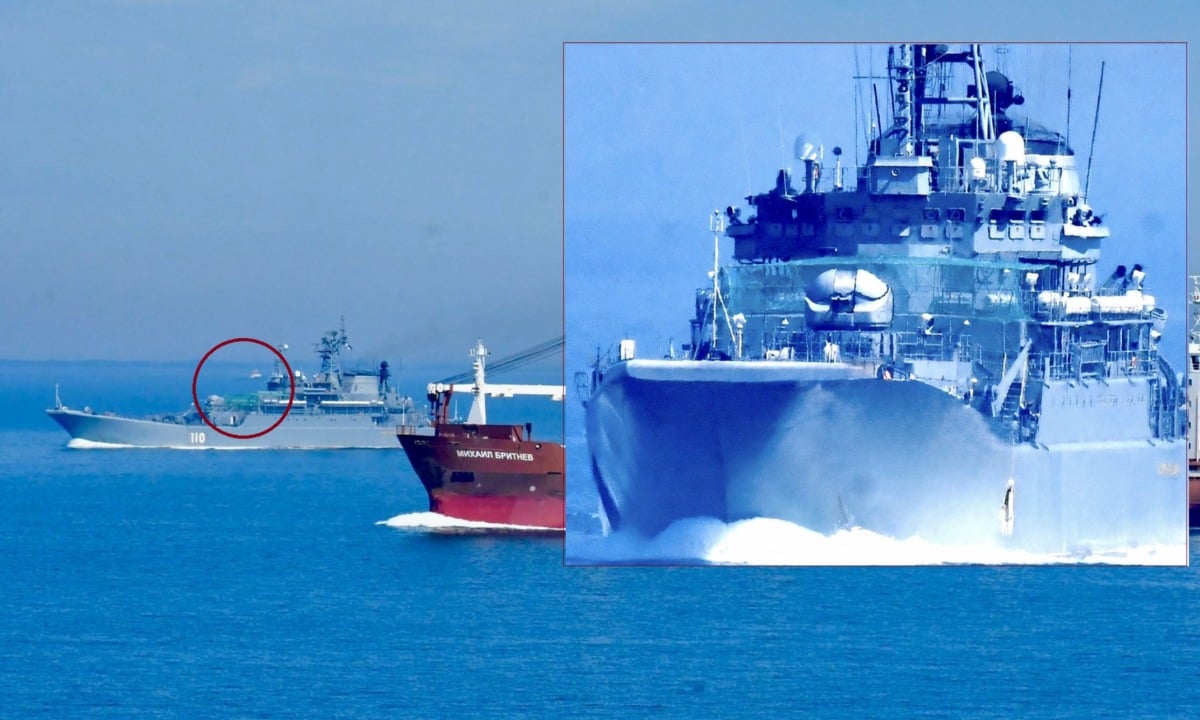
- Russian Baltic Fleet landing ship Aleksandr Shabalin was photographed escorting cargo vessel Mikhail Britnev in the Baltic Sea fitted with thin anti-drone mesh netting.
- Russian military Telegram channel Voenny Osvedomitel stated the mesh can stop at most a light FPV drone, not the heavier Ukrainian FP-2 strike systems targeting Russian naval vessels.
A photograph making the rounds among Russian military analysts shows the Russian Navy’s latest answer to Ukraine’s growing drone threat at sea: a thin green mesh net, the kind more commonly found on garden trellises or insect screens, draped over the superstructure of a 40-year-old landing ship tasked with escorting a cargo vessel through the Baltic Sea. The image, showing the Project 775 large landing ship Aleksandr Shabalin accompanying the freighter Mikhail Britnev, prompted a wave of ridicule from commentators on Russian military Telegram channels who noted that the makeshift screen would barely stop the lightest battlefield drones, let alone the heavy strike systems Ukraine has been using to hit Russian warships.
The Telegram channel Voenny Osvedomitel, one of Russia’s most-followed military commentary outlets, was characteristically blunt in its assessment of what the photograph revealed.
“There can be no other purpose for this thin green net,” the channel wrote. “If very lucky, such a net will stop at most an FPV drone, but in no way the heavy FP-2 and their analogues, with which Ukraine strikes ships of the Russian Navy.”
The FP-2 is a long-range one-way attack drone produced by Ukrainian defense company Fire Point, developed on the same airframe design as the company’s FP-1 deep-strike drone but reconfigured for shorter operational distances and carrying a substantially heavier warhead. That combination of purpose-built guidance, significant explosive payload, and combat-proven employment against Russian naval targets puts the FP-2 in an entirely different destructive category from the small commercial quadcopters the thin mesh might theoretically deflect. The improvised green netting visible on the Shabalin offers no meaningful defense against a weapon of that class, which is precisely the point the Russian commentators were making.
The Aleksandr Shabalin is a Ropucha-class large landing ship, a vessel class built in Gdańsk, Poland, between the mid-1970s and early 1990s for the Soviet Navy and designed for an entirely different mission: transporting armored vehicles and infantry directly onto beaches through bow and stern doors. The ship displaces 4,080 metric tons (4,497 short tons), stretches 112.5 meters (369 feet) in length, and carries a crew of 87. Its armament consists of two twin 57 mm (2.2 in) gun mounts and rocket artillery systems, the kind of weapons suited to supporting a beach assault rather than defending a convoy from aerial drone attack.
Using the Shabalin to escort a cargo ship through the Baltic is itself a story of improvisation, and Voenny Osvedomitel did not miss it. The channel noted that deploying a landing ship as an escort vessel is clearly not a choice made from a position of strength, observing that the Russian fleet simply lacks adequate dedicated escort ships and is therefore occasionally forced to use vessels whose primary purpose is moving cargo and troops ashore. Russia has been formalizing its practice of providing naval escorts for civilian cargo vessels transiting the Baltic since early 2026, when the Russian government’s maritime board announced measures to protect shipping it considers strategically important, according to the Atlantic Council, which documented the policy shift. The practical reality is that the Baltic Fleet’s inventory of capable surface combatants is limited, and sending a landing ship to play escort is the kind of solution that produces photographs.
The Mikhail Britnev, the cargo vessel the Shabalin was accompanying, is a general cargo ship built in 1995 sailing under the Russian flag, with vessel tracking data placing it on Baltic Sea routes toward Russian ports. Russia has progressively expanded its use of naval escorts for civilian and military logistics vessels in the Baltic as Western nations, particularly the Baltic states, Finland, Sweden, and NATO maritime forces, have intensified inspections and detentions of vessels associated with Russia’s shadow fleet, the informal network of ships moving Russian cargo outside the official international shipping system. The need to provide armed escort for cargo that previously moved without incident reflects how significantly Russia’s maritime logistics situation has deteriorated as the war in Ukraine has continued and Western sanctions pressure has mounted.
The anti-drone netting itself is part of a broader and accelerating trend across the Russian Navy, one that carries its own implicit admission about the threat environment Moscow’s sailors now operate in. Similar mesh structures have appeared on Russian surface warships and submarines across multiple fleets, from the Black Sea to the Baltic to the Arctic, and most recently on strategic ballistic missile submarines at the Rybachiy base in Russia’s Pacific Fleet, located approximately 7,400 kilometers (4,600 miles) from the Ukrainian front lines. Naval News reported in May 2026 that satellite imagery showed two Borei-class nuclear submarines covered in anti-drone netting, a development analysts read as evidence of Russian commanders taking the threat of Ukrainian long-range surprise attacks seriously even at bases far removed from the fighting.
The practical limitations of the approach are well understood among military observers. The nets provide a degree of protection against the smallest and slowest commercial FPV quadcopters, which carry small shaped-charge warheads comparable to a rocket-propelled grenade, but they offer no meaningful defense against larger purpose-built strike systems. They do nothing against maritime drone boats, which have been responsible for some of Ukraine’s most damaging naval strikes. And as analysts have noted, a skilled drone operator can fly around or through gaps in static netting with relative ease, since FPV drones are highly maneuverable and Ukrainian operators have demonstrated the ability to navigate through open hatches on armored vehicles and into confined spaces. What the netting consistently accomplishes is something else: it signals anxiety. A navy that fits insect mesh to a landing ship pressed into convoy escort duty through what was, until recently, considered a relatively safe stretch of European water is a navy that knows the rules of the maritime environment have changed in ways it has not fully answered.
Russia has invested in more sophisticated counter-drone solutions as well. The Murmansk Arctic University patented a system in September 2025 for shipborne turrets that deploy fiber-optic-tethered multicopters for close-range drone defense, and various Russian naval vessels have received electronic warfare equipment intended to jam and spoof incoming systems. But those solutions take time and resources to develop, procure, and install, and they are not yet present on every vessel that needs protection. In the interim, the thin green netting does what thin green netting can do.