

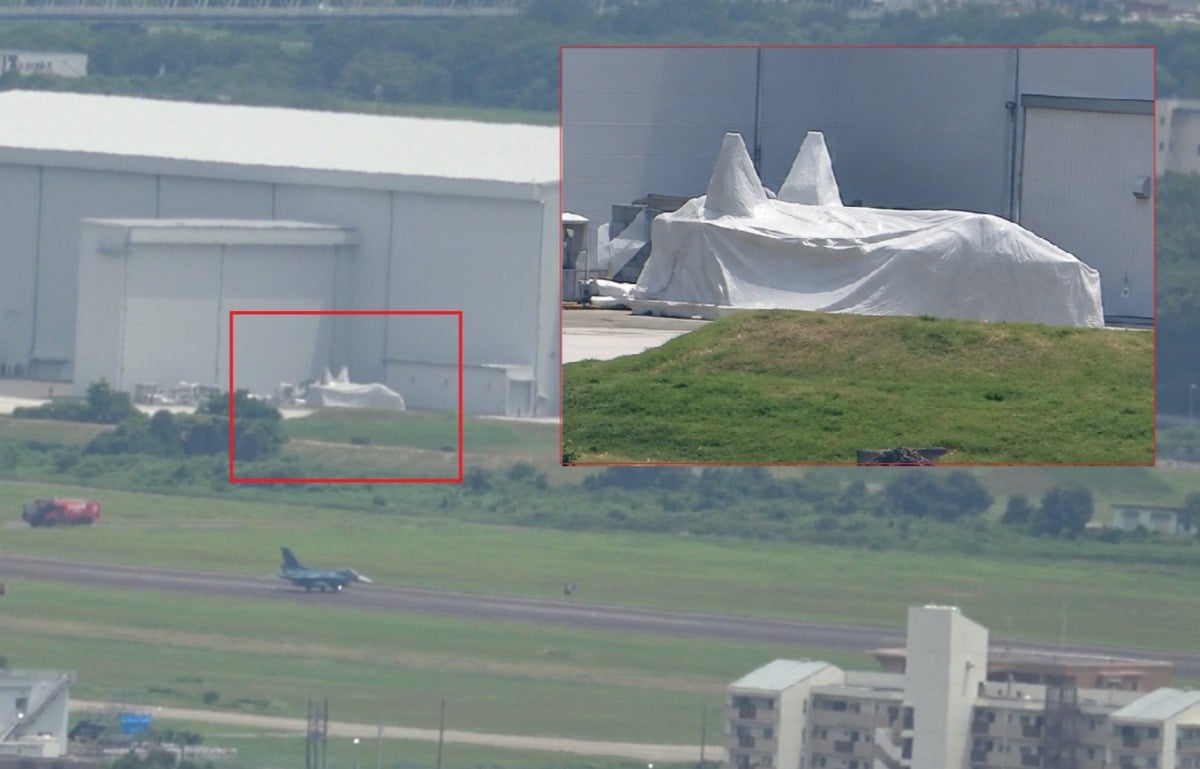
- A twin-tailed aircraft covered entirely in white fabric was photographed at Japan's Gifu Air Base on June 18, 2026, by Japanese aviation observer @intpt93.
- A separate post by @Mumbo_Ghost described a new Electronic Warfare Evaluation Facility at Gifu built to replace an outdated anechoic chamber for F-3, SOJ, and AWACS testing.
A mystery military aircraft draped entirely in white fabric was spotted at Japan’s Gifu Air Base on June 18, 2026, triggering immediate speculation across defense-focused social media about what the shrouded airframe might be and why it was being kept hidden in plain sight on an active flight line.
The sighting was first posted by Japanese aviation observer account @intpt93 on X, where it accumulated 2.2 million views within hours of publication, a level of engagement that reflects how rarely anything visually unusual appears at Gifu, one of Japan’s most important flight test and evaluation facilities. The account’s reaction was unscripted: “Huh… Whaaaaaat!!!! Biggest shock of the day.” The photographs show what appears to be a twin-tailed aircraft with its entire airframe covered in white sheeting or fabric, parked on the ramp area outside a hangar at the base. The covering obscures all external details including any markings, sensor apertures, inlet geometry, and surface features that would allow definitive identification from the available imagery.
Gifu Air Base, located in Gifu Prefecture in central Japan, serves as the primary home of the Japan Air Self-Defense Force’s Air Development and Test Wing, the organization responsible for evaluating new aircraft, systems, and equipment before they enter service with Japan’s air arm. The base hosts a diverse mix of aircraft types at any given time, including modified test platforms, prototype systems, and production aircraft undergoing specific capability evaluations, making it both a natural location for unusual sightings and a place where operational security around sensitive programs is taken seriously. The presence of a shrouded aircraft on the Gifu ramp is not inherently surprising given the base’s mission, but the scale and completeness of the covering applied to this particular airframe, combined with its apparent twin-tail configuration, has attracted attention from observers who track Japanese defense aviation developments.
The twin-tail silhouette visible through or above the fabric covering is the most analytically significant detail available from the images. A number of posts comparing the mystery aircraft to nearby aircraft provided a size reference, noting that compared to an F-2 parked in closer proximity to the camera, the shrouded aircraft’s dimensions appear comparable to an F-15, suggesting a platform in the same general size class as Japan’s primary air superiority fighter rather than a smaller trainer or light combat type. The Japan Air Self-Defense Force operates the F-15J and F-15DJ, license-built variants of the McDonnell Douglas F-15 Eagle, as its primary high-end interceptor, and Gifu regularly hosts F-15 test activities including avionics upgrades and system integration work. An F-15 variant undergoing radar cross-section evaluation or electronic warfare system testing would be a plausible candidate for the kind of comprehensive external covering visible in the images, though this remains inference rather than confirmed identification.
The separately circulating information about a new electronic warfare evaluation facility at Gifu, shared by OSINT account @Mumbo_Ghost, provides relevant context for interpreting why an aircraft might be shrouded on the ramp there at this particular moment. The post describes a new Electronic Warfare Evaluation Facility being constructed or recently completed at the base, intended to replace an existing anechoic chamber, a specially lined room designed to absorb electromagnetic signals and prevent outside radio frequency interference from contaminating test measurements, that had become too small and outdated for current requirements. The new facility reportedly supports testing of fighter aircraft, stand-off jamming systems referred to by the abbreviation SOJ, and airborne early warning and control aircraft of the AWACS type, a comprehensive capability that covers the full range of electronic warfare and radar evaluation missions that a modern air force needs to conduct.
An anechoic chamber of the type described is the standard facility used to measure an aircraft’s radar cross-section, the technical term for how large a radar return a given aircraft produces when illuminated by an enemy radar system, as well as to evaluate the performance of onboard electronic warfare equipment in a controlled electromagnetic environment free from external interference. If the shrouded aircraft at Gifu is undergoing or preparing for radar cross-section evaluation, the external covering would serve a straightforward purpose: preventing observers, including satellite imagery analysts and anyone with a camera near the base perimeter, from seeing the precise configuration of any low-observable features, structural modifications, or sensor installations that might be under evaluation and that the Japan Air Self-Defense Force or its program partners have not yet publicly disclosed.
Japan is in the midst of one of the most significant periods of military aviation development in its postwar history, with the domestically developed F-X next-generation fighter program, now officially designated the F-3, under active development by Mitsubishi Heavy Industries in collaboration with BAE Systems of the United Kingdom and Leonardo of Italy under the Global Combat Air Programme partnership. While the F-3 is not expected to fly in prototype form for several years, associated technology demonstrators, radar systems, and electronic warfare components are actively being developed and tested, and Gifu is the logical location for that evaluation work. Whether the shrouded aircraft represents an F-3 related technology demonstrator, a modified F-15J undergoing electronic warfare system integration, or something else entirely cannot be determined from the available imagery.
What the images confirm is that Japan is actively testing something at Gifu that its air force prefers not to show to cameras, at a base that has just upgraded its electronic warfare evaluation infrastructure, during a period when Japan’s defense modernization is moving faster than at any point in recent memory. The white fabric covering that drew 2.2 million views on a June afternoon is doing exactly the job it was put there to do: telling observers that something significant is happening while revealing nothing about what that something actually is.